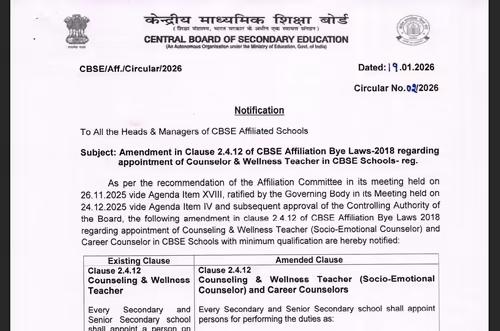
For years, parents, educators, and mental health advocates have been sounding the alarm: India’s education system is producing high achievers—but at what cost to their emotional well-being? Now, the Central Board of Secondary Education (CBSE) has taken a bold step toward answering that question. In a historic policy shift approved in November 2025 and rolled out in January 2026, **CBSE student counseling** and career guidance are no longer optional extras—they’re mandatory requirements for every school under its affiliation .
This isn’t just a bureaucratic update; it’s a fundamental reimagining of what a ‘good education’ means in modern India. By embedding trained professionals directly into the school ecosystem, CBSE is signaling that mental health, emotional resilience, and informed career choices are as critical as math scores or science grades. But can this ambitious plan succeed in a system long criticized for its academic pressure and resource gaps?
Table of Contents
- What the New CBSE Student Counseling Rules Entail
- Why This Change Is a Long-Overdue Necessity
- Implementation Challenges and School Readiness
- The Role of Counseling & Wellness Teachers
- Impact on Students, Parents, and the Future of Education
- Conclusion: A Bold Step Toward Holistic Learning
- Sources
What the New CBSE Student Counseling Rules Entail
The revised CBSE Affiliation Bye-Laws now include explicit clauses requiring all affiliated schools—new and existing—to integrate structured counseling services. Key provisions include:
- Mandatory Staffing: Schools with up to 1,000 students must appoint at least one full-time Counseling & Wellness Teacher. Larger schools (1,001–2,000 students) need two, and institutions with over 2,000 students must have a minimum of three such professionals .
- Career Guidance Component: In addition to wellness support, schools must also provide certified Career Counselors who help students navigate academic streams, competitive exams, and vocational pathways.
- Qualification Standards: All counselors must hold recognized degrees or diplomas in psychology, counseling, or related fields from institutions approved by the Rehabilitation Council of India (RCI) or equivalent bodies.
- Confidentiality & Ethics: Strict protocols ensure student privacy, with clear guidelines on when parental or administrative intervention is required.
These changes will be phased in, with full compliance expected by the start of the 2026–27 academic year. Non-compliant schools risk warnings, fines, or even de-affiliation—a serious consequence that underscores CBSE’s commitment .
Why This Change Is a Long-Overdue Necessity
The timing couldn’t be more urgent. According to the National Crime Records Bureau (NCRB), over 13,000 students died by suicide in 2024 alone—a staggering 8% increase from the previous year . Experts consistently cite academic pressure, career uncertainty, and lack of emotional support as key contributing factors.
While elite private schools have offered counseling for years, the vast majority of India’s 25,000+ CBSE-affiliated institutions—especially in semi-urban and rural areas—have operated without any formal mental health infrastructure. This policy aims to democratize access, ensuring that a child in a small-town school gets the same psychological support as one in a metro city.
Implementation Challenges and School Readiness
Despite its noble intent, the rollout faces significant hurdles:
- Shortage of Trained Professionals: India has fewer than 7,000 certified clinical psychologists for a population of 1.4 billion—far below WHO recommendations .
- Budget Constraints: Many schools, particularly low-fee institutions, may struggle to afford additional staff salaries.
- Stigma Around Mental Health: Cultural taboos may prevent students from seeking help, even if services are available.
- Teacher Workload: In some cases, existing teachers may be asked to take on counseling duties without proper training—a dangerous shortcut.
To address these, CBSE is partnering with NGOs and universities to launch fast-track certification programs and offering grants to schools in underserved regions. Still, success will depend on sustained government support and community buy-in.
The Role of Counseling & Wellness Teachers
These professionals won’t just handle crises. Their role is proactive and preventive:
- Conducting regular wellness workshops on stress management, peer relationships, and digital citizenship.
- Identifying early signs of anxiety, depression, or learning disabilities.
- Collaborating with parents and teachers to create individualized support plans.
- Guiding students through career aptitude assessments and college application processes.
As one CBSE official noted, “We’re not just preventing tragedy—we’re building resilience, self-awareness, and purpose.”
Impact on Students, Parents, and the Future of Education
For students, this could mean finally having a safe space to voice fears about board exams, family expectations, or social isolation. For parents, it offers reassurance that their child’s school is invested in their whole being—not just their report card.
Long-term, this policy could reshape India’s educational philosophy, moving it closer to global models like Finland’s, where well-being is central to learning. It also aligns with the National Education Policy (NEP) 2020’s emphasis on “holistic development” and “multi-disciplinary learning” .
Conclusion: A Bold Step Toward Holistic Learning
The mandatory **CBSE student counseling** initiative is more than a policy—it’s a cultural reset. While challenges remain, the very act of institutionalizing mental health and career guidance sends a powerful message: every student matters, not just for their grades, but for their humanity. If implemented thoughtfully, this could be the most impactful education reform in decades. For parents navigating this new landscape, our guide on [INTERNAL_LINK:how-to-talk-to-your-child-about-mental-health] offers practical support.
Sources
- “CBSE revises affiliation rules to make student counseling mandatory,” Times of India.
- “CBSE Affiliation Bye-Laws (Amendment) 2025,” Central Board of Secondary Education.
- “CBSE issues circular on mandatory counseling services,” The Hindu.
- “Accidental Deaths & Suicides in India 2024,” National Crime Records Bureau (NCRB).
- “Mental Health Atlas – India,” World Health Organization (WHO).
- “National Education Policy 2020,” Ministry of Education, Government of India.