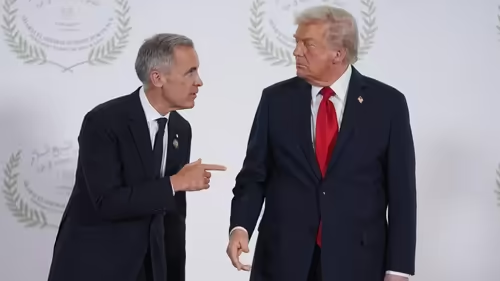
In a move that has sent shockwaves through Washington, Canadian Prime Minister Mark Carney has just wrapped up a historic four-day state visit to China, culminating in a high-stakes summit with President Xi Jinping. This isn’t just another diplomatic handshake; it’s a clear, strategic realignment. And the catalyst? The relentless economic and political aggression of America’s MAGA movement.
The Carney-Xi meeting, held at Beijing’s Great Hall of the People on January 16, 2026, is the first of its kind since 2017 . It signals a dramatic thaw in a relationship that had been frozen for nearly a decade. But this isn’t merely about repairing old ties—it’s about building a new future, one that deliberately diversifies Canada’s economic and political dependencies away from an increasingly unpredictable southern neighbor.
Table of Contents
- The Geopolitical Catalyst: MAGA Hubris
- What the Carney-Xi Meeting Actually Achieved
- Why This is a Strategic Necessity for Canada
- The Broader Implications for Global Trade
- Conclusion: A New Era of Canada-China Relations
- Sources
The Geopolitical Catalyst: MAGA Hubris
Let’s be blunt: Canada didn’t wake up one day and decide to cozy up to Beijing out of the blue. This pivot is a direct, defensive reaction to the hostile environment created by the U.S.’s current political climate. The MAGA agenda, with its “America First” mantra, has evolved into a more aggressive “America Only” policy that views allies like Canada as economic rivals to be dominated, not partners to be nurtured.
Threats of annexation, the imposition of crippling tariffs on Canadian goods, and a general air of contempt from Washington have left Ottawa with little choice but to seek new, reliable partners . As one analyst put it, Donald Trump and his MAGA lieutenants have made it clear that America—not China—is the real existential threat facing Canada . This perceived betrayal by its closest ally has forced Canada’s hand, driving it straight into China’s waiting arms.
What the Carney-Xi Meeting Actually Achieved
The outcomes of the Carney-Xi meeting are both concrete and symbolic, laying the groundwork for a robust new partnership.
Major Trade Breakthroughs
The most immediate and impactful result is a significant trade deal. Both nations have agreed to slash tariffs on a range of goods, most notably on Chinese electric vehicles (EVs)—a complete reversal of the 100% tariffs Canada imposed in 2024 . In return, China will lower barriers for key Canadian exports like canola, pork, and critical minerals . This deal is a lifeline for Canadian farmers and miners who have been caught in the crossfire of U.S.-China trade wars.
A New Strategic Partnership
Beyond trade, the leaders have formally established a “new strategic partnership” aimed at fostering cooperation in areas like clean energy, scientific research, and even tourism . China has also announced visa-free entry for Canadian citizens, a major goodwill gesture designed to boost people-to-people ties . This framework moves the relationship beyond simple transactional economics into a more structured, long-term collaboration.
Why This is a Strategic Necessity for Canada
For Prime Minister Carney, this visit was never just about politics; it was about national economic security. Relying on a single market—the United States—for over 75% of its exports is a massive vulnerability, especially when that market is governed by volatile and protectionist policies. By forging stronger ties with China, the world’s second-largest economy, Canada is actively de-risking its own economy .
This strategy is about resilience. It’s about ensuring that Canadian businesses have alternative markets and that Canadian consumers aren’t held hostage to the whims of U.S. trade policy. As Carney himself has stated, it’s necessary to improve trade ties with China to offset the looming threat of U.S. tariffs . This isn’t an ideological shift; it’s a pragmatic one born out of necessity.
The Broader Implications for Global Trade
The ripple effects of this new Canada-China axis will be felt far beyond North America and Asia. It represents a powerful counter-narrative to the growing trend of economic blocs and decoupling. While the U.S. pushes its allies to isolate China, Canada’s actions demonstrate that a more nuanced, multi-vector foreign policy is not only possible but profitable.
This move could embolden other middle powers—nations like Australia, South Korea, or even members of the EU—who are also trying to navigate the treacherous waters between Washington and Beijing. It sends a clear message: smaller economies don’t have to be mere pawns in a great power game; they can chart their own course for their own benefit.
Conclusion: A New Era of Canada-China Relations
The Carney-Xi meeting is a watershed moment in modern geopolitics. It’s a stark illustration of how domestic political movements in one country—in this case, the MAGA-driven policies in the U.S.—can have profound and unintended consequences on the global stage. By pushing Canada away, Washington has inadvertently pushed it toward Beijing.
This new strategic partnership is built on mutual economic interest and a shared desire for a more stable, predictable international order. For Canada, it’s a bold step toward securing its economic future. For the world, it’s a reminder that the global landscape is far more complex and interconnected than a simple two-power rivalry. The era of Canada being a passive follower in U.S. foreign policy may well be over, replaced by a more assertive and independent player on the world stage.
Sources
- “Canada and China forge new strategic partnership amid…”
- “Xi-Carney meeting puts China and Canada on the road to…”
- “On January 16, 2026, Canadian Prime Minister Mark…”
- “Will Carney reset China-Canada relations?”
- “MAGA hubris drives Canada into China’s arms”
- “Canada’s time to ditch US and go with China”
- “Trump calls Canada-China deal ‘good thing’ as US officials…”
- “Trump calls Canada-China deal ‘good thing’ as U.S….”
- “Canada, China strike trade deals to slash tariffs on EVs,…”