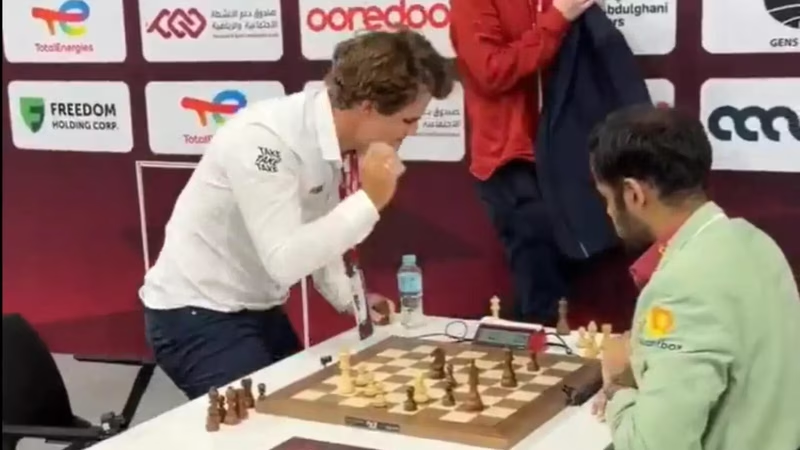
In the silent, high-stakes world of elite chess, a single sound can echo louder than a thousand moves. That’s exactly what happened at the 2025 World Blitz Championship in Doha when Magnus Carlsen—widely regarded as the greatest chess player of his generation—slammed his hand on the table in visible frustration after losing to India’s 21-year-old prodigy, Arjun Erigaisi.
The moment, captured by cameras and witnessed by players and fans alike, has ignited a fierce debate across the chess community. Was it a raw, human reaction from a perfectionist under immense pressure? Or was it a breach of the sport’s long-standing code of conduct? Grandmaster Levon Aronian, a former world top-10 player and respected voice in the circuit, didn’t mince words: “Such acts are penalised as unsportsmanlike behaviour,” he stated firmly .
This incident—now widely known as the Carlsen table slam—is more than just a viral moment. It touches on deeper questions about sportsmanship, the psychological toll of elite competition, and the evolving image of chess in the age of streaming and social media.
Table of Contents
- The Incident: What Happened Between Carlsen and Arjun Erigaisi?
- Aronian’s Response: Why the Table Slam Crossed the Line
- FIDE Rules on Unsportsmanlike Conduct: What Does the Rulebook Say?
- Carlsen’s History of On-Board Emotions: Is This a Pattern?
- The Pressure Cooker of Blitz Chess: Why Emotions Run Hot
- Public Opinion Divided: Is Carlsen Being Unfairly Judged?
The Incident: What Happened Between Carlsen and Arjun Erigaisi?
The clash took place during the second round of the World Blitz Championship in Doha. Carlsen, the world No. 1 and defending champion, was expected to cruise past the young Indian GM. But Arjun Erigaisi had other plans. Playing with nerve and precision, Erigaisi outmaneuvered Carlsen in a tense endgame, securing one of the biggest wins of his career .
Immediately after the loss, Carlsen—visibly stunned—slammed his hand on the chess table before quickly walking away. The arbiter on duty, Chris Bird, was present and observed the incident. While no immediate penalty was issued, the moment became the talk of the tournament hall and, soon after, the global chess community .
Aronian’s Response: Why the Table Slam Crossed the Line
Levon Aronian, known for his calm demeanor and deep respect for the game’s traditions, was unequivocal in his criticism. Speaking to reporters, he didn’t just call it rude—he framed it as a technical violation. “In official tournaments, such behaviour is explicitly classified as unsportsmanlike conduct and can be penalised,” Aronian explained .
His point wasn’t merely moral; it was procedural. In a sport where silence, focus, and mutual respect are foundational, any act that disrupts the atmosphere or shows disrespect to the opponent or the game itself is frowned upon—even if it’s just a frustrated hand gesture.
FIDE Rules on Unsportsmanlike Conduct: What Does the Rulebook Say?
Aronian’s claim is backed by the official rulebook. According to the FIDE Laws of Chess, Article 11.5 states: “It is forbidden to distract or irritate the opponent in any manner whatsoever.” Furthermore, the FIDE Fair Play Guidelines list “aggressive or disrespectful behaviour” as grounds for disciplinary action .
While a table slam may not seem as severe as verbal abuse, it can be interpreted as an act of aggression—especially in the hyper-focused environment of a world championship. Arbiters have discretion to issue warnings, deduct time, or even forfeit a game in extreme cases.
Carlsen’s History of On-Board Emotions: Is This a Pattern?
This isn’t the first time Carlsen’s on-board demeanor has drawn scrutiny. Over the years, he’s been seen sighing loudly, making exaggerated gestures, and even walking away mid-game during the 2021 World Championship against Ian Nepomniachtchi—a move that sparked its own controversy .
Supporters argue that Carlsen’s intensity is part of what makes him great—that his emotional investment fuels his legendary resilience. Critics, however, contend that as the face of modern chess, he has a responsibility to uphold the sport’s decorum, especially with millions of young fans watching.
The Pressure Cooker of Blitz Chess: Why Emotions Run Hot
It’s crucial to understand the context: this was a blitz game, where each player has just 3 minutes plus a 2-second increment. Mistakes are punished instantly. There’s no time to recover, reflect, or regroup. The mental load is immense, and the margin for error is microscopic.
Losing to a younger, lower-rated opponent in such a high-profile event is a massive blow—even for a player of Carlsen’s caliber. The frustration is understandable. But as Aronian and many others argue, understanding doesn’t equate to acceptance. The expectation at the elite level is to manage those emotions internally.
Public Opinion Divided: Is Carlsen Being Unfairly Judged?
Online, the chess world is split. On platforms like Twitter and Chess.com forums, fans are debating fiercely. One camp sees Carlsen as human—“He’s not a robot,” reads a popular comment. The other insists that excellence includes emotional control: “If a schoolkid did that, they’d be reprimanded. Why not a world champion?”
For deeper insights into chess ethics and conduct, our analysis on [INTERNAL_LINK:fair-play-in-modern-chess] explores how the game is balancing tradition with the realities of modern competition.
Conclusion
The Carlsen table slam may seem like a small moment in a long tournament, but it has opened a much-needed conversation about respect, pressure, and the soul of chess. While Carlsen’s passion is undeniable, Aronian’s call for adherence to sportsmanship rules is a reminder that chess is not just a battle of intellect—it’s also a test of character. As the game continues to grow in popularity, how its icons behave off the board will matter just as much as their moves on it.
Sources
- Times of India: ‘Unsportsmanlike behaviour’: Aronian blasts Carlsen’s table slam
- Web search results on Arjun Erigaisi vs Magnus Carlsen World Blitz Championship 2025 [[2], [5]]
- FIDE Handbook: Laws of Chess
- Web search results on Carlsen’s past on-board behaviour [[4], [6]]