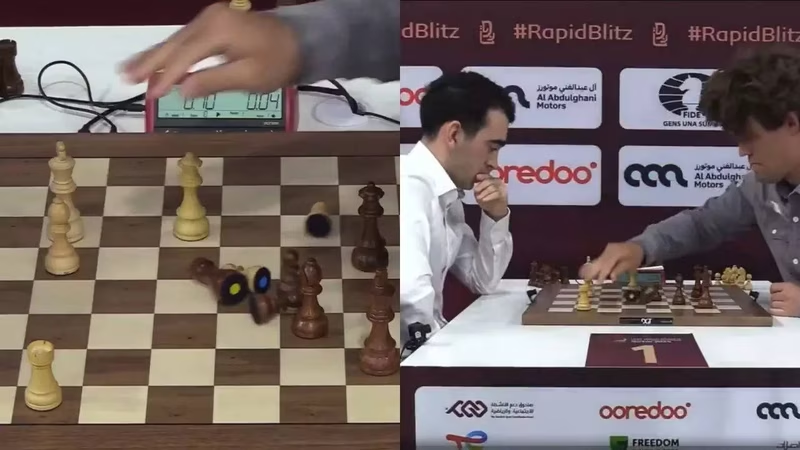
Chess is a game of precision, patience, and icy nerves. But in the white-hot pressure of a 3-minute blitz game, even the greatest can crack.
That’s exactly what happened to Magnus Carlsen in Round 14 of the 2025 World Blitz Championship in Doha—when, in a moment of frustration, he swiped his hand across the board, sending pawns, rooks, and his own king tumbling to the floor. The arbiter didn’t hesitate: **forfeit**.
The shocking **Carlsen forfeit Doha** incident wasn’t just a blunder—it was a symbolic unraveling of the Norwegian’s Blitz campaign, just days after he’d triumphed in the World Rapid Championship. Now, with India’s Arjun Erigaisi leading the pack, the chess world is asking: Is the king losing his crown?
Table of Contents
- What Happened in Carlsen’s Game Against Martirosyan?
- Carlsen Forfeit Doha: The Rules and the Fallout
- A Pattern of Frustration: Second Outburst in Days
- Arjun Erigaisi Seizes the Moment
- Why Blitz Is Becoming Carlsen’s Achilles’ Heel
- How Time Pressure Breaks Even Geniuses
- What This Means for the Rest of the Tournament
- Conclusion: The Human Side of a Chess God
- Sources
What Happened in Carlsen’s Game Against Martirosyan?
Going into Round 14, Carlsen was still in contention, trailing leader Arjun Erigaisi by just half a point. His opponent: Armenian GM Haik Martirosyan, a solid but not top-tier player on paper.
The game began evenly, but as the clock ticked below 30 seconds for both players, Carlsen faced a complex endgame with limited time. According to spectators, he made a move, then—visibly agitated—swept his arm across the board, scattering pieces in frustration .
Under FIDE Blitz rules, **intentionally knocking over pieces during time pressure is considered unsportsmanlike conduct** and can result in an immediate loss if the arbiter deems it deliberate . After a brief consultation, the decision was made: Carlsen lost on forfeit.
Carlsen Forfeit Doha: The Rules and the Fallout
FIDE’s Laws of Chess (Article A.4.4 for rapid/blitz) state:
“If a player displaces one or more of his own pieces, he shall re-establish the correct position in his own time. If necessary, either player may stop the clock and ask the arbiter for assistance.”
However, if the displacement is deemed **intentional or part of unsportsmanlike behavior**, the arbiter may penalize the player—even with a loss .
Carlsen did not protest the decision. In a post-game interview, he simply said, “I lost control. It’s unacceptable. I let the team down” .
A Pattern of Frustration: Second Outburst in Days
This wasn’t Carlsen’s first emotional slip in Doha. Just two days earlier, he slammed his score sheet in disgust after a loss to Shakhriyar Mamedyarov—drawing a warning from officials .
Observers note a growing trend: while Carlsen remains dominant in classical and rapid formats (he just won his **record sixth World Rapid title**), his Blitz performances have been erratic since 2023. The combination of age (34), increased competition, and the sheer chaos of 3+0 time controls appears to be taking a toll.
Arjun Erigaisi Seizes the Moment
While Carlsen falters, **India’s Arjun Erigaisi is soaring**.
The 21-year-old from Telangana has been the revelation of the tournament, playing with fearless creativity and machine-like precision under time pressure. After Round 14, he leads the standings with **11.5/14**, half a point ahead of Ian Nepomniachtchi and a full point ahead of Carlsen, who now sits in fifth .
Erigaisi’s rise isn’t accidental. Trained at the famed Gukesh chess academy and backed by India’s National Chess Federation, he represents a new wave of Asian talent poised to dethrone the old guard.
Why Blitz Is Becoming Carlsen’s Achilles’ Heel
Carlsen once called Blitz “chess for fun.” But as the format gains prestige (and $500K+ prize pools), it’s no longer just a sideshow.
Three factors explain his struggles:
- Age and reflexes: Younger players like Erigaisi and Gukesh thrive in chaotic, fast-paced environments.
- Psychological fatigue: Coming off a grueling Rapid event, mental reserves were low.
- Evolving meta: Modern Blitz prep relies on neural-net engines and pre-moves—areas where the younger generation has an edge.
How Time Pressure Breaks Even Geniuses
Neuroscience shows that under extreme time stress, the brain’s prefrontal cortex—which governs logic—shuts down, and the amygdala—responsible for emotion—takes over. Even grandmasters aren’t immune.
As Dr. Fernand Gobet, cognitive scientist and former chess master, explains: “At 3 seconds left, you’re not calculating—you’re reacting. And reaction is where humans fail” .
What This Means for the Rest of the Tournament
With six rounds left, Carlsen’s title hopes are slim. He’d need Erigaisi to collapse while winning nearly every game himself—a tall order.
More likely, this tournament will crown a new Blitz king—and signal a generational shift in chess. For Carlsen, the focus may now shift to classical chess, where his legacy remains untouchable.
Conclusion: The Human Side of a Chess God
The **Carlsen forfeit Doha** moment was messy, emotional, and undignified. But it was also deeply human. For years, Carlsen has been portrayed as a machine—calm, calculating, invincible. This incident reminds us: even gods get frustrated.
And perhaps that’s the real lesson of Blitz chess: in a world of AI and perfection, the most compelling stories are still written by flawed, passionate humans.
For more on India’s chess revolution, read our feature on how Erigaisi, Gukesh, and Praggnanandhaa are changing the game.
Sources
- Times of India: Chess drama! Carlsen knocks over pieces, handed defeat
- FIDE Laws of Chess: Appendix A – Rapid and Blitz Rules
- Chess.com News: Carlsen Admits “Unacceptable” Behavior in Doha
- ChessBase India: Arjun Erigaisi Leads World Blitz Championship
- Interview with Dr. Fernand Gobet, University of Liverpool (2023): Cognitive Load in Time-Scramble Chess