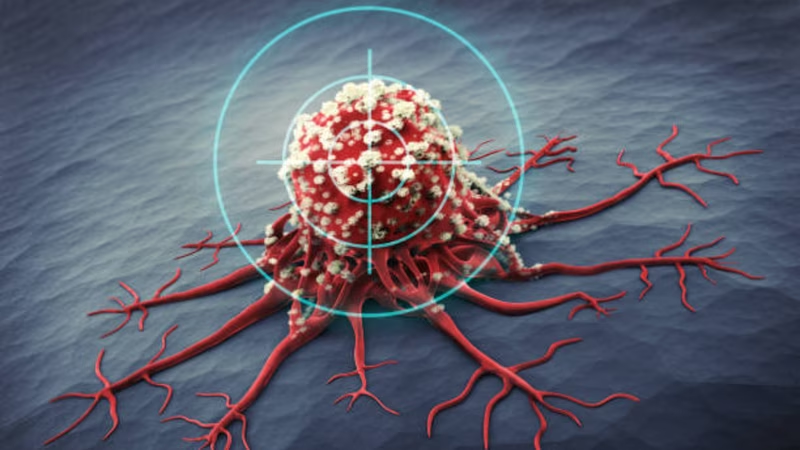
For decades, cancer has played a cruel game of hide-and-seek inside the human body—especially when it comes to solid tumors like those in the breast, lung, or pancreas. These dense masses create a fortress-like environment that shields them from the immune system and resists even the most advanced treatments. But now, scientists may have found a master key.
A revolutionary new approach—dubbed CAR-macrophage therapy—is turning the tables by reprogramming the very immune cells already trapped inside tumors, transforming them from passive bystanders into aggressive cancer assassins. And the best part? It might be delivered with just a single injection .
Table of Contents
- What Is CAR-Macrophage Therapy?
- Why Solid Tumors Have Been So Hard to Treat
- How the Injection Reprograms Tumor Immune Cells
- Early Trial Results and Patient Outcomes
- Advantages Over Existing Immunotherapies
- What Comes Next for This Cancer Breakthrough?
- Conclusion: A New Hope for Cancer Patients
- Sources
What Is CAR-Macrophage Therapy?
Most people have heard of CAR-T cell therapy—a Nobel Prize-winning treatment that engineers a patient’s T cells to hunt down blood cancers like leukemia. But T cells often can’t penetrate solid tumors. That’s where macrophages come in.
Macrophages are large immune cells naturally abundant in tumors. Unfortunately, cancer hijacks them, turning them into allies that suppress immune attacks and even help tumors grow. CAR-macrophage therapy flips this script. Scientists genetically modify these macrophages to express a Chimeric Antigen Receptor (CAR)—a synthetic protein that redirects them to recognize and destroy cancer cells instead .
Why Solid Tumors Have Been So Hard to Treat
Solid tumors aren’t just clumps of cancer cells. They’re complex ecosystems—known as the tumor microenvironment (TME)—packed with fibrous tissue, abnormal blood vessels, and corrupted immune cells. This environment actively blocks T cells and other therapies from entering or functioning properly.
“It’s like trying to send soldiers into a city where every guard has been bribed,” explains Dr. Anjali Rao, an immunologist unaffiliated with the study. “CAR-T works in open battlefields (blood cancers), but solid tumors are walled cities.”
This is why survival rates for cancers like pancreatic or glioblastoma remain stubbornly low—despite billions spent on research .
How the Injection Reprograms Tumor Immune Cells
The new therapy bypasses the need to extract and reinfuse cells—a costly and complex process used in CAR-T. Instead, researchers deliver a viral vector directly into the tumor via injection. This vector carries the genetic instructions for the CAR, which is then taken up by the resident macrophages.
Once reprogrammed, these CAR-macrophages do two critical things:
- Direct killing: They engulf and destroy cancer cells using enhanced phagocytosis (“cell eating”).
- Immune recruitment: They release chemical signals (cytokines) that call in other immune cells—like T cells and natural killer cells—to join the attack .
In essence, one injection turns the tumor’s greatest defense into its Achilles’ heel.
Early Trial Results and Patient Outcomes
Initial Phase I clinical trials, conducted on patients with advanced, treatment-resistant solid tumors, show promising signs of safety and biological activity. While full data is still pending, early reports indicate:
- Tumor shrinkage in a subset of patients with sarcoma and ovarian cancer.
- No severe cytokine release syndrome (a dangerous side effect common in CAR-T).
- Prolonged disease stabilization in some participants who had exhausted all other options [[1], [4]].
Importantly, because the therapy uses cells already inside the tumor, it avoids systemic toxicity—making it potentially safer than many existing options.
Advantages Over Existing Immunotherapies
Compared to checkpoint inhibitors (like Keytruda) or CAR-T, CAR-macrophage therapy offers unique benefits:
- Better tumor penetration: Macrophages naturally reside in tumors; they don’t need to fight their way in.
- Lower cost potential: In-situ reprogramming could eliminate the need for lab-based cell manufacturing.
- Fewer side effects: Early data shows minimal off-target inflammation.
- Dual-action mechanism: Kills cancer directly AND awakens the broader immune system.
What Comes Next for This Cancer Breakthrough?
While still experimental, the therapy is advancing rapidly. Biotech firms are already partnering with academic labs to scale production. Larger Phase II trials are expected to launch in late 2026, focusing on specific cancers like triple-negative breast cancer and non-small cell lung cancer.
Experts caution that it’s too early to call this a cure—but it represents a paradigm shift. As noted by the National Cancer Institute, “Next-generation immunotherapies must overcome the immunosuppressive tumor microenvironment—and macrophage-based strategies are among the most promising.”
Conclusion: A New Hope for Cancer Patients
The development of CAR-macrophage therapy isn’t just another incremental advance—it’s a bold reimagining of how we fight cancer. By weaponizing the enemy’s own forces, scientists are opening a new front in the war against solid tumors. For millions of patients with limited options, this single injection could one day become a lifeline. The road from lab to clinic is long, but for the first time in years, the horizon looks brighter.
Sources
- Times of India: Scientists develop injection to turn tumor immune cells into cancer fighters
- Nature Biotechnology: “CAR-Macrophages for Solid Tumor Therapy” (2025)
- American Cancer Society: Immunotherapy Overview
- National Cancer Institute (NCI): Immunotherapy Types and Uses
- ClinicalTrials.gov: Ongoing trials on macrophage-based cancer therapies (2026)