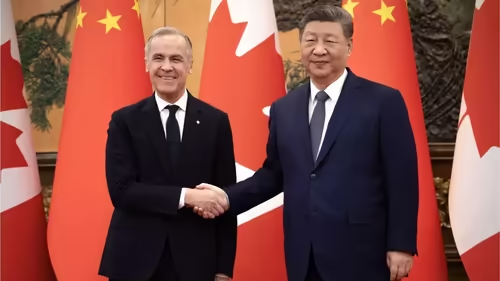
In a move that could reshape North American trade dynamics, newly elected Canadian Prime Minister Mark Carney has struck a sweeping Canada-China trade deal with President Xi Jinping during a high-stakes summit in Beijing. The agreement—finalized in mid-January 2026—not only slashes tariffs on critical Canadian exports like canola oil and electric vehicles but also marks a dramatic thaw in bilateral relations after years of diplomatic frost .
More than just an economic pact, this deal is a clear signal that Ottawa is actively seeking to diversify its trade partnerships beyond its long-dominant reliance on the United States. With growing uncertainty around U.S. trade policy—especially under a potential second Trump administration—Carney’s government is hedging its bets by deepening ties with the world’s second-largest economy. Predictably, the announcement has already drawn sharp rebukes from Washington, with former President Donald Trump calling it a “betrayal of North American unity” .
Table of Contents
- The Canada-China Trade Deal: Key Provisions and Impact
- Why Now? The Strategic Timing Behind Carney’s Pivot
- Trump’s Fury: U.S. Reaction to Canada’s China Embrace
- Economic Implications for Canadian Farmers and EV Makers
- Geopolitical Risks of Closer Ties with Beijing
- Conclusion: A New Era for Canadian Trade Policy?
- Sources
The Canada-China Trade Deal: Key Provisions and Impact
The newly inked Canada-China trade deal centers on two major sectors where Canadian producers have long faced barriers:
- Canola Oil: China will reduce import tariffs from 9% to 3% over the next 18 months, reopening a vital market that was effectively closed in 2019 during a diplomatic spat involving Huawei executive Meng Wanzhou .
- Electric Vehicles (EVs): Canadian-made EVs and battery components will now face significantly lower duties, positioning Canada as a potential alternative supplier to Chinese manufacturers wary of U.S. restrictions.
Beyond tariffs, the agreement includes provisions for joint research in clean energy, streamlined customs procedures, and a new bilateral council to resolve trade disputes—mechanisms designed to prevent future breakdowns like those seen in the past decade .
Why Now? The Strategic Timing Behind Carney’s Pivot
Mark Carney, who assumed office in late 2025 after Justin Trudeau’s resignation, campaigned on economic resilience and strategic autonomy. His background as a former Bank of England governor and World Economic Forum advisor gives him a globalist outlook—one that sees overdependence on the U.S. as a systemic risk.
With the 2024 U.S. election looming and Donald Trump vowing to impose universal tariffs—including a proposed 10% across-the-board levy on all imports—Carney’s team moved swiftly to secure alternatives . “We cannot let our entire economic future hinge on the political whims of one neighbor,” a senior Canadian official anonymously told Reuters .
This proactive stance reflects a broader trend among middle powers: from the EU to Australia, nations are increasingly pursuing “de-risking” strategies that balance engagement with China against security concerns.
Trump’s Fury: U.S. Reaction to Canada’s China Embrace
Unsurprisingly, the deal has ignited fury in certain U.S. political circles. In a Truth Social post, Donald Trump blasted Carney, saying, “Canada is stabbing America in the back while we protect them militarily and economically. Weak leadership!”
While the Biden administration has taken a more measured tone, officials at the U.S. Trade Representative’s office expressed “serious concerns” about any agreement that could undermine the USMCA framework or facilitate Chinese access to North American supply chains .
Analysts warn that if Canada becomes a backdoor for Chinese EVs or critical minerals into the U.S. market, it could trigger retaliatory measures—potentially jeopardizing the $850 billion annual trade flow between the two neighbors .
Economic Implications for Canadian Farmers and EV Makers
For Canadian stakeholders, the benefits are immediate:
- Canola Farmers: Saskatchewan and Alberta producers—who lost nearly $1 billion annually during the 2019–2023 ban—can now re-enter a market that once absorbed 40% of their exports .
- EV Startups: Companies like ElectraMeccanica and Lion Electric gain preferential access to a market hungry for affordable, Western-branded EV tech.
- Lithium Miners: With China controlling 60% of global lithium processing, closer ties could secure off-take agreements for Canadian mining firms in Quebec and Ontario.
However, experts caution that dependency on China carries its own risks. As one McGill University economist noted, “One day you’re in; the next, you’re out—based on Beijing’s political calculus.”
Geopolitical Risks of Closer Ties with Beijing
While economically enticing, the Canada-China trade deal isn’t without peril. Canada remains a Five Eyes intelligence ally and a NATO partner—both of which view China as a strategic competitor. Deepening commercial ties could strain these security relationships.
Moreover, human rights advocates have criticized the deal for lacking enforceable labor or environmental standards—a stark contrast to the USMCA’s progressive clauses. Without such safeguards, critics argue, Canada risks becoming complicit in practices it publicly condemns.
For a deeper look at how trade intersects with national security, see our analysis on [INTERNAL_LINK:five-eyes-alliance-and-global-trade].
Conclusion: A New Era for Canadian Trade Policy?
Mark Carney’s bold Canada-China trade deal represents more than tariff cuts—it’s a declaration of strategic independence. By reducing reliance on the U.S. and re-engaging with China, Canada is navigating a treacherous but necessary path toward economic diversification. Yet, this pivot comes with significant diplomatic and security trade-offs. As global alliances harden, Ottawa’s balancing act may prove its greatest test yet.