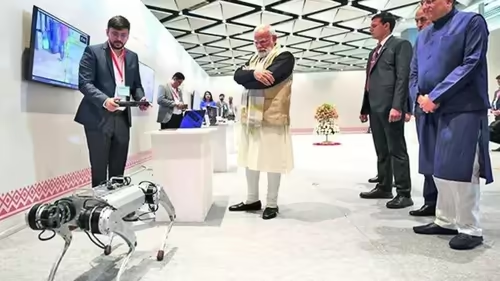
Prime Minister Narendra Modi has thrown down the gauntlet. In a recent address, he declared a clear and ambitious goal: “Our goal should be that in the coming 10 years, India will lead the world in new startup trends and technology.” This isn’t just a hopeful statement; it’s a direct call to action for India’s entire entrepreneurial ecosystem. But can a nation, currently ranked as the world’s third-largest startup hub, truly leapfrog its way to the top?
Table of Contents
- Modi’s Bold Vision for India’s Startup Future
- The Current State of India’s Startup Ecosystem
- From Local Jobs to Global Value Chain
- The Roadmap to Leading Startup Trends
- Challenges on the Path to Global Dominance
- Conclusion: Is Modi’s Decade-Long Bet a Sure Win?
- Sources
Modi’s Bold Vision for India’s Startup Future
Speaking on National Startup Day, marking a decade of the Startup India initiative, PM Modi expressed immense confidence in the “courage, confidence and innovation” of the nation’s entrepreneurs . His message was twofold: celebrate the past decade’s success and prepare for an even more ambitious future.
The Prime Minister’s vision goes beyond creating another billion-dollar company (unicorn). He is nudging Indian startups to focus on deep technology—areas like artificial intelligence, quantum computing, and advanced manufacturing—that can solve complex global problems and position India not just as a market, but as a primary source of innovation .
The Current State of India’s Startup Ecosystem
The foundation for this audacious goal is already strong. Over the past ten years, the Startup India Mission has indeed become a “revolution” . The numbers speak volumes:
- India is home to the world’s third-largest startup ecosystem, with over 200,000 DPIIT-recognised startups as of late 2025 .
- The ecosystem has generated more than 21 lakh direct jobs, with millions more created indirectly across various sectors .
- It boasts over 100 unicorns, a testament to its scaling potential .
However, the picture isn’t all rosy. While India ranks 3rd by volume, its position in the comprehensive Global Startup Ecosystem Rankings has seen some volatility, even dropping to 22nd place in a recent report . This highlights a critical gap between quantity and the quality of ecosystem support, funding, and market access.
From Local Jobs to Global Value Chain
PM Modi’s call is not just about technological leadership; it’s deeply intertwined with economic strategy. He explicitly urged companies to “create more jobs locally” while simultaneously becoming an integral “part of the global value chain” .
This dual focus is crucial. On one hand, startups are powerful engines for domestic employment, fostering a culture of job creation rather than just job seeking . On the other, integrating into the global value chain means Indian firms must move beyond being service providers or local market players. They need to become indispensable partners in international supply networks, exporting their innovative products and services worldwide.
The Roadmap to Leading Startup Trends
So, how can India transition from a major player to the definitive leader in global startup trends? The path forward likely involves several key pillars:
1. Doubling Down on Deep Tech
Moving away from pure consumer internet plays towards hard-tech innovation is non-negotiable. Government initiatives must align to provide R&D grants, access to specialized labs, and a regulatory sandbox for testing cutting-edge technologies.
2. Building a Robust Domestic Manufacturing Base
As the PM emphasized, a focus on manufacturing is key . A strong ‘Make in India’ for startups ensures supply chain resilience, cost efficiency, and a tangible export product, moving beyond just software.
3. Fostering Patient Capital
Deep tech ventures require long-term investment horizons. The ecosystem needs more venture capital and private equity funds willing to be patient, alongside a thriving corporate venture capital scene from established Indian conglomerates.
4. Strategic Global Partnerships
Actively seeking collaborations with leading research institutions and tech hubs across the US, Europe, and Asia will be essential for knowledge transfer and market entry.
Challenges on the Path to Global Dominance
The road ahead is fraught with obstacles. Bureaucratic hurdles, a complex tax structure, and a sometimes risk-averse banking sector can stifle innovation. Furthermore, while the talent pool is vast, there’s a persistent gap in highly specialized skills required for deep tech fields. Bridging this gap through a reformed education system and upskilling programs is paramount.
There’s also the global competition to consider. The US and China have massive, mature ecosystems with unparalleled access to capital and talent. For India to lead, it must not just compete, but create entirely new paradigms that others will follow—a tall order indeed.
Conclusion: Is Modi’s Decade-Long Bet a Sure Win?
PM Modi’s challenge to make India the leader in global startup trends is a powerful narrative that can galvanize the nation’s entrepreneurial spirit. The foundation is solid, the ambition is clear, and the potential rewards—for jobs, economic growth, and national prestige—are enormous. However, turning this vision into reality will demand more than just government support; it requires a collective, sustained effort from entrepreneurs, investors, academia, and industry. The next ten years will be the ultimate test of whether India’s startup revolution can truly become a global leadership movement.