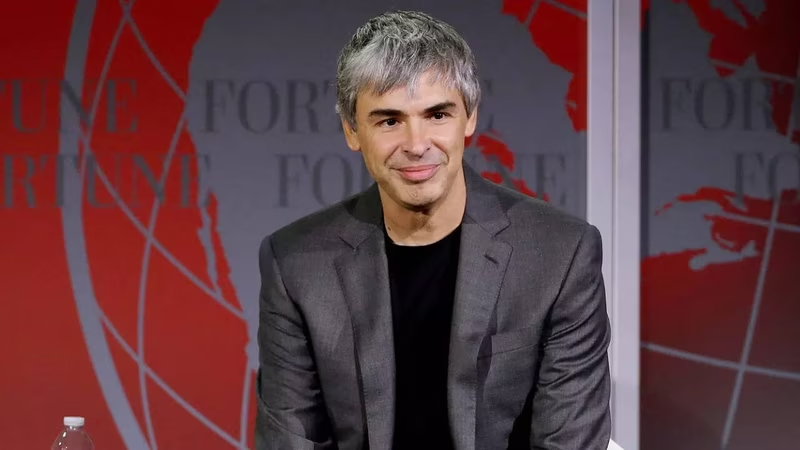
California has long been the undisputed capital of global tech innovation—home to Silicon Valley, venture capital giants, and some of the world’s most influential tech founders. But that crown may be slipping.
Rumors are swirling that two of its most iconic residents, Google co-founder Larry Page and PayPal pioneer Peter Thiel, are preparing to sever residential ties with the state. The catalyst? A controversial proposal to impose a 5% annual wealth tax on individuals with net worths exceeding $1 billion .
This isn’t just about two billionaires packing up their beach houses. It’s a high-stakes economic warning shot. If California loses its tech titans, it risks more than just tax revenue—it could jeopardize its status as the epicenter of global innovation. So, what’s really behind this potential exodus, and what does it mean for the future of the Golden State?
Table of Contents
- What Is the Proposed California Wealth Tax?
- Why Larry Page and Peter Thiel May Leave
- A History of Tax-Driven Migration in the U.S.
- Economic Impact on California If Billionaires Flee
- Arguments For and Against the Wealth Tax
- Where Are the Billionaires Headed?
- Conclusion: Can California Afford to Lose Its Tech Titans?
- Sources
What Is the Proposed California Wealth Tax?
Introduced by state Senator Scott Wiener, the “California Wealth Tax Act” would levy a 5% annual tax on the net worth of individuals exceeding $1 billion—making it one of the most aggressive wealth taxes ever proposed in the United States . The bill also includes a 2% rate for those worth between $50 million and $1 billion.
Proponents argue the tax could generate up to $30 billion annually—funds earmarked for housing, healthcare, and climate resilience. “This is about fairness,” Senator Wiener stated. “The ultra-wealthy have benefited immensely from California’s ecosystem. It’s time they pay their fair share.”
But critics warn the policy could trigger unintended consequences, including capital flight, reduced investment, and a brain drain from the state’s innovation economy.
Why Larry Page and Peter Thiel May Leave
Both billionaires have long expressed skepticism about high taxation and government overreach. Thiel, a vocal libertarian, has criticized California’s “anti-business” regulatory environment for years and already holds significant assets in tax-friendly states like Wyoming and Texas .
Larry Page, though more private, has reportedly shifted much of his operational focus away from California in recent years. With an estimated net worth of over $120 billion, a 5% wealth tax could cost him $6 billion annually—more than the GDP of many small nations .
For billionaires whose wealth is largely tied to stock (not liquid cash), such a tax would force them to sell shares annually just to pay the bill—a scenario many see as punitive and economically inefficient .
A History of Tax-Driven Migration in the U.S.
This isn’t the first time taxes have reshaped America’s elite geography:
- Elon Musk moved from California to Texas in 2020, citing state taxes and regulations.
- Hedge fund managers like Ken Griffin relocated from Illinois to Florida to avoid high income taxes.
- California itself has seen a net outflow of residents to states like Arizona, Nevada, and Idaho for over a decade, per U.S. Census data .
According to a 2023 study by the National Bureau of Economic Research (NBER), high-income households are 30% more likely to relocate in response to top marginal tax rate increases .
Economic Impact on California If Billionaires Flee
Losing a few ultra-wealthy residents might seem symbolic, but the ripple effects could be profound:
- Lost tax revenue: Even without a wealth tax, billionaires contribute significantly through income, property, and sales taxes.
- Reduced venture capital: Many billionaires fund startups directly or through angel networks based in California.
- Job market cooling: Tech HQs often follow leadership. If founders leave, companies may decentralize or relocate.
- Philanthropy decline: Californian universities, museums, and nonprofits rely heavily on billionaire donations.
[INTERNAL_LINK:impact-of-billionaire-migration-on-local-economies] explores how similar shifts have affected cities like New York and Chicago.
Arguments For and Against the California Wealth Tax
Supporters say:
- It addresses extreme inequality in a state with both immense wealth and severe homelessness.
- It funds critical public services without raising taxes on the middle class.
- Other countries (e.g., Norway, Switzerland) successfully implement wealth taxes.
Opponents counter:
- It’s legally dubious—valuation of illiquid assets (like private company stakes) is highly subjective.
- It violates the U.S. Constitution’s prohibition on direct taxes without apportionment (a likely Supreme Court challenge).
- It punishes success and discourages innovation and investment.
The U.S. Treasury Department has previously noted that wealth taxes are “administratively complex and economically inefficient” .
Where Are the Billionaires Headed?
Top destinations for California’s elite include:
- Texas: No state income tax, booming tech hubs in Austin and Dallas.
- Florida: No income or wealth tax, favorable trust laws.
- Wyoming: Strong asset protection laws, minimal taxation, and privacy for LLCs.
- Nevada: Close to California but with far lower tax burdens.
Many don’t fully leave—they establish legal residency elsewhere while maintaining California properties, a strategy that reduces tax liability while preserving lifestyle benefits .
Conclusion: Can California Afford to Lose Its Tech Titans?
The proposed California wealth tax is rooted in a noble goal: economic justice. But policy must balance morality with practicality. Driving away the very innovators who built the state’s modern economy could backfire spectacularly—hurting not just the wealthy, but the workers, startups, and public institutions that depend on their presence.
As Larry Page and Peter Thiel weigh their next move, California faces a defining question: Is it willing to risk its innovation crown for a tax that may never even be enforced? The answer could reshape the American economic landscape for decades.
Sources
- The Times of India: California may lose two of the world’s biggest tech billionaires
- Office of Sen. Scott Wiener: California Wealth Tax Act Proposal
- Wall Street Journal: Peter Thiel’s Wyoming Strategy
- Forbes Real-Time Billionaires List
- Tax Policy Center: Challenges of Implementing a Wealth Tax
- U.S. Census Bureau: California Domestic Migration Trends
- NBER: Taxation and the Geographic Mobility of High-Income Households
- U.S. Department of the Treasury: Report on Wealth Taxes (2019)
- California Society of CPAs: Establishing Nonresident Status