California’s Billionaire Brain Drain: A Self-Inflicted Wound?
The sun-kissed promise of California is looking a little less golden for its wealthiest residents. The state’s proposal for a California wealth tax—a one-time, 5% levy on residents with a net worth exceeding $1 billion—has ignited a firestorm of protest from the very tech elite who helped build its modern economy .
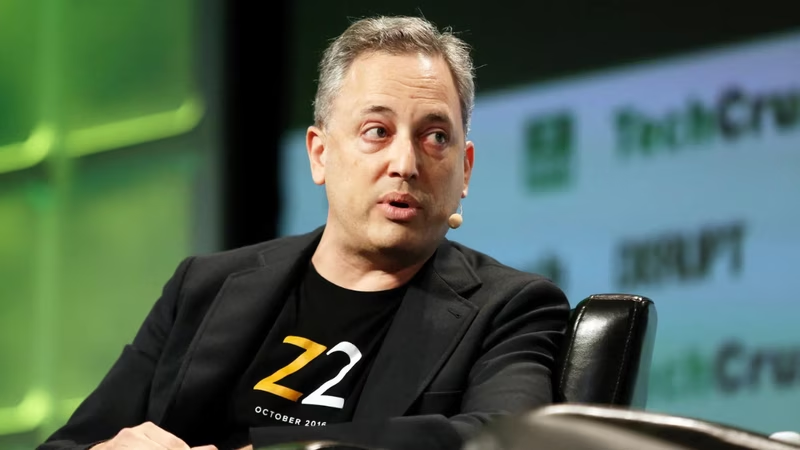
The latest voice in this growing chorus of dissent is David Sacks, a prominent Silicon Valley investor, co-founder of Craft Ventures, and a key AI advisor to the White House. In a series of blunt social media posts, Sacks called the proposed tax a “confiscation of net worth” and openly hinted at his departure from the state [[1], [2]]. His warning isn’t just a personal grievance; it’s a stark signal of a potential economic earthquake in the making.
Table of Contents
- What Is the California Wealth Tax?
- The Threat from David Sacks
- A Growing Billionaire Exodus
- The Economic Argument: For and Against
- Will They Really Leave?
- Conclusion
- Sources
What Is the California Wealth Tax?
Dubbed the “2026 Billionaire Tax Act,” the proposed ballot measure is a direct response to growing calls for economic equity. Backed by powerful labor and healthcare unions, the initiative aims to impose a one-time 5% tax on the net worth of roughly 200 of the state’s wealthiest individuals [[13], [18]]. The goal is to raise an estimated $100 billion, which proponents argue would be a transformative investment in public healthcare, education, and climate initiatives .
The tax would be a radical departure from the current system, which primarily taxes income. This new structure would target unrealized capital gains—the vast paper wealth held in stocks, real estate, and other assets—which is a primary source of wealth for tech founders and investors .
The Threat from David Sacks
David Sacks’ criticism has been among the most vocal and high-profile. On X, he stated, “To be clear, the Billionaire Tax Act in California is not (just) an unrealized gains tax. [It’s a] 5% across-the-board confiscation of net worth” [[4], [6]]. This language frames the policy not as taxation, but as a form of state-sanctioned seizure.
As a central figure in the tech world and a current government advisor, Sacks’ potential departure carries significant symbolic weight. It suggests a deep fracture between the state government and the entrepreneurial class that has long been its economic engine. His stance echoes a broader libertarian-leaning philosophy in Silicon Valley that views such taxes as a direct attack on innovation and success .
A Growing Billionaire Exodus
Sacks is far from alone. Reports indicate that other foundational figures of the tech industry are making similar plans. Google co-founder Larry Page and famed venture capitalist Pete Thiel are both said to be “preparing to flee California” if the California wealth tax passes [[24], [25]].
For a state that already faces challenges with housing costs and business regulations, the prospect of losing not just capital but also the brainpower and network effects these individuals provide is a serious concern. The potential exodus isn’t just about the tax revenue lost from these few hundred people; it’s about the downstream impact on the entire ecosystem of startups, venture capital, and high-paying jobs they support .
The Economic Argument: For and Against
The debate is deeply polarized, with compelling points on both sides.
Proponents’ View: Revenue for Public Good
Advocates argue that the tax is a matter of simple fairness. They point out that the top 0.1% of Californians hold a disproportionate share of the state’s wealth, while many residents struggle with basic needs. The projected $100 billion in revenue could fund critical public services without raising taxes on the middle class .
Opponents’ View: A Flight of Capital
Critics, however, warn of severe unintended consequences. Historical data from European nations that have implemented wealth taxes often show a net loss in revenue as the wealthy relocate their assets and residency . They argue that California would become less competitive, driving its most successful entrepreneurs to more business-friendly states like Texas or Florida, or even abroad. A Stanford University analysis suggested such a move could lead to a long-term, multi-billion dollar annual loss in state income tax revenue .
Will They Really Leave?
Some economists dismiss the billionaires’ threats as bluster—a negotiating tactic to scare lawmakers into backing down. They argue that the deep personal, professional, and lifestyle ties to California are too strong for a mass exodus .
However, the trend of businesses and high-net-worth individuals relocating to states with lower tax burdens is a well-documented reality of the last decade. For a deeper look at this national migration pattern, [INTERNAL_LINK:us-state-migration-trends-2025] offers valuable context. The question isn’t just whether they *can* leave, but whether the political and economic climate has made them *want* to.
Conclusion
The proposed California wealth tax has become a flashpoint in the national conversation about inequality, economic policy, and the social contract. David Sacks’ warning, echoed by other tech giants, presents a stark ultimatum to the state: raise a colossal sum for public good at the potential cost of its economic crown jewels. As the 2026 ballot date approaches, California stands at a crossroads, forced to choose between a bold step toward equity and the risk of triggering a self-inflicted billionaire exodus that could reshape its future for decades to come.
Sources
- Times of India: Another upset and angry tech billionaire may leave America’s tech capital
- David Sacks on X: https://twitter.com/DavidSacks [[1], [4], [6]]
- California Legislative Analyst’s Office on Wealth Tax Proposals [[30], [31]]
- The New York Times reporting on Thiel and Page’s plans
- California Secretary of State Ballot Initiative Filings [[18], [19]]