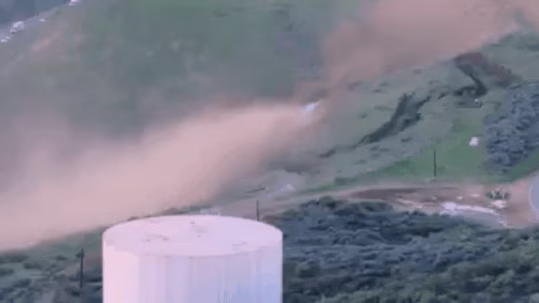
Terrifying Blast Shakes Southern California: Gas Line Explosion in Castaic
On a quiet afternoon in Los Angeles County, the ground shook, the sky darkened with smoke, and residents described a sound like a “jet engine crashing”—all signs of a catastrophic California gas line explosion near Castaic on December 27, 2025 .
The rupture of a major natural gas pipeline sent a towering plume of fire and debris into the air, prompting immediate shelter-in-place orders, the closure of a critical stretch of Interstate 5, and a swift emergency response from fire, police, and hazardous materials teams. While no fatalities have been reported, the incident has reignited urgent debates about aging infrastructure, geological risks, and pipeline safety in fire- and flood-prone California.
Table of Contents
- What Happened During the California Gas Line Explosion?
- Emergency Response and Highway Shutdown
- Mudslide or Infrastructure Failure? Investigating the Cause
- Are California’s Pipelines Safe? A Growing Concern
- Eyewitness Accounts: ‘My House Shook Like an Earthquake’
- Who Regulates These Pipelines—and Is It Enough?
- Conclusion: A Wake-Up Call for Infrastructure Resilience
- Sources
What Happened During the California Gas Line Explosion?
According to the Los Angeles County Fire Department, the explosion occurred around 2:15 p.m. PST in the hills near Castaic, just north of Santa Clarita . A section of a high-pressure natural gas transmission line—operated by a major utility—ruptured violently, igniting a massive fireball visible for miles.
Video footage shared widely on social media showed thick black and white smoke billowing into the sky, with embers and debris raining down over a wide area. The blast was so powerful that it registered on local seismic monitors, mimicking a small earthquake .
Emergency Response and Highway Shutdown
Authorities immediately issued a shelter-in-place order for residents within a two-mile radius, urging them to close windows and turn off HVAC systems to avoid potential gas inhalation. At the same time, the California Highway Patrol shut down Interstate 5 between Parker Road and Lake Hughes Road—a vital artery connecting Los Angeles to Northern California .
Firefighters did not attempt to extinguish the blaze immediately. Instead, they focused on cooling surrounding structures and allowing the gas to burn off safely—a standard procedure for high-pressure pipeline fires to prevent a larger secondary explosion. The highway reopened the following morning after air quality and structural assessments were completed .
Mudslide or Infrastructure Failure? Investigating the Cause
While the official cause remains under investigation by the National Transportation Safety Board (NTSB) and state agencies, early reports point to a recent mudslide as a potential trigger .
Heavy rainfall in the preceding week had saturated the steep terrain around Castaic—a region prone to landslides after wildfires. Soil movement could have stressed or displaced the buried pipeline, leading to a rupture. However, experts caution that other factors, such as corrosion, material fatigue, or construction defects, cannot be ruled out.
“Pipelines in geologically active zones require constant monitoring,” says Dr. Elena Martinez, a civil engineering professor at UCLA. “A mudslide might be the spark, but the underlying vulnerability could be decades old.”
Are California’s Pipelines Safe? A Growing Concern
This incident is not isolated. California’s pipeline network includes over 50,000 miles of transmission and distribution lines, some dating back to the 1930s . Critics argue that regulatory oversight has not kept pace with climate threats like wildfires, droughts, and extreme rainfall.
Key concerns include:
- Aging infrastructure not designed for modern climate stressors.
- Inadequate landslide risk mapping near buried pipelines.
- Delayed replacement schedules due to budget constraints.
The 2010 San Bruno pipeline explosion, which killed eight people, led to sweeping reforms—but many believe more is needed .
Eyewitness Accounts: ‘My House Shook Like an Earthquake’
Local residents described scenes of panic and confusion. “It sounded like a fighter jet crashing into the mountains,” said Maria Lopez, a Castaic resident. “Then the whole house vibrated. I thought it was an earthquake.”
Others reported seeing “a mushroom cloud” and feeling heat waves even a mile away. Many families evacuated spontaneously before official orders arrived, highlighting the need for faster emergency alert systems in rural zones.
Who Regulates These Pipelines—and Is It Enough?
Natural gas pipelines in the U.S. are primarily regulated by the PHMSA (Pipeline and Hazardous Materials Safety Administration), a federal agency under the Department of Transportation. In California, the California Public Utilities Commission (CPUC) also conducts inspections and enforces safety rules .
However, watchdog groups like the Pipeline Safety Trust argue that inspection frequencies are too low and penalties for violations too lenient. With climate change amplifying natural hazards, calls for real-time pipeline monitoring and stricter siting rules are growing louder.
Conclusion: A Wake-Up Call for Infrastructure Resilience
The California gas line explosion in Castaic is more than an isolated accident—it’s a stark reminder that America’s critical energy infrastructure is increasingly vulnerable to the compound effects of aging systems and a changing climate. As investigations continue, the focus must shift from reaction to prevention: upgrading pipelines, mapping geological risks, and ensuring communities are protected before the next disaster strikes.
Sources
- Times of India: “Gas line explosion rocks California: Video shows debris clouds filling the sky” .
- Los Angeles County Fire Department Incident Report (Dec 27, 2025) .
- USGS Seismic Data Logs – Southern California .
- California Highway Patrol Traffic Advisories .
- Caltrans Highway Reopening Notice .
- California Energy Commission – Pipeline Infrastructure Overview .
- National Transportation Safety Board (NTSB) – San Bruno Report Archive .
- Pipeline Safety Trust – Independent Safety Advocacy Group .
- [INTERNAL_LINK:california-climate-infrastructure-risks]
- [INTERNAL_LINK:us-pipeline-safety-regulations]