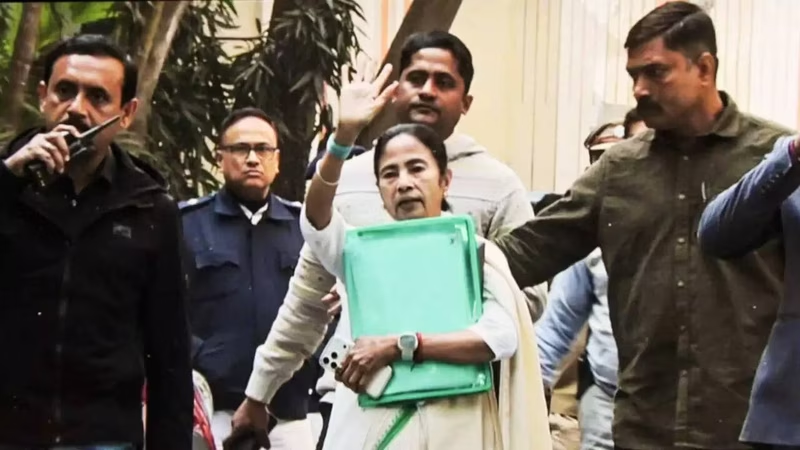
The legal battle between the West Bengal government and the Centre has spilled into the hallowed halls of the Calcutta High Court, resulting in a chaotic scene that forced the adjournment of a critical hearing. On Friday, January 9, 2026, the court was set to hear the ED plea seeking a First Information Report (FIR) against Chief Minister Mamata Banerjee, but the proceedings were derailed by what sources described as “large-scale commotion in the courtroom” . The case, now rescheduled for January 14, sits at the explosive intersection of law, politics, and a high-stakes election countdown.
Table of Contents
- The ED Plea and the Allegations
- Courtroom Chaos and Adjournment
- TMC’s Counter-Narrative: Political Persecution
- The I-PAC Raids: A Strategic Target?
- Legal Precedents and the Road Ahead
- Conclusion: A Test for Indian Democracy
- Sources
The ED Plea and the Allegations
The core of the ED plea stems from the raids conducted on January 8, 2026, on premises linked to the political consultancy firm I-PAC in Kolkata . The Enforcement Directorate, which is investigating an alleged 2020 coal smuggling and money laundering case, claims that during these raids, Chief Minister Mamata Banerjee personally intervened and removed crucial documents and electronic evidence .
The agency has formally accused the CM of obstructing its investigation—a serious charge that, if proven, could have significant legal and political consequences. In its petition to the Calcutta High Court, the ED is seeking the registration of an FIR against Banerjee for her alleged actions, framing it as a direct interference in a federal probe .
Courtroom Chaos and Adjournment
The atmosphere in the courtroom on Friday was reportedly highly charged. With a large contingent of TMC lawyers and supporters present, the situation quickly escalated beyond control. According to court sources, the presiding judge expressed “strong displeasure over the situation,” citing the inability to conduct a fair and orderly hearing .
This unprecedented level of disruption inside a high court is a stark indicator of the intense political passions this case has ignited. The adjournment to January 14 is not just a procedural delay; it’s a temporary pause in a rapidly escalating conflict that has captured national attention .
TMC’s Counter-Narrative: Political Persecution
The Trinamool Congress has completely rejected the ED’s narrative. From their perspective, the entire episode is a manufactured crisis designed to tarnish the image of their leader and destabilize their government. The party argues that the I-PAC offices contained sensitive political data related to their upcoming 2026 election strategy, not evidence of any financial crime .
They contend that the CM’s visit to the site was to protect her party’s confidential information from being misused by a central agency they believe is acting on political orders. This framing—of a democratically elected leader defending her party’s democratic rights against an overzealous and partisan agency—is central to the TMC’s public messaging .
The I-PAC Raids: A Strategic Target?
To understand the gravity of the situation, one must look at the role of I-PAC. As a leading political consultancy, I-PAC is known for its sophisticated data analytics and campaign management services. Its work for the TMC makes it a repository of invaluable strategic information.
A raid on such an entity is perceived not just as a legal action but as a direct assault on the party’s electoral machinery. This context explains why the TMC has reacted with such ferocity, viewing the ED plea as the legal arm of a broader political strategy to gain an unfair advantage in the next state elections.
Legal Precedents and the Road Ahead
The Calcutta High Court now faces a complex legal and constitutional question. Can a sitting Chief Minister be booked for allegedly obstructing an investigation? What are the protocols for handling politically sensitive material during a raid? These are uncharted waters that will test the judiciary’s independence and its ability to navigate intense political pressure.
The outcome of the January 14 hearing will be pivotal. It could either de-escalate the situation by providing clear judicial guidance or further inflame tensions by validating one side’s narrative over the other. For a deeper understanding of the legal framework governing such agencies, you can refer to the official guidelines on the Enforcement Directorate’s powers and functions.
Conclusion: A Test for Indian Democracy
The adjournment of the ED plea is more than a legal footnote; it’s a symptom of a deepening political crisis. The standoff between the Centre and West Bengal has moved from the streets of Kolkata to the courtroom, blurring the lines between law enforcement and political warfare. As the nation watches, the Calcutta High Court’s next move will not only decide the immediate fate of this case but will also send a powerful signal about the state of India’s federal democracy and the rule of law. The events of January 14 will be a crucial chapter in this unfolding drama.
Sources
- Times of India: ‘Commotion in courtroom’: Calcutta HC adjourns ED plea seeking FIR against Mamata
- LiveLaw: Calcutta HC Adjourns ED Plea Seeking FIR Against Mamata Banerjee
- [INTERNAL_LINK:centre-vs-state-politics-in-india]
- [INTERNAL_LINK:role-of-enforcement-directorate-in-india]