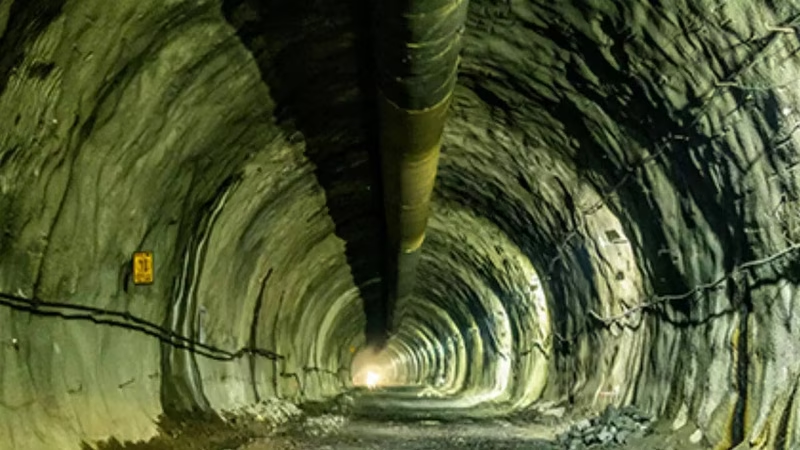
Deep beneath the rugged hills of Maharashtra’s Palghar district, a quiet but historic moment just unfolded—one that could reshape how millions of Indians travel. The National High-Speed Rail Corporation Limited (NHSRCL) has announced the successful breakthrough of a 1.5-kilometre mountain tunnel, marking the **first completed mountain tunnel** on India’s ambitious **bullet train** corridor between Mumbai and Ahmedabad. This isn’t just another construction update—it’s a pivotal engineering milestone that clears a major hurdle in one of the country’s most complex infrastructure projects.
With this achievement, the entire stretch from Thane to Ahmedabad is now technically unobstructed. The only remaining bottleneck? The challenging 21-km undersea tunnel between Mumbai’s BKC and Thane. But more on that later. For now, let’s unpack what this breakthrough means, why it matters, and how close we really are to riding India’s first **bullet train** by August 15, 2027.
Table of Contents
- The Palghar Tunnel Breakthrough: What Happened?
- Why This Mountain Tunnel Was a Critical Challenge
- Current Status of the Mumbai-Ahmedabad Bullet Train Corridor
- Can India Really Launch the Bullet Train by 2027?
- Economic and Social Impact of the Bullet Train
- What’s Next for the Bullet Train Project?
- Conclusion: A Symbol of Progress, Not Just a Tunnel
- Sources
The Palghar Tunnel Breakthrough: What Happened?
On January 2, 2026, NHSRCL confirmed the full excavation of a 1,500-meter-long mountain tunnel in the Palghar region, located along the Mumbai–Thane section of the high-speed rail line. This tunnel cuts through the challenging basalt rock formations of the Western Ghats foothills—a geologically complex zone that demanded advanced tunnel boring machines (TBMs) and precision engineering.
According to official statements, this breakthrough “marks a major step forward in ensuring seamless and uninterrupted rail alignment” between Thane and Ahmedabad. The success means trains can now theoretically run at full speed without needing to navigate surface-level curves or terrain disruptions in this segment .
Why This Mountain Tunnel Was a Critical Challenge
Mountain tunnels aren’t just holes in the ground—they’re marvels of modern civil engineering. In the case of the Palghar tunnel, engineers faced multiple hurdles:
- Geological Instability: The Western Ghats region is prone to seismic activity and features fractured basalt rock that can collapse without proper support.
- Water Infiltration: Underground aquifers and monsoon rains posed constant risks of flooding during excavation.
- Environmental Sensitivity: The area is ecologically fragile, requiring strict compliance with forest and wildlife regulations.
- Logistical Access: Transporting massive TBMs and construction materials to remote hillside locations was a logistical nightmare.
Overcoming these obstacles required collaboration between Indian engineers and Japanese technical experts—a partnership central to the entire **Mumbai-Ahmedabad bullet train** project, which is being built with significant support from Japan’s Shinkansen technology and soft loans from JICA (Japan International Cooperation Agency) .
Current Status of the Mumbai-Ahmedabad Bullet Train Corridor
The 508-km high-speed rail corridor is being built in phases. As of early 2026, the progress is uneven but accelerating:
- Surat–Bilimora (58 km): Nearly 95% complete. This stretch is expected to be the first operational segment.
- Vadodara–Ahmedabad: Major civil works—including viaducts and stations—are well underway.
- Thane–Ahmedabad: Now fully clear of mountain or terrain obstacles thanks to the Palghar breakthrough.
- Mumbai–Thane (21 km): Still the most complex section due to the undersea tunnel beneath Thane Creek.
This undersea tunnel—India’s first—is being constructed using immersed tube technology and is expected to be one of the deepest rail tunnels in the country. Its completion is the final piece of the puzzle .
Can India Really Launch the Bullet Train by 2027?
NHSRCL remains optimistic about the **August 15, 2027** launch target for the first **bullet train** service. But experts urge caution. While the Palghar breakthrough is significant, the Mumbai–Thane undersea segment remains high-risk. Delays in land acquisition, monsoon disruptions, or unforeseen technical issues could still push the timeline.
That said, the pace has picked up dramatically since 2024. With 85% of the total alignment now under construction and Japanese partners providing continuous oversight, the 2027 deadline is no longer a pipe dream—it’s a real, albeit challenging, target .
Economic and Social Impact of the Bullet Train
Beyond speed and engineering, the **high-speed rail India** project promises transformational benefits:
- Travel Time Cut: Mumbai to Ahmedabad in just 2 hours (down from 6–7 by conventional train).
- Regional Connectivity: Boosts economic integration between Gujarat and Maharashtra, India’s two most industrialized states.
- Job Creation: Over 25,000 jobs during construction, with thousands more in operations and maintenance.
- Technology Transfer: Indian engineers are gaining world-class expertise in high-speed rail systems.
For more on how this fits into India’s broader infrastructure vision, see our analysis on [INTERNAL_LINK:india-infrastructure-2030].
What’s Next for the Bullet Train Project?
The immediate focus for NHSRCL is threefold:
- Accelerate work on the Mumbai–Thane undersea tunnel using specialized TBMs.
- Complete station construction at key hubs like Thane, Virar, and Boisar.
- Begin track-laying and signaling system installation on the completed viaducts.
Testing of the first Shinkansen-style train, expected to arrive in late 2026, will likely begin on the Surat–Bilimora stretch by early 2027.
Conclusion: A Symbol of Progress, Not Just a Tunnel
The Palghar mountain tunnel breakthrough is more than an engineering win—it’s a powerful symbol of India’s commitment to modern, sustainable, and high-efficiency transportation. While challenges remain, especially in the Mumbai–Thane segment, the path to a functional **bullet train** is clearer than ever. For millions of future passengers, August 15, 2027, could mark the dawn of a new era in Indian rail travel.
Sources
- NHSRCL Official Website: https://www.nhsrcl.in/
- “Bullet train milestone: First mountain tunnel breakthrough achieved in Maharashtra’s Palghar”, The Times of India: https://timesofindia.indiatimes.com/…
- Japan International Cooperation Agency (JICA) – Mumbai–Ahmedabad HSR Project: https://www.jica.go.jp/english/
- Ministry of Railways, Government of India: https://indianrailways.gov.in/