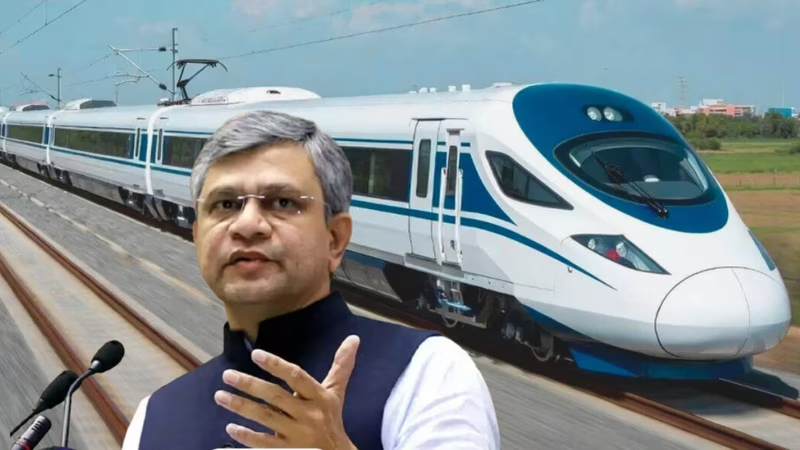
Mark your calendars! After years of anticipation, delays, and groundbreaking ceremonies, India’s dream of a high-speed rail network is becoming a tangible reality. Railway Minister Ashwini Vaishnaw has delivered a definitive timeline: the nation’s first bullet train by 2027 will be ready for service on August 15, 2027 . But that’s not all—India’s rail revolution is happening in two major waves, with the debut of the first Vande Bharat sleeper train just a year away in January 2026 . This is the inside track on what’s coming, where it’s going, and how it changes everything.
Table of Contents
- First Wave: The Vande Bharat Sleeper Train (January 2026)
- Second Wave: The Bullet Train by 2027
- The Phased Launch Strategy: Surat to Bilimora First
- Project Details & The Crucial Japan Partnership
- Impact on Travel and the Economy
- Conclusion: A Transformative Moment for India
- Sources
First Wave: The Vande Bharat Sleeper Train (January 2026)
Before the bullet train arrives, Indian Railways is set to redefine overnight travel with the launch of the country’s first Vande Bharat sleeper train in mid-January 2026 . The inaugural route will connect Guwahati in Assam to Howrah (Kolkata) in West Bengal .
This new train is a game-changer for long-distance journeys. Designed with modern amenities, enhanced safety features, and improved comfort, it aims to make overnight travel not just convenient but truly enjoyable. Fares are expected to be competitive, offering a premium experience at a reasonable cost . This launch is a significant step in the “Make in India” initiative, showcasing the country’s growing prowess in advanced rail manufacturing.
Second Wave: The Bullet Train by 2027
The crown jewel of India’s rail modernization is, of course, the Mumbai-Ahmedabad High-Speed Rail (MAHSR) corridor. Minister Vaishnaw’s declaration that the bullet train by 2027 will be operational on August 15th has provided the clarity and confidence the public and investors have been waiting for .
Once fully complete, this 508-kilometer corridor will slash the travel time between India’s financial capital and its leading industrial city from a grueling 6-7 hours to just about 2 hours and 17 minutes . Trains will cruise at speeds of up to 320 kmph, a stark contrast to the current average speeds on the route.
The Phased Launch Strategy: Surat to Bilimora First
Rather than waiting for the entire corridor to be finished, Indian Railways has smartly opted for a phased commissioning. The very first section to open to the public will be the 47-kilometer stretch between Surat and Bilimora . This initial launch in 2027 will serve as a proof-of-concept and a major morale booster for the project.
Following the Surat-Bilimora launch, the next sections to be rolled out are expected to be Vapi to Surat and Bilimora to Vadodara . This staged approach allows for operational experience to be gained while construction continues on the more complex segments, like the undersea tunnel between Mumbai and Thane.
Project Details & The Crucial Japan Partnership
The MAHSR project is a flagship example of international cooperation. It’s being developed with Japan, which is providing its world-renowned Shinkansen technology—the same system that has operated for over 60 years with a perfect safety record .
The financial scale is equally impressive. The total project cost is estimated at a staggering ₹1.10 lakh crore (approximately $14.5 billion) . Japan is shouldering more than 80% of this cost through a highly concessional loan with an interest rate of just 0.1% . This partnership goes beyond just funding; it includes technology transfer, staff training, and the supply of the E5 series Shinkansen trainsets .
Impact on Travel and the Economy
The arrival of the bullet train by 2027 will have far-reaching consequences:
- Economic Integration: It will create a single, integrated economic and industrial zone between Mumbai and Ahmedabad, boosting business, tourism, and real estate development along the corridor.
- Safety and Efficiency: The Shinkansen technology promises unparalleled safety and punctuality, setting a new benchmark for rail travel in India.
- Job Creation: The project has already created tens of thousands of jobs and will continue to do so during its operational phase.
- Environmental Benefits: By providing a fast, reliable alternative to air and road travel, the bullet train is expected to significantly reduce the carbon footprint of inter-city transportation.
This rail revolution is not just about speed; it’s about transforming how a nation moves and connects. [INTERNAL_LINK:make-in-india-success-stories] will likely count this as a major milestone.
Conclusion: A Transformative Moment for India
The dual announcements of the Vande Bharat sleeper in 2026 and the bullet train by 2027 signal a new dawn for Indian Railways. It’s a bold leap from a legacy system to a future-ready one. While challenges in execution and final costs remain, the commitment from the highest levels of government, backed by a strong international partnership, makes this vision more achievable than ever before. India is finally on the high-speed rail map, and the journey has just begun.
Sources
- Times of India: Bullet train by 2027! Ashwini Vaishnaw reveals key routes
- India Today: ‘Buy A Bullet Train Ticket On 15 August 2027’: Vaishnaw
- The Hindu: Vande Bharat sleeper train to be launched in January 2026
- NDTV: India’s first bullet train to roll out on August 15, 2027
- Japan International Cooperation Agency (JICA): Official website for project financing details