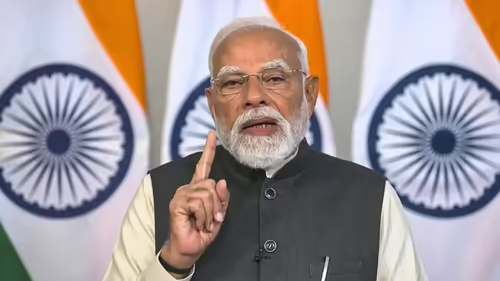
Prime Minister Narendra Modi didn’t hold back. He called the Union Budget 2026 a “historic” document, a definitive roadmap on the “high flight toward Viksit Bharat.” But in a world full of political promises, what does this actually mean for the average citizen, a small business owner, or an ambitious young professional? Let’s cut through the noise and dissect the real meat of this budget.
Table of Contents
- What is Viksit Bharat and Why Does it Matter?
- The Real Substance of Budget 2026
- The ‘Mother of All Deals’: India-EU FTA Explained
- Sitharaman’s Record Ninth Budget: A Strategic Masterstroke?
- Conclusion: Is the Flight Path Clear for Viksit Bharat?
- Sources
What is Viksit Bharat and Why Does it Matter?
The term Viksit Bharat, or Developed India, is the central pillar of the government’s long-term vision, targeting the year 2047—the 100th anniversary of India’s independence. It’s not just a slogan; it’s a comprehensive framework aiming to transform India into a $30 trillion economy with a focus on inclusive growth, technological leadership, and global influence [[20]].
This vision goes beyond mere GDP numbers. It encompasses rationalizing over 20,000 compliances, simplifying 300+ laws, and creating a future-ready workforce [[21]]. The Union Budget 2026 is being positioned as the critical financial engine to power this ambitious journey.
The Real Substance of Budget 2026
Finance Minister Nirmala Sitharaman’s ninth consecutive budget is built on three core “Kartavyas” (duties): Yuva (Youth), Garib (Poor), and Annadata (Farmers). But the most tangible takeaway is the government’s unwavering commitment to infrastructure-led growth.
Record Capital Expenditure
The government has announced a massive capital expenditure of ₹12.2 lakh crore for FY 2026-27, marking a significant 9% increase from the previous year [[4]]. This is the highest-ever allocation, signaling a clear intent to boost long-term economic capacity through roads, railways, ports, and digital infrastructure. This move is expected to create jobs, improve logistics efficiency, and attract private investment.
Boosting MSMEs and Innovation
Recognizing the backbone of the Indian economy, the budget offers strong support for Micro, Small, and Medium Enterprises (MSMEs). While specific liquidity schemes are detailed, the overarching theme is to ease their access to credit and markets [[1]]. Furthermore, there’s a clear push towards future technologies, with allocations for semiconductor manufacturing and AI capacity building [[7]].
Tax Simplification
In a major win for businesses and individuals alike, the government has streamlined the tax code, reducing the number of sections from a staggering 819 to a more manageable 536. This move is aimed squarely at improving clarity, reducing litigation, and enhancing the ease of doing business in India [[8]].
The ‘Mother of All Deals’: India-EU FTA Explained
PM Modi’s reference to the “mother of all deals” isn’t hyperbole. On January 27, 2026, India and the European Union officially concluded a landmark Free Trade Agreement (FTA) after nearly two decades of negotiations [[12]]. This deal is a game-changer.
The agreement is expected to drastically reduce or eliminate tariffs on a vast array of goods, from chemicals and pharmaceuticals to textiles and agricultural products [[19]]. For Indian youth and MSMEs, this opens up a massive, high-value market of over 450 million consumers. It’s a direct channel for Indian businesses to scale globally and for the workforce to gain exposure to international best practices.
The target for the deal to enter into force is late 2026, pending legal scrubbing and ratification by both sides [[11]]. Its successful implementation could be one of the most significant economic catalysts for the Viksit Bharat vision.
Sitharaman’s Record Ninth Budget: A Strategic Masterstroke?
Presentation number nine is more than just a record; it’s a testament to policy continuity. In an era of global economic uncertainty, this consistency is a powerful signal to investors. The budget avoids populist giveaways and instead doubles down on a strategic, long-term investment thesis.
By focusing on capital expenditure, structural reforms like tax simplification, and leveraging international trade deals, the government is attempting to build a resilient and self-sustaining economic model. This approach aligns perfectly with the multi-decade horizon required for achieving a Viksit Bharat.
Conclusion: Is the Flight Path Clear for Viksit Bharat?
PM Modi’s description of the Union Budget 2026 as “historic” seems well-founded. It’s a bold, forward-looking document that directly feeds into the Viksit Bharat mission. The combination of record domestic investment and a transformative international trade deal creates a powerful dual engine for growth.
However, the true test lies in execution. Can the government ensure these funds are spent efficiently? Can the benefits of the EU FTA truly trickle down to the smallest entrepreneur? The blueprint is ambitious, but its success will be measured not in announcements, but in real-world impact on the lives of a billion Indians. For now, the flight path is set, and the engines are roaring.
Sources
- Groww. “Union Budget 2026 Key Highlights: What You Need to Know.” https://groww.in/blog/union-budget-2026-key-highlights
- The Hindu. “Union Budget 2026-27 highlights: Key announcements by FM Nirmala Sitharaman.” https://www.thehindu.com/business/budget/budget-2026-highlights-nirmala-sitharaman-speech/article70577520.ece
- MyNRI Portal. “EU–India Trade Deal Sealed on 27 January 2026 ‘Mother of all Deals’.” https://www.mynriportal.com/eu-india-trade-deal-sealed-on-27-january-2026-mother-of-all-deals/
- Lexology. “The India EU FTA 2026: A Structural Shift in Trade, Investment and Regulation.” https://www.lexology.com/library/detail.aspx?g=39e47ef0-d260-4fb6-9c1e-f25f442e6f25
- Big Story Network. “It’s Official: India-EU FTA Targeting Late 2026 Rollout.” https://bigstorynetwork.com/content/its-official-india-eu-fta-targeting-late-2026-rollout
- Indian Institute of Public Administration. “A Roadmap to Viksit Bharat 2047.” https://www.iipa.org.in/upload/Background_Note_A_Roadmap_to_Viksit_Bharat_2047.pdf
- Officers Pulse. “Roadmap For Viksit Bharat @ 2047.” https://officerspulse.com/2025/04/03/roadmap-for-viksit-bharat-2047/
- PwC India. “Union Budget 2026 | Insights and Analysis.” https://www.pwc.in/budget/union-budget-2026.html