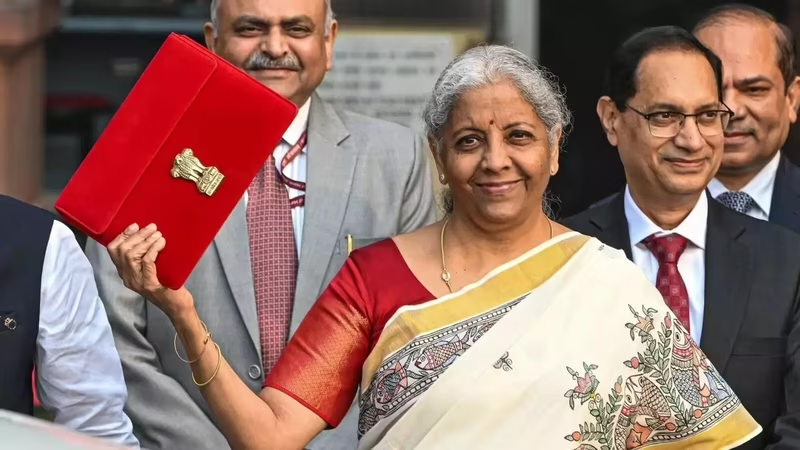
Get ready for a landmark moment in India’s fiscal calendar. For the first time since Independence, the Union Budget 2026 will be presented not on a weekday—but on a Sunday. Lok Sabha Speaker Om Birla officially confirmed that Finance Minister Nirmala Sitharaman will table the budget on February 1, 2026, during a session that begins on January 28 . This unprecedented scheduling decision has sparked widespread curiosity: Why break a 75-year tradition? And what does it signal about the government’s priorities?
Table of Contents
- Why Is Budget 2026 Being Presented on a Sunday?
- A Historic First in India’s Fiscal History
- What to Expect from Nirmala Sitharaman’s Eighth Budget
- The Budget Session Timeline and Key Dates
- Global Context: Do Other Countries Present Budgets on Weekends?
- Implications for Markets and Citizens
- Conclusion
- Sources
Why Is Budget 2026 Being Presented on a Sunday?
While the government hasn’t issued an official explanation, several practical and symbolic theories are circulating. One strong possibility is logistical alignment. February 1, 2026, falls just before the Hindu festival of Vasant Panchami—a day often considered auspicious for new beginnings. Presenting the Budget 2026 on this date could carry cultural significance.
Another angle is parliamentary efficiency. With the Budget Session starting on January 28 (a Wednesday), holding the presentation on Sunday may allow for a full week of pre-budget discussions, followed by immediate post-budget debates from Monday onward. This could streamline the legislative process, especially if the government aims to pass key finance bills before the fiscal year ends on March 31.
A Historic First in India’s Fiscal History
Since 1947, every Union Budget has been presented on a weekday—typically late February, and later shifted to February 1 under the Modi administration in 2017. The move to a Sunday breaks a long-standing convention rooted in colonial-era practices when budgets were aligned with the British parliamentary calendar.
This shift isn’t just ceremonial; it reflects a broader trend of the Indian government reimagining institutional rituals to suit contemporary needs. From merging the Railway Budget with the main budget in 2017 to advancing the presentation date, the finance ministry has steadily modernized its approach. The Sunday presentation of Budget 2026 may be the boldest step yet in this evolution.
Nirmala Sitharaman’s Record-Setting Budget
If all goes as planned, this will be Finance Minister Nirmala Sitharaman’s eighth consecutive budget—a record for any full-term finance minister in India’s history. Her tenure has been marked by major reforms, including corporate tax cuts, production-linked incentive (PLI) schemes, and a strong focus on infrastructure and digital public infrastructure like UPI and ONDC .
What to Expect from Nirmala Sitharaman’s Eighth Budget
As India eyes a $5 trillion economy, Budget 2026 is expected to double down on three key pillars:
- Capital Expenditure: Continued high spending on roads, railways, and green energy to fuel growth.
- Job Creation: Enhanced skilling initiatives and support for MSMEs to tackle youth unemployment.
- Fiscal Prudence: Balancing populist measures with a credible path to reduce the fiscal deficit below 4.5% of GDP.
Analysts also anticipate announcements around urban housing, healthcare expansion under Ayushman Bharat, and possibly tweaks to personal income tax slabs ahead of state elections .
The Budget Session Timeline and Key Dates
The upcoming parliamentary session is tightly packed:
- January 28, 2026: Budget Session begins
- February 1, 2026 (Sunday): Union Budget 2026 presented at 11 AM
- February 2–5: General discussion on the budget
- Late February–March: Detailed scrutiny of demands for grants and passage of Finance Bill
This compressed timeline underscores the government’s urgency to implement its fiscal roadmap without delay.
Global Context: Do Other Countries Present Budgets on Weekends?
While rare, it’s not unheard of. In 2020, New Zealand’s government presented its budget on a Thursday, but emergency fiscal updates have occasionally landed on weekends during crises. The UK typically presents its budget on a Wednesday, while the U.S. President’s budget request is submitted to Congress in early February—but actual appropriations happen months later.
India’s move stands out because it’s a deliberate, non-emergency shift to a weekend—a signal that the government sees no need to conform to outdated norms. For more on global budget practices, see the International Monetary Fund’s primer on national budgeting.
Implications for Markets and Citizens
For financial markets, a Sunday announcement means traders and analysts will have the entire day to digest the document before markets open on Monday. This could lead to more informed, less volatile reactions compared to traditional weekday releases.
For citizens, the timing makes the budget more accessible. Families can watch the live broadcast together, and media coverage can dominate weekend news cycles—potentially increasing public engagement with fiscal policy, a domain often seen as too technical or distant.
Conclusion
The Sunday presentation of Budget 2026 is far more than a scheduling quirk—it’s a symbolic break from the past and a statement of intent. As India navigates complex economic challenges—from global uncertainty to domestic job creation—the government is signaling its willingness to innovate, even in its oldest institutions. Whether this bold move translates into transformative policies remains to be seen, but one thing is certain: February 1, 2026, will be a date etched in India’s economic history books.
Sources
- Times of India: It’s a first! Budget 2026 to be presented on a Sunday; Om Birla confirms date
- Ministry of Finance, Government of India: Union Budget Documents Archive
- International Monetary Fund (IMF): Back to Basics: What Is a Budget?
- Economic Times & Business Standard reports on pre-budget expectations (2025–2026)