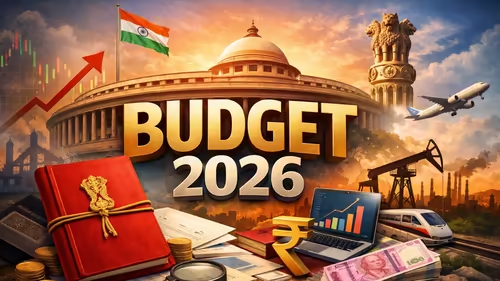
Introduction: A Budget Like No Other
Get ready for a historic moment. On February 1, 2026, Finance Minister Nirmala Sitharaman will step into Parliament to present the Budget 2026, and she’ll be making history by doing it on a Sunday—the very first time this has ever happened in independent India [[37]]. This isn’t just a quirky scheduling change; it’s a powerful symbol of how a centuries-old tradition is constantly evolving. But what else don’t you know about the Union Budget? From its mysterious absence in the Constitution under its common name to the iconic red ledger that replaced a colonial briefcase, the story is far richer than most realize.
Table of Contents
- The Constitutional Name Game: It’s Not Called the ‘Budget’!
- Budget 2026: The Groundbreaking Sunday Premiere
- From Colonial Evenings to Modern Mornings
- Why February 1st Became the New Norm
- The Symbolic Shift from Briefcase to Bahi Khata
- The End of an Era: Railway Budget’s Integration
- More Fascinating Budget Trivia
- Conclusion: A Living Document of Our Economy
- Sources
The Constitutional Name Game: It’s Not Called the ‘Budget’!
Here’s a mind-bender for you: if you search the Indian Constitution for the word “Budget,” you won’t find it. Instead, what we all know as the Union Budget is formally titled the “Annual Financial Statement.” This crucial document is mandated under Article 112 of the Constitution, which directs the President to lay before Parliament a statement of the estimated receipts and expenditures of the Government of India for that year [[1]]. So, every time you hear “Budget 2026,” remember, you’re really talking about the Annual Financial Statement—a name that carries immense legal and historical weight.
Budget 2026: The Groundbreaking Sunday Premiere
The most talked-about fact about Budget 2026 is its unprecedented presentation day. For decades, the budget has been a weekday affair, typically on a Thursday or Friday. However, since the government shifted the official date to February 1st in 2017, a unique situation arose in 2026: February 1st falls on a Sunday [[45]]. Rather than move the date, the government decided to stick to the schedule, making this a landmark event in India’s fiscal calendar [[39]]. This decision underscores a commitment to a predictable economic calendar, even if it means breaking a long-standing convention.
From Colonial Evenings to Modern Mornings
The timing of the budget speech is another relic of our colonial past. For most of the 20th century, the budget was presented at 5 PM, a practice inherited directly from the British. This evening ritual continued until 1999 when then-Finance Minister Yashwant Sinha moved the presentation to 11 AM [[16]]. The shift was strategic, allowing markets a full trading day to react to the announcements, thereby promoting greater stability and transparency in the financial system.
Why February 1st Became the New Norm
Before 2017, the Union Budget was traditionally presented on the last working day of February. This often left a very short window for Parliament to pass the necessary appropriation bills before the new financial year began on April 1st. To fix this bottleneck and give ministries more time to kickstart their projects from day one, the government, under Finance Minister Arun Jaitley, advanced the date to February 1st starting with the 2017-18 budget [[11]]. This seemingly small change has had a significant impact on the efficiency of government spending.
The Symbolic Shift from Briefcase to Bahi Khata
For over 70 years, Finance Ministers carried their budget documents in a leather briefcase, a direct nod to the British Chancellor of the Exchequer’s famous red box [[29]]. In a powerful act of cultural assertion, Nirmala Sitharaman broke this tradition in 2019 by presenting the budget in a ‘bahi khata’—a traditional Indian ledger bound in red cloth [[32]]. This wasn’t just a prop; it was a statement. The ‘bahi khata’ symbolizes indigenous accounting practices and a move away from colonial symbols, representing a uniquely Indian identity in our economic governance.
The End of an Era: Railway Budget’s Integration
Another major structural reform came in 2017 with the merger of the Railway Budget with the Union Budget. This separate railway budget was a 92-year-old practice, initiated in 1924 based on the recommendations of the Acworth Committee [[24]]. While it was a grand annual event in itself, the government decided to merge it to end the artificial separation of finances, improve transparency, and allow for a more holistic view of national infrastructure spending [[20]]. The first combined budget under this new structure was presented on February 1, 2017.
More Fascinating Budget Trivia
The world of the Union Budget is filled with intriguing details:
- The First Budget: India’s very first budget was presented not by an Indian, but by James Wilson, a Scotsman and the founder of The Economist, on April 7, 1860 [[15]].
- Interim vs. Full Budget: Independent India’s first Finance Minister, R.K. Shanmukham Chetty, presented an interim budget in November 1947, with the first full budget coming in February 1948 [[10]].
- The Blue Sheet: The actual speech read by the Finance Minister is written on a special blue paper, a tradition that continues to this day.
Conclusion: A Living Document of Our Economy
The story of the Budget 2026 is more than just numbers and allocations. It’s a narrative woven with threads of history, culture, and evolving governance. From its formal title as the Annual Financial Statement to its groundbreaking Sunday debut, every detail reflects a nation that respects its past while boldly shaping its future. As we await the big announcement, understanding these lesser-known facts gives us a deeper appreciation for the complex and fascinating machinery of our democracy’s financial heart.
Sources
- Ministry of Finance, Government of India. “The Union Budget of India.” https://www.data.gov.in/ministrydepartment/Ministry%20of%20Finance
- Press Information Bureau (PIB). “Merger of Rail Budget With Union Budget.” https://www.pib.gov.in/newsite/PrintRelease.aspx?relid=153672
- The Hindu. “Union Budget 2026: From ‘Bahi Khata’ to ‘Blue Sheet’.” https://www.thehindu.com/business/budget/union-budget-2026-interesting-facts-to-know-bahi-khata-and-more/article70564056.ece
- NDTV. “Sunday Budget Returns After 27 Years In 2026.” https://www.ndtv.com/india-news/union-budget-2026-to-be-presented-on-sunday-first-since-1999-10786010
- ICICI Direct. “History of Union Budget in India: Key Highlights & Evolution.” https://www.icicidirect.com/ilearn/personal-finance/articles/history-of-union-budget-in-india