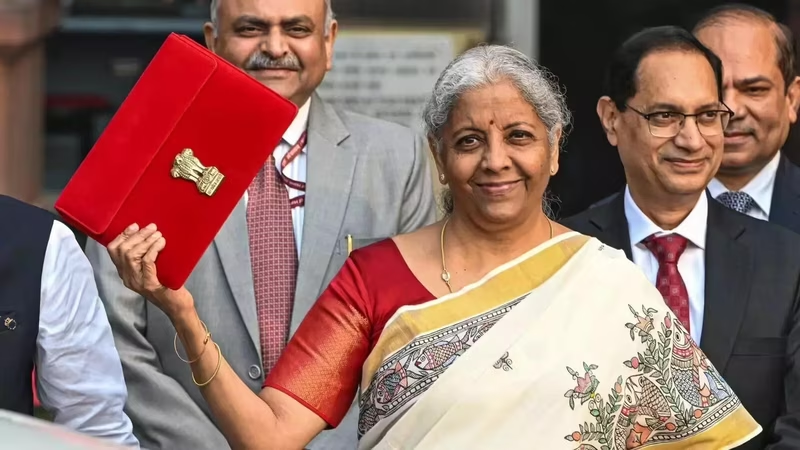
The political and financial heart of India is about to beat faster. The government has officially announced that the Budget 2026 session of Parliament will run from January 28 to April 2, 2026, split neatly into two distinct phases . This isn’t just a routine calendar update; it’s the opening act for the fiscal narrative that will shape every citizen’s life—from the taxes you pay to the infrastructure you use and the jobs on the horizon.
Table of Contents
- The Confirmed Budget 2026 Timeline: Key Dates You Must Know
- Why Is the Session Split Into Two Phases?
- What Can We Expect from Budget 2026?
- A Look Back: How This Session Compares to Previous Years
- Conclusion: Mark Your Calendars and Stay Informed
- Sources
The Confirmed Budget 2026 Timeline: Key Dates You Must Know
Mark these dates in your diary because they are non-negotiable fixtures in India’s economic calendar:
- January 28, 2026: The Budget Session officially commences with the President’s Address to a joint sitting of both Houses of Parliament .
- January 29, 2026: The Department of Economic Affairs will table the Economic Survey 2025-26, providing a comprehensive review of the economy’s performance over the past year and its outlook .
- February 1, 2026: Finance Minister Nirmala Sitharaman will present the Union Budget 2026-27 in the Lok Sabha. This is the main event where the government unveils its revenue and expenditure plans .
- February 13, 2026: The first phase of the session concludes .
- March 9, 2026: The second phase of the session begins, focusing on the detailed scrutiny and passing of budgetary demands and other pending legislation .
- April 2, 2026: The session officially ends .
Why Is the Session Split Into Two Phases?
This two-phase structure is a well-established parliamentary tradition, not a new invention for 2026. It serves a crucial strategic purpose. The Budget Session is typically the longest of the year, often spanning 2-3 months .
The first phase is dedicated to the grand unveiling: the President’s address, the Economic Survey, and the main Budget speech. This period is filled with general debates on the nation’s economic direction.
The break between February 13 and March 9 allows Members of Parliament (MPs) to return to their constituencies. They can consult with their constituents, gather feedback on the proposed budget, and prepare for the nitty-gritty work ahead. The second phase is where the real legislative heavy lifting happens. During this time, Parliament forms department-related standing committees to scrutinize each ministry’s budget demands in detail—a process known as the ‘guillotine’—before voting them into law .
What Can We Expect from Budget 2026?
While the final numbers remain a closely guarded secret, industry experts and economists have already laid out their expectations. The overarching theme for Budget 2026 is likely to be “growth continuity.”
According to EY India, the government is expected to prioritize a predictable tax framework, steady public investment, and targeted support for key sectors to unlock private capital . With India’s economy forecast to expand by 7–7.5% , the budget is seen as a critical tool to maintain this momentum.
Key areas of focus are anticipated to include:
- Capital Expenditure (Capex): A continued push on infrastructure projects to drive long-term growth .
- Tax Simplification: With the new Income Tax Act set to roll out from April 2026, there are strong expectations for measures that simplify compliance and provide greater certainty for taxpayers .
- Employment & Skilling: Policies aimed at boosting job creation, particularly in the manufacturing and services sectors .
- Digital Public Infrastructure: Further investment in India’s world-leading digital stack to enhance financial inclusion and service delivery .
For a deeper dive into sector-specific predictions, check out our analysis on [INTERNAL_LINK:budget-2026-sector-expectations].
A Look Back: How This Session Compares to Previous Years
The timing of the Budget 2026 session follows a recent trend of an earlier start. Historically, the Budget Session began in late February or early March. However, since 2017, the government has advanced the date to February 1 to allow ministries to start their operations from the beginning of the new financial year on April 1 .
The current schedule for 2026, starting on January 28, is almost identical to the 2025 session, which ran from January 31 to April 4 . This consistency provides a stable and predictable framework for both the legislature and the markets. For more on the evolution of India’s budgetary process, you can refer to this detailed overview from PRS India .
Conclusion: Mark Your Calendars and Stay Informed
The announcement of the Parliament session dates for Budget 2026 is more than just a procedural formality. It’s a clear signal of the government’s intent to stick to its fiscal calendar and deliver a budget designed to propel the nation forward. From the initial fanfare of the Economic Survey to the final passage of appropriation bills, every step in this two-month journey is critical. As a citizen, staying informed about these developments is the first step to understanding how national policy will impact your personal finances and professional opportunities.
Sources
- Times of India. “Budget 2026: Parliament session from January 28-April 2; to be held in two phases.” https://timesofindia.indiatimes.com/…
- Official announcements on Budget Session 2026 dates and key events [[2], [3], [4], [6], [9]].
- PRS Legislative Research. “Overview Of The Budget Process In The Parliament Of India.” https://prsindia.org/ .
- EY India. “EY India outlines key expectations from Union Budget 2026.” .
- Various reports on historical session dates and economic forecasts [[10], [15], [18], [26]].