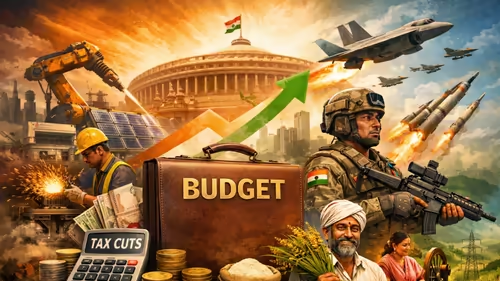
Every year, the Union Budget is more than just numbers—it’s a mirror reflecting the government’s vision, anxieties, and ambitions. With Budget 2026 just around the corner, all eyes are on what Finance Minister Nirmala Sitharaman will unveil in Parliament. But before we speculate about the future, it’s crucial to understand the past. By examining the last five Union Budgets (2021–2025), we can uncover powerful trends that may well dictate the direction of this year’s fiscal blueprint.
Table of Contents
- The Big Picture: Budget 2026 in Context
- Key Themes from the Last Five Budgets
- Infrastructure: The Unwavering Priority
- Manufacturing and PLI Schemes: Gaining Momentum
- Green Energy and Climate Resilience on the Rise
- Social Spending: Health, Education, and Rural India
- What to Expect in Budget 2026
- Conclusion: Learning from History to Shape the Future
- Sources
The Big Picture: Budget 2026 in Context
Budget 2026 arrives at a pivotal moment. India is on track to become the world’s third-largest economy, yet it faces headwinds—global inflation, geopolitical tensions, and the need to sustain domestic consumption. Against this backdrop, the government must balance growth, equity, and fiscal prudence. Historical data shows that since 2021, the focus has steadily shifted from pandemic recovery to long-term structural transformation—a trend likely to continue in Budget 2026.
Key Themes from the Last Five Budgets
A review of Union Budgets from 2021 to 2025 reveals three dominant pillars:
- Capital Expenditure Push: Gross capital formation by the government rose from ₹4.39 lakh crore in 2021–22 to over ₹11.11 lakh crore in 2025–26 (BE).
- Atmanirbhar Bharat (Self-Reliant India): Emphasis on domestic manufacturing, digital public infrastructure, and reducing import dependence.
- Inclusive Development: Increased allocations for health, education, and rural employment schemes like MGNREGA.
Infrastructure: The Unwavering Priority
From roads and railways to ports and urban transit, infrastructure has been the backbone of India’s post-pandemic strategy. The PM GatiShakti National Master Plan, launched in 2021, has guided multi-modal connectivity investments. In Budget 2025 alone, ₹11.11 lakh crore was allocated for capital expenditure—nearly 3.4% of GDP—the highest ever .
This trend is unlikely to reverse. Experts anticipate that Budget 2026 will double down on infrastructure, especially in tier-2 and tier-3 cities, to boost job creation and logistics efficiency. Expect announcements on new Vande Bharat routes, metro expansions, and greenfield airport projects.
Manufacturing and PLI Schemes: Gaining Momentum
The Production-Linked Incentive (PLI) scheme, introduced in Budget 2021, has evolved into a cornerstone of industrial policy. Initially covering 10 sectors, it now spans 14—including electronics, pharmaceuticals, and advanced chemistry cells (batteries). Over ₹1.97 lakh crore has been committed under PLI, with early success in mobile phone exports (up from $3 billion in 2014 to over $14 billion in 2024) .
Budget 2026 may expand PLI to emerging sectors like AI hardware, semiconductors, and renewable energy components. The goal? To make India a global manufacturing hub—not just an assembly line.
Green Energy and Climate Resilience on the Rise
Climate action has moved from the margins to the mainstream. The 2023 budget introduced the Green Hydrogen Mission with a ₹19,744 crore outlay. Subsequent budgets have increased funding for solar parks, battery storage, and EV charging infrastructure.
With COP29 approaching and India’s net-zero pledge by 2070, Budget 2026 is expected to introduce new fiscal incentives for carbon capture, green steel, and circular economy startups. A potential “green bond” window for state governments could also be on the table.
Social Spending: Health, Education, and Rural India
While capital expenditure dominates headlines, social sector allocations remain critical. Post-pandemic, health spending surged—Ayushman Bharat coverage now exceeds 55 crore beneficiaries. However, as a percentage of GDP, public health expenditure remains below 2%, drawing criticism from economists .
Likewise, education funding has stagnated near 2.9% of total outlay. Rural distress, despite strong MGNREGA allocations, persists due to implementation gaps. Budget 2026 may address these through outcome-based funding models or direct benefit transfers linked to performance metrics.
What to Expect in Budget 2026
Based on historical trends and current economic realities, here’s our forecast for key priorities:
- Record Capital Expenditure: Likely to exceed ₹12 lakh crore, focused on logistics and urban infrastructure.
- PLI 2.0: Expansion into deep-tech and clean energy manufacturing.
- Digital Public Infrastructure (DPI): New investments in AI governance, data sovereignty, and fintech innovation.
- Fiscal Consolidation: A gradual return to the 4.5% fiscal deficit target by 2026, balancing growth and stability.
- Tax Reforms: Possible tweaks to personal income tax slabs and GST rationalization for MSMEs.
Conclusion: Learning from History to Shape the Future
The past five budgets tell a story of resilience, ambition, and strategic recalibration. As we approach Budget 2026, the government stands at a crossroads: maintain momentum on infrastructure and manufacturing, or pivot toward deeper social investment and climate adaptation. One thing is certain—history won’t just inform this budget; it will define its legacy. For more insights on India’s economic trajectory, explore our analysis on [INTERNAL_LINK:india-economic-outlook-2026].
Sources
- Ministry of Finance, Government of India: Union Budget Archives (2021–2025)
- Times of India: Budget 2026: What the past five years say about this year’s priorities
- Press Information Bureau (PIB): PLI Scheme Updates
- Economic Survey 2024–25: Chapter on Social Sector Expenditure