Introduction: The Speech Is Just the Tip of the Iceberg
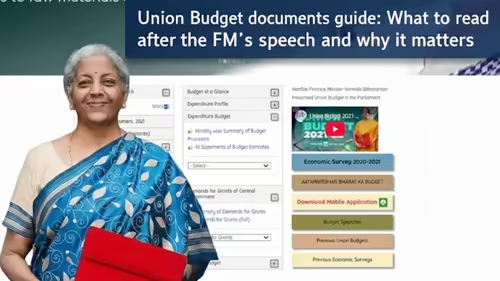
On February 1, 2026, Finance Minister Nirmala Sitharaman delivered her Union Budget speech—a polished, high-level narrative designed for headlines and soundbites. But if you stopped there, you’ve only seen half the picture. The real substance, the granular details that affect your taxes, your business, and your investments, lives not in the oratory, but in the dense, meticulously crafted Budget 2026 documents. These official papers are where policy meets reality, and understanding them is your key to making smarter financial decisions [[5]].
Table of Contents
- Why the Speech Isn’t Enough
- Essential Budget 2026 Documents to Read
- How to Navigate the Document Jungle
- What Each Document Reveals About Your Finances
- Expert Tip: Turn Data into Action
- Conclusion: Be an Informed Citizen, Not a Passive Listener
- Sources
Why the Speech Isn’t Enough
The Budget speech is a masterclass in political communication. It’s concise, optimistic, and focused on big themes like growth, innovation, and welfare. However, it intentionally omits the nitty-gritty: exact tax slabs, expenditure allocations by department, fiscal deficit calculations, and the fine print of new schemes. For investors, entrepreneurs, and even salaried individuals, these details are non-negotiable. Relying solely on the speech is like buying a car based only on its paint job—you need to check the engine, too [INTERNAL_LINK:budget-impact-on-personal-finance].
Budget 2026 documents: Your Essential Reading List
The Ministry of Finance releases a suite of documents every year. Here are the five you absolutely cannot skip:
- The Annual Financial Statement (AFS): This is the core document, mandated by Article 112 of the Constitution. It details the government’s estimated receipts and expenditures for the upcoming fiscal year, broken down into Revenue and Capital accounts [[8]].
- The Finance Bill: This is the legal backbone of the Budget. It contains all the proposed changes to tax laws, including income tax, GST, customs duties, and more. If a change isn’t in this bill, it doesn’t happen [[9]].
- The Expenditure Profile: Want to know exactly how much money is allocated to health, education, or defense? This document provides a detailed, ministry-wise breakdown of planned spending [[10]].
- The Macro-Economic Framework Statement: This outlines the government’s projections for key economic indicators like GDP growth, inflation, and fiscal deficit. It’s crucial for understanding the broader economic context [[11]].
- The Budget at a Glance: A great starting point for beginners. It offers a simplified, summarized view of the AFS and key fiscal numbers, perfect for getting your bearings before diving deep [[12]].
How to Navigate the Document Jungle
These documents can be intimidating. Here’s a pro tip: don’t read them cover to cover. Instead, use their built-in structure.
- Use the Index and Table of Contents: Every major document has one. Jump straight to sections relevant to your interests (e.g., “Direct Taxes” in the Finance Bill).
- Compare with Last Year: The best way to spot changes is to compare the 2026 figures with the 2025 Revised Estimates. A sudden spike or drop in a department’s allocation often signals a policy shift.
- Leverage External Summaries: Reputable financial institutions and news outlets publish their own analyses. Use them as a guide, but always cross-check with the original source.
For a deeper understanding of India’s fiscal processes, the official portal of the Union Budget is an indispensable, high-authority resource.
What Each Document Reveals About Your Finances
Let’s connect the dots between these dry documents and your personal bottom line.
- Annual Financial Statement: Shows the government’s overall fiscal health. A high fiscal deficit could mean future tax hikes or inflationary pressure.
- Finance Bill: Directly impacts your take-home pay. Changes in tax slabs, deductions (like 80C), or capital gains rules are all here.
- Expenditure Profile: If you’re in the infrastructure sector, a massive allocation to roads means potential contracts. If you’re a student, increased education spending could mean more scholarships.
Expert Tip: Turn Data into Action
Reading is just step one. The real value comes from acting on your insights. If the Finance Bill introduces a new tax benefit for EV purchases, and you were planning to buy a car, now’s the time to research. If the Expenditure Profile shows a huge push for green hydrogen, it might be worth looking at related stocks or funds [INTERNAL_LINK:green-energy-investment-opportunities-post-budget]. Knowledge is power, but applied knowledge is profit.
Conclusion: Be an Informed Citizen, Not a Passive Listener
The Budget 2026 documents are not just bureaucratic paperwork; they are a blueprint for the nation’s economic direction over the next year. By moving beyond the headline-grabbing speech and engaging directly with these primary sources, you transform from a passive observer into an empowered citizen and a savvy financial planner. In a world of information overload, this level of due diligence is your ultimate competitive advantage.
Sources
- [[5]] Times of India: Budget 2026: What to read after Niramala’s speech and why it matters
- [[8]] Ministry of Finance, Government of India: Annual Financial Statement
- [[9]] Ministry of Finance, Government of India: Finance Bill, 2026
- [[10]] Ministry of Finance, Government of India: Expenditure Profile
- [[11]] Ministry of Finance, Government of India: Macro-Economic Framework Statement
- [[12]] Ministry of Finance, Government of India: Budget at a Glance