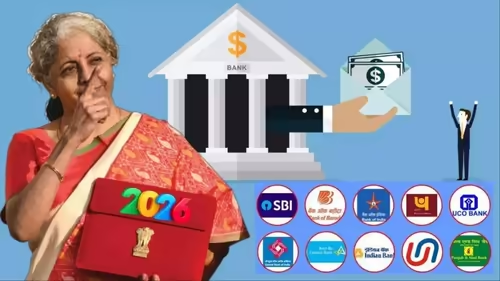
Let’s cut through the noise. The Union Budget 2026 wasn’t just about tax slabs and infrastructure spends; it was a strategic blueprint for the future of Indian finance. At its heart lies a single, powerful announcement: the formation of a high-level committee on Banking for Viksit Bharat. This isn’t just another bureaucratic panel—it’s a potential catalyst for the most significant overhaul of our financial sector in a decade.
With the banking industry riding a wave of strong balance sheets and record profitability [[31]], the government is clearly looking to leverage this momentum to fuel the next phase of India’s economic journey. But what are the real implications? And who stands to win or lose?
Table of Contents
- What is the ‘Banking for Viksit Bharat’ Committee?
- The Bold Plan to Reshape Public Sector NBFCs
- Why Now? A Health Check on the Indian Banking Sector
- Potential Impact and Key Challenges Ahead
- Conclusion: A New Era for Indian Finance?
- Sources
What is the ‘Banking for Viksit Bharat’ Committee?
Announced by Finance Minister Nirmala Sitharaman during her Budget 2026 speech, the Banking for Viksit Bharat committee is tasked with nothing less than a comprehensive review of the entire financial sector’s structure, governance, and legal framework [[3]]. Its primary mission is to align the banking and financial services landscape with the ambitious goals of a developed India by 2047.
This high-level panel is expected to delve into critical areas that have long been on the industry’s wish list:
- Modernizing outdated laws: Reviewing and potentially overhauling legacy legislation like the SARFAESI Act to make it more effective in today’s digital economy [[11]].
- Enhancing governance: Proposing new standards for board oversight and risk management in both public and private sector banks.
- Boosting credit flow: Identifying bottlenecks that prevent efficient credit delivery to MSMEs, agriculture, and other priority sectors.
- Integrating technology: Creating a roadmap for the seamless adoption of AI, blockchain, and other deep-tech solutions across the financial ecosystem [[2]].
In essence, this committee is the government’s answer to the question: “How do we build a financial system that can support a $5 trillion, and eventually a $10 trillion, economy?” It’s a top-down strategy to ensure the plumbing of our economy is not just functional but world-class.
The Bold Plan to Reshape Public Sector NBFCs
One of the most concrete and immediate actions stemming from the Banking for Viksit Bharat vision is the planned restructuring of public sector Non-Banking Financial Companies (NBFCs) [[8]]. The government has signaled a clear intent to consolidate these entities into fewer, larger, and financially stronger institutions.
The model for this consolidation appears to be the successful merger of Power Finance Corporation (PFC) and REC Limited, which created a financial behemoth focused on the power sector [[23]]. By applying this playbook to other public sector NBFCs, the government aims to:
- Improve operational efficiency by eliminating redundancies and achieving economies of scale.
- Strengthen balance sheets to allow for greater lending capacity and better risk absorption.
- Enhance their strategic focus on specific national development goals, such as infrastructure financing or affordable housing.
This move comes at a time when the NBFC sector is under increased regulatory scrutiny. The Reserve Bank of India has already cancelled the licenses of several non-compliant players [[25]], signaling a clear push towards a more robust and consolidated sector. The Budget 2026 announcement provides a clear path forward for the state-owned segment of this market.
Why Now? A Health Check on the Indian Banking Sector
The timing of this major reform initiative is no accident. The Indian banking sector is currently in one of its strongest positions in recent history. According to a report by ICRA, the sector is enjoying healthy credit growth, stable profitability, and significantly improved asset quality heading into FY2026 [[30]].
Key indicators paint a picture of a resilient and thriving system:
| Metric | Status (as of late 2025 / early 2026) | Source |
|---|---|---|
| Gross NPA Ratio | Fell to a multi-year low of ~2.2% | [[34]] |
| Credit Growth | Around 14.4% year-on-year | [[32]] |
| Capital Adequacy | Strong, with CET1 ratios at ~14.8% | [[34]] |
| Profitability | Public sector banks contributed 47% to overall sector profits | [[36]] |
This robust health provides the perfect foundation for structural reforms. When a patient is strong, it’s the ideal time for a major, transformative surgery. The government is seizing this moment of strength to implement changes that might have been too risky during a period of stress. As SBI Research notes, the sector is at a “crucial stage of transformation” marked by this very strength and rapid digitalization [[38]].
Potential Impact and Key Challenges Ahead
If executed well, the Banking for Viksit Bharat initiative could be a watershed moment. For consumers and businesses, it could mean easier access to credit, more innovative financial products, and a more secure banking environment. For the economy, it promises a more efficient allocation of capital, which is the lifeblood of growth.
However, the path is fraught with challenges:
- Implementation Risk: High-level committees can sometimes produce lengthy reports that gather dust. The real test will be in swift and decisive action.
- Stakeholder Alignment: Balancing the interests of public sector banks, private players, foreign investors, and regulators will be a complex political and economic task.
- Pace of Change: The global financial landscape is evolving rapidly. The committee’s recommendations must be forward-looking and agile enough to keep pace.
The success of this vision will depend on whether it can move beyond a theoretical exercise and translate into tangible, on-the-ground changes that benefit the end-user—the common citizen and the small entrepreneur.
Conclusion: A New Era for Indian Finance?
The ‘Banking for Viksit Bharat’ panel is more than a budget announcement; it’s a declaration of intent. It signals that the government is ready to tackle the deep-rooted structural issues in the financial sector head-on. With a healthy banking system as its base and a clear vision for a developed India as its north star, this initiative has the potential to unlock a new era of financial inclusion, innovation, and stability. The ball is now in the committee’s court to deliver a roadmap that is as bold as the vision itself. For anyone with a stake in India’s economic future—investors, business owners, or simply citizens—this is a story worth watching very closely.
Sources
- [[3]] The Economic Times: Budget 2026: Sitharaman proposes high-level committee to review banking sector under Viksit Bharat
- [[8]] Moneycontrol: Budget 2026: FinMin charts consolidation path for NBFCs under Viksit Bharat vision
- [[30]] ICRA: India’s banking sector stays healthy in FY2026
- [[34]] Asian Banking & Finance: Indian banks hit decade-high returns but profit set to soften
- [[36]] Bajaj Finserv: How Has the Indian Banking Sector Performed in 2026?
- [[38]] SBI Research: Indian Banking Sector: A Trend Analysis – SBI
- [INTERNAL_LINK:indian-economy-growth-2026]
- [INTERNAL_LINK:budget-2026-tax-changes-explained]