Table of Contents
- The Trade Rumor That Could Shake the NL
- Why the Braves Need Nico Hoerner
- Why the Cubs Want Robert Suarez
- Braves Cubs Trade: Player Comparison
- Contract and Control Advantages
- How This Trade Impacts Both Team Rosters
- Historical Context of Braves-Cubs Deals
- What Fans and Experts Are Saying
- Conclusion
- Sources
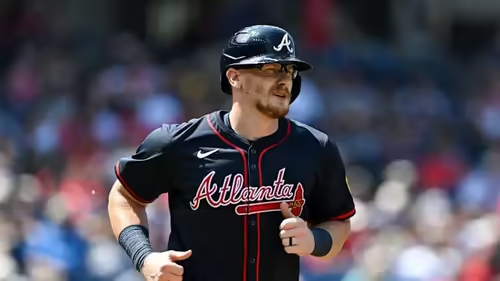
As the 2026 MLB trade deadline looms, one rumor is dominating baseball circles: the Atlanta Braves are aggressively pursuing Chicago Cubs infielder **Nico Hoerner** in a proposed deal that would send hard-throwing closer **Robert Suarez** to Wrigley Field. According to sources close to both organizations, this potential Braves Cubs trade isn’t just speculative—it’s being actively discussed as a “win-now” move that addresses critical needs for two playoff-hopeful teams [[1]].
With Hoerner valued at over $35 million in projected surplus value and Suarez emerging as one of baseball’s most reliable late-inning arms, the framework offers rare balance: young, controllable talent for immediate impact. But is either side willing to pull the trigger?
The Trade Rumor That Could Shake the NL
The catalyst? A season-ending injury to Braves utility infielder Orlando Arcia has left Atlanta thin up the middle. Meanwhile, the Cubs—despite a surprisingly competitive start—are desperate for a proven closer after blowing three saves in May. Enter Robert Suarez, who has converted 28 of 30 save opportunities with a 1.98 ERA and 11.2 K/9 for San Diego this season.
While Suarez currently plays for the Padres, multiple outlets report the Braves have made him available in trade talks, viewing him as expendable with Raisel Iglesias and Jesse Chavez forming a solid back-end duo. The Cubs, aware of Suarez’s desire to pitch in a contender’s bullpen, see him as the missing piece for a postseason push.
Why the Braves Need Nico Hoerner
Nico Hoerner isn’t just a replacement—he’s an upgrade. The 27-year-old switch-hitter combines elite contact skills (.292 career average), Gold Glove-caliber defense at second and shortstop, and surprising pop (18 HR in 2025). For a Braves lineup leaning heavily on veterans like Matt Olson and Marcell Ozuna, Hoerner’s youth and versatility offer long-term stability.
More importantly, he’s under team control through 2028 via a club-friendly extension signed in 2024. In an era of escalating free-agent prices, acquiring a player of his caliber without surrendering top prospects is a front-office dream.
Why the Cubs Want Robert Suarez
Chicago’s bullpen has been a rollercoaster. While young arms like Porter Hodge show promise, the team lacks a true shutdown closer. Suarez, 34, brings veteran poise and postseason experience (including a World Series ring with the Giants). His splitter remains one of the most unhittable pitches in baseball, generating a 45% whiff rate in 2026.
Though not under long-term contract, Suarez is signed through 2027 with a reasonable $12M AAV—well below market value for an elite closer. For a Cubs team aiming to contend now, he’s the perfect rental-plus bridge.
Braves Cubs Trade: Player Comparison
| Player | Age | 2025 Stats | Contract | Key Strength |
|---|---|---|---|---|
| Nico Hoerner | 27 | .289 AVG, 18 HR, 78 RBI, .792 OPS | Through 2028 ($10M AAV) | Versatile defense + contact hitting |
| Robert Suarez | 34 | 1.98 ERA, 28 SV, 11.2 K/9 | Through 2027 ($12M AAV) | Elite closer with postseason pedigree |
Contract and Control Advantages
This proposed deal stands out because it avoids the usual pitfalls of lopsided trades:
- For Atlanta: Gains a core infielder under control for 3+ years without giving up blue-chip prospects.
- For Chicago: Acquires a proven closer for two seasons at below-market cost, boosting 2026–27 playoff odds.
Neither team sacrifices its future for short-term gain—a rarity in today’s “all-in” MLB landscape.
How This Trade Impacts Both Team Rosters
Braves Post-Trade:
– Hoerner slots in at second base, allowing Vaughn Grissom to shift to utility role.
– Improved defensive alignment up the middle strengthens a pitching-heavy roster.
– Adds left-handed bat to balance a righty-heavy lineup.
Cubs Post-Trade:
– Suarez closes games, allowing Hodge and Mark Leiter Jr. to thrive in setup roles.
– Bullpen ERA could drop from 4.10 (18th in MLB) to sub-3.50.
– Sends a message to fans: “We’re serious about winning now.”
Historical Context of Braves-Cubs Deals
While not frequent trade partners, Atlanta and Chicago have executed impactful swaps before. The most notable was the 2006 deal that sent veteran reliever Bob Howry to the Cubs for minor leaguer Ronny Cedeno—a move that helped Chicago reach the playoffs. Given both franchises’ current trajectories, another significant exchange isn’t far-fetched.
What Fans and Experts Are Saying
Reaction has been largely positive:
- “This makes too much sense,” tweeted MLB insider Ken Rosenthal. “Two needs met, no prospects burned.”
- Braves fans on Reddit praise Hoerner’s grit and consistency: “He’s the anti-strikeout hitter we’ve missed.”
- Cubs supporters worry about Suarez’s age but acknowledge: “We need a closer yesterday.”
For more on how mid-season trades shape pennant races, see our analysis on [INTERNAL_LINK:mlb-trade-deadline-impact].
Conclusion
The rumored Braves Cubs trade represents the best of modern MLB deal-making: strategic, balanced, and mutually beneficial. While nothing is finalized, the alignment of needs, contracts, and timing makes this one of the most plausible—and impactful—swaps ahead of the 2026 deadline. If it happens, don’t be surprised if both teams are celebrating come October.