Bombay HC’s Ultimatum: Fix Mumbai’s Air Pollution or Lose Your Salary
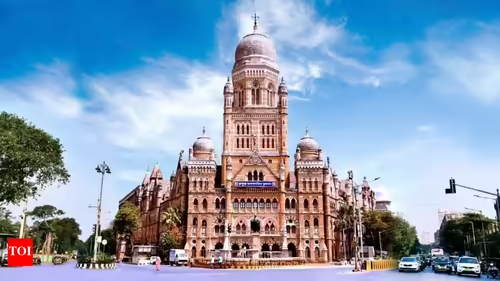
Mumbai, a city that never sleeps, is now gasping for breath. And its civic guardians are on the brink of losing their paychecks because of it. In a landmark and scathing hearing this week, the Bombay High Court delivered a powerful ultimatum to the Brihanmumbai Municipal Corporation (BMC) and the Navi Mumbai Municipal Corporation (NMMC): demonstrate a genuine, immediate, and effective effort to combat the city’s deteriorating air quality, or the commissioners will not see their next salary.
This isn’t just a stern talking-to; it’s a direct financial threat from the highest judicial authority in the state, signaling a new era of accountability for environmental governance. With Mumbai’s Air Quality Index (AQI) consistently hovering in the ‘Poor’ category, the court’s patience has run out.
Table of Contents
- The Court’s Scathing Indictment
- Mumbai’s Alarming AQI Reality
- BMC and NMMC Under the Microscope
- What Does This Mean for Civic Accountability?
- Conclusion: A Watershed Moment for Mumbai
- Sources
The Court’s Scathing Indictment
The Bombay High Court’s frustration was palpable. The bench didn’t mince words, accusing the civic bodies of showing a “belligerent disregard” for its previous orders on pollution control . The trigger for this harsh stance was the perceived insincerity in the affidavits submitted by the NMMC and BMC, which the court felt were mere paperwork exercises devoid of real action on the ground.
The judges’ message was crystal clear: “We propose to pass an order directing the Commissioner, NMMC not to draw his salary till further orders are passed by this court,” with a similar warning extended to the BMC chief . This proposal is a direct consequence of the authorities’ failure to enforce existing regulations and implement promised mitigation strategies effectively . It’s a move designed to cut through bureaucratic inertia and force immediate, tangible results.
Mumbai’s Alarming Air Pollution Reality
The court’s anger is rooted in hard data. As of January 24, 2026, Mumbai’s air quality paints a grim picture. Multiple monitoring stations report AQI levels deep in the ‘Poor’ category. Real-time data shows readings as high as 156 at the US Consulate station, which falls into the ‘Unhealthy’ bracket for sensitive groups . Other sources place the city-wide average around 147-148, a level that poses significant health risks to the general population [[10], [11]].
To put this in perspective, an AQI between 101-200 is classified as ‘Poor,’ meaning even healthy individuals may begin to experience respiratory symptoms, while those with heart or lung disease, children, and older adults should avoid prolonged outdoor exertion. This is not a temporary spike; it’s a chronic crisis that demands urgent intervention.
BMC and NMMC Under the Microscope
The court’s directive puts the spotlight squarely on the two primary urban local bodies responsible for the region’s environment. While both corporations have previously submitted affidavits listing various Mumbai air pollution control measures—such as dust suppression at construction sites and actions against industrial polluters—the judiciary is no longer satisfied with promises on paper [[19], [24]].
The key issue appears to be a massive gap between policy and enforcement. The court noted a lack of sincere effort and a failure to translate these listed measures into a visible, measurable improvement in air quality . The situation in Navi Mumbai, in particular, drew sharp criticism, with the court questioning the very foundation of the NMMC’s affidavit . This suggests that the problem isn’t just a lack of plans, but a systemic failure in execution and oversight.
What Does This Mean for Civic Accountability?
The High Court’s threat to withhold the commissioner’s salary is a radical step that redefines accountability in public office. Traditionally, civic chiefs operate with a degree of insulation from direct financial penalties for departmental failures. This move shatters that norm.
Here’s why this is a potential game-changer:
- Personal Stakes: It directly ties the personal financial well-being of the top official to the performance of their department on a critical public health issue.
- Breaking Bureaucratic Silos: It forces the commissioner to mobilize every resource within the BMC, cutting across departments to address the crisis with a singular focus.
- A Precedent for Other Cities: If successful, this could set a powerful precedent for other Indian cities grappling with environmental degradation, showing that judicial bodies are willing to impose concrete consequences for inaction.
This approach aligns with the growing global understanding that clean air is a fundamental right, not a privilege. For more on the global context of urban air quality management, you can refer to resources from the World Health Organization (WHO).
Conclusion: A Watershed Moment for Mumbai
The Bombay High Court’s ultimatum is more than just a headline; it’s a watershed moment for Mumbai’s fight against air pollution. By threatening the purse strings of its most powerful civic officers, the judiciary has sent an unambiguous message: the status quo is unacceptable. The health of millions of Mumbaikars is at stake, and paper promises are no longer enough. The ball is now firmly in the BMC and NMMC’s court. Their immediate, transparent, and effective action over the coming days and weeks will determine not only the city’s air quality but also the fate of their leadership’s compensation. For residents, this is a long-overdue push for a cleaner, healthier, and more livable Mumbai.
Sources
- Times of India: Will stop BMC chief’s salary if AQI doesn’t improve: Bombay HC
- NDTV: Bombay HC halts NMMC chief’s salary, raps BMC over failure to curb air pollution
- AQICN: Mumbai Air Quality Index (AQI)
- The Weather Channel: Mumbai AQI Today
- World Health Organization: Ambient (outdoor) air pollution