Introduction: From Elements of Doom to a Dose of Levity
When you think of Deepa Mehta, grand, emotionally searing epics like the ‘Elements Trilogy’—Fire, Earth, and Water—likely come to mind. Her work is known for its unflinching look at social injustice, tradition, and human suffering. So, it’s a delightful surprise to learn that the same visionary director once sought refuge from that very gravity by writing a light-hearted romantic comedy in record time. In an exclusive reflection, Mehta revealed that she wrote the script for Bollywood Hollywood in just two months, calling it “just the medicine I needed” [1]. Far from being a simple rom-com, the 2002 film is a sharp, affectionate satire of the NRI (Non-Resident Indian) experience—a topic that remains strikingly relevant today.
Table of Contents
- Bollywood Hollywood Deepa Mehta: The Origin Story
- Not About Bollywood—But About ‘Home’
- The Casting Coup: Rahul Khanna and Lisa Ray
- Why the Film Resonates with NRIs Today
- A Departure That Became a Cult Classic
- Conclusion: The Power of Playful Storytelling
- Sources
Bollywood Hollywood Deepa Mehta: The Origin Story
After the intense backlash and production struggles surrounding her film Water in the late 1990s, Mehta found herself creatively and emotionally drained. She needed a palate cleanser—a project that was joyful, uncomplicated, and fun. “I’d just come out of the trauma of Water being shut down… I needed something that was the complete opposite,” she recalled [1].
That ‘something’ became Bollywood Hollywood. Written in a swift and inspired two-month burst in 2001, the script was Mehta’s conscious escape from the weight of her previous work. It was her “medicine”—a playful, self-aware comedy that allowed her to explore a different side of her storytelling without the burden of heavy political or social commentary.
Not About Bollywood—But About ‘Home’
Despite its title, Bollywood Hollywood is not a film about the Indian film industry. Mehta is quick to clarify this common misconception. “The title is ironic,” she explained. “The film isn’t about cinema at all. It’s about the emotional ties that bind an NRI family to their idea of India” [1].
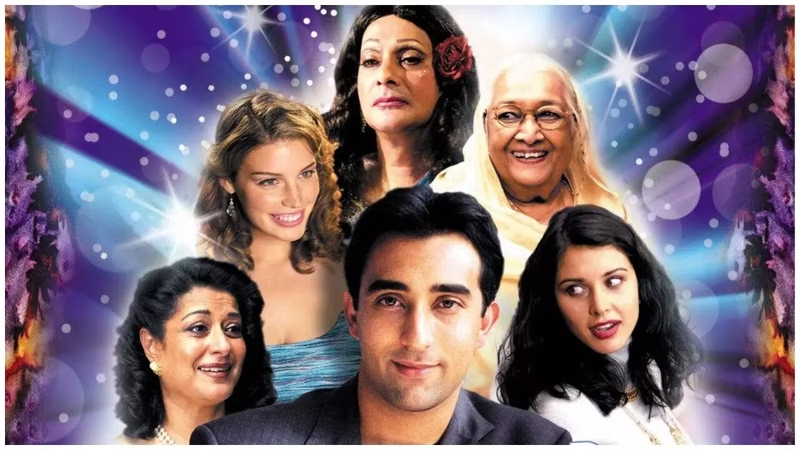
The story follows Rahul Seth (Rahul Khanna), a wealthy Toronto-based NRI bachelor who, under pressure from his traditional parents to marry an Indian girl, hires a South Asian escort, Sue (Lisa Ray), to pose as his fiancée. What unfolds is a clever exploration of identity, assimilation, and the cultural ironies faced by the diaspora. The film humorously dissects the Seth family’s performative Indianness—complete with saris, bhajans, and a deep, often comical, yearning for a homeland many of them have never truly lived in.
The Casting Coup: Rahul Khanna and Lisa Ray
Mehta’s casting choices were instrumental to the film’s charm and authenticity. She paired the charming, everyman appeal of Rahul Khanna—a star on the rise after 1942: Love Story—with the then-newcomer Lisa Ray, whose grace and wit made her the perfect counterpoint.
Adding further depth were veteran actors Moushumi Chatterjee and Kulbhushan Kharbanda, who played Rahul’s parents. Their performances grounded the film’s satire in genuine warmth and familial love, preventing the humor from ever becoming mean-spirited. Mehta noted that their presence lent the film a “classic Bollywood family feel,” which was essential to its ironic tone [1].
Why the Film Resonates with NRIs Today
Over two decades later, Bollywood Hollywood feels more relevant than ever. The NRI experience it captures—of navigating dual identities, the pressure to conform to cultural expectations from afar, and the often-absurd lengths taken to preserve tradition—is a reality for millions across the globe.
In an age of global migration and digital connectivity, where second- and third-generation diaspora youth grapple with questions of belonging, Mehta’s film offers a gentle, humorous mirror. Its enduring appeal lies in its empathy; it laughs with its characters, not at them. This is why it has achieved cult status among South Asian communities worldwide, from Canada to the UK to Australia.
A Departure That Became a Cult Classic
While Bollywood Hollywood was a stylistic departure for Mehta, it proved that her talents weren’t confined to hard-hitting drama. The film was a critical and commercial success in Canada and among diaspora audiences, demonstrating her versatility as a storyteller.
It also stands as a testament to the creative necessity of play. Sometimes, the most powerful artistic statements aren’t born from pain, but from the simple, human need for joy and levity. By allowing herself that space, Mehta created a work that, while lighter in tone, is no less insightful about the human condition—and the peculiar, poignant comedy of cultural displacement.
Conclusion: The Power of Playful Storytelling
Deepa Mehta’s revelation about the Bollywood Hollywood writing process is a powerful reminder that great art can emerge from many places—even from a desire to simply have fun. In a career defined by courage and confrontation, this joyful, two-month detour stands as a unique and beloved chapter. It’s a film that doesn’t just entertain; it invites us to laugh at the beautiful absurdities of trying to belong in two worlds at once. And in today’s complex global landscape, that’s a message—and a medicine—we could all use.
Sources
[1] “Exclusive | Did you know Deepa Mehta wrote ‘Bollywood Hollywood’ in just two months?”, Times of India
[2] Archival interviews and commentary on Deepa Mehta’s filmography
[3] Analysis of NRI representation in 2000s Indian cinema