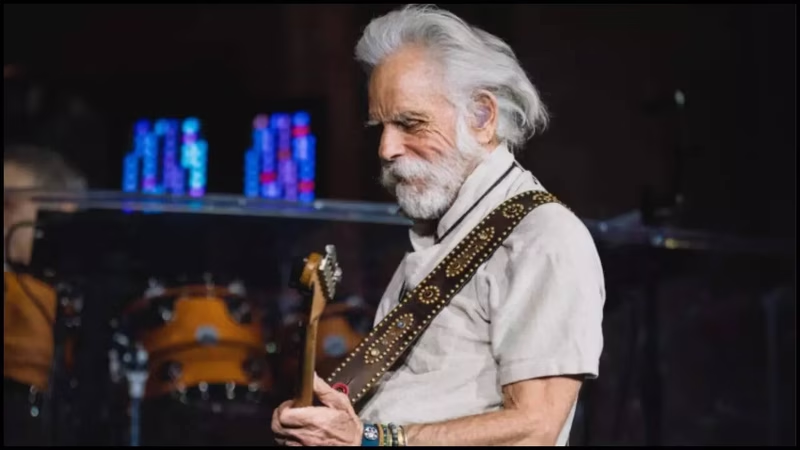
The final chord has rung out for one of rock ‘n’ roll’s most enduring figures. Bob Weir, the visionary rhythm guitarist and founding member of the Grateful Dead, has died at the age of 78. His spokesperson confirmed the news, stating that his death was the result of complications from a long and private battle with cancer, with lung-related issues being the final cause .
Weir’s passing marks the end of an era. He wasn’t merely a sideman in one of America’s most influential bands; he was a co-architect of a sprawling, decades-long musical experiment that redefined live performance and fostered a global community of fans known as “Deadheads.” His unique guitar style, characterized by its complex jazz-influenced chords and interlocking rhythms with Jerry Garcia, was the bedrock upon which the Dead’s improvisational magic was built. Today, we remember his fiery spirit, his unwavering dedication to his craft, and a legacy he once said was meant to “last for centuries” .
Table of Contents
- The Official Announcement of Bob Weir Death
- A Life in Music: The Grateful Dead Journey
- Beyond the Dead: Weir’s Solo and Collaborative Work
- The Deadhead Phenomenon: Building a Musical Community
- Tributes Pour In From Across the Music World
- Conclusion: An Enduring Legacy
- Sources
The Official Announcement of Bob Weir Death
The news of Bob Weir death was delivered with a sense of profound loss by his longtime spokesperson. The statement confirmed that Weir had been fighting cancer for some time, and his health had recently declined due to complications stemming from his lungs . The family has requested privacy during this difficult period, while also expressing their gratitude for the outpouring of love and support from fans around the world.
This announcement has sent shockwaves through the global music community, with fans lighting candles, sharing favorite concert recordings, and posting tributes on social media using the hashtag #ThankYouBob.
A Life in Music: The Grateful Dead Journey
Weir’s story is inseparable from the Grateful Dead. He co-founded the band in 1965 in Palo Alto, California, alongside Jerry Garcia, Ron “Pigpen” McKernan, Phil Lesh, and Bill Kreutzmann. At just 17 years old, he was the youngest member, but his musical intuition was far beyond his years.
Over the next three decades, the Dead became a cultural phenomenon. They were pioneers of the psychedelic rock scene and masters of the live jam, where no two performances of a song were ever the same. Weir’s role was crucial; while Garcia was the lead voice, Weir’s intricate rhythm work provided the harmonic canvas that allowed the entire band to explore. Hits like “Truckin’,” “Sugar Magnolia,” and “Casey Jones” showcased his songwriting and vocal talents, making him a beloved frontman in his own right.
Beyond the Dead: Weir’s Solo and Collaborative Work
Even after the Grateful Dead officially disbanded following Jerry Garcia’s death in 1005, Weir never stopped creating music. He embarked on a prolific solo career and formed several new projects to keep the spirit alive, including:
- RatDog: A versatile band that explored a wide range of American roots music.
- Furthur: Formed with former Dead bassist Phil Lesh, this group directly carried the torch of the Grateful Dead’s live legacy.
- Dead & Company: A hugely successful collaboration with John Mayer, Oteil Burbridge, and Jeff Chimenti that introduced the Dead’s music to a whole new generation of fans.
[INTERNAL_LINK:bob-weir-musical-evolution] details his journey from the Acid Tests to stadium tours with Dead & Company.
The Deadhead Phenomenon: Building a Musical Community
Perhaps Weir’s greatest contribution was not just the music he made, but the community he helped build. The Grateful Dead actively encouraged fans to record and trade their live shows, fostering a culture of sharing and deep musical appreciation. This created the “Deadhead” nation—a loyal, nomadic family of fans who followed the band across the country, creating a unique subculture that persists to this day.
Weir understood that the band’s relationship with its audience was symbiotic. The energy from the crowd fueled their improvisations, making every concert a unique, communal event. This philosophy of music as a shared, living experience is a core part of his legacy.
Tributes Pour In From Across the Music World
Following the news of his passing, an avalanche of tributes has flooded in from fellow musicians and cultural icons. Artists like Elton John, Bruce Springsteen, and members of Phish have all shared heartfelt messages, praising Weir’s genius, his kindness, and his unwavering commitment to his artistic vision .
His influence can be heard in countless jam bands and artists who value improvisation and audience connection over polished studio perfection.
Conclusion: An Enduring Legacy
The Bob Weir death is a monumental loss for American music. He was more than a guitarist; he was a cultural architect whose work transcended genre and generation. From the smoky clubs of San Francisco to the biggest stages in the world, he played with a passion and a spirit that was utterly infectious. As he once hoped, his legacy is indeed built to last for centuries, living on in every note played by a new band inspired by his freedom, and in every fan who finds community through his music.
Sources
- Official statement from Bob Weir’s spokesperson confirming his death and cause .
- Historical quotes and context on Weir’s view of the Grateful Dead’s legacy .
- Reports on the widespread tributes from the music industry .
- [INTERNAL_LINK:history-of-the-grateful-dead]
- Rock & Roll Hall of Fame – Official Website