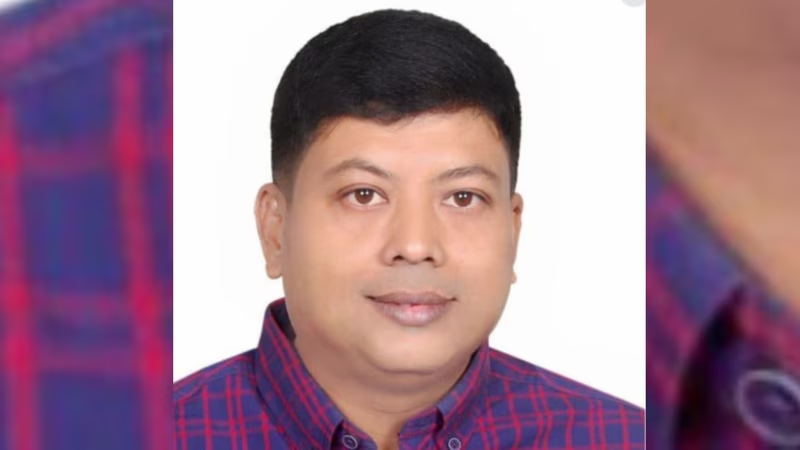
BNP Youth Leader Assassinated in Dhaka: Political Violence Erupts in Bangladesh’s Capital
In a chilling escalation of political unrest, Azizur Rahman Musabbir—a senior leader of the Bangladesh Nationalist Party’s (BNP) volunteer wing, Swechchhasebak Dal—was gunned down in broad view of Dhaka’s bustling Karwan Bazar on Tuesday night. The targeted assassination, which also left fellow activist Sufian Byapari Masud injured, has sent shockwaves through the country’s fragile democratic landscape. Within hours, around 200 BNP activists descended on the crime scene, staging an impassioned protest and demanding justice. Police have confirmed the incident but have yet to identify suspects or a motive—though many point to the increasingly volatile climate of political intimidation in Bangladesh .
Table of Contents
- Who Was Azizur Rahman Musabbir?
- The Karwan Bazar Attack: Timeline and Details
- BNP Protests and Public Outcry
- Historical Context: Political Violence in Bangladesh
- Government Response and Investigation
- Implications for Bangladesh’s Political Future
- Conclusion
- Sources
Who Was Azizur Rahman Musabbir?
Musabbir, 38, was not just a grassroots organizer—he was a rising figure in the BNP’s youth mobilization strategy. As a leader of the Swechchhasebak Dal, the party’s dedicated volunteer corps, he played a key role in coordinating rallies, managing local party logistics, and engaging students and young professionals in opposition politics.
Colleagues describe him as “fearless” and “deeply committed to democratic restoration.” His death is seen as a major blow to the BNP’s efforts to rebuild its street presence after years of government crackdowns that saw thousands of its leaders and supporters jailed or driven into exile .
The Karwan Bazar Attack: Timeline and Details
According to eyewitnesses and police reports, the attack occurred shortly after 8:30 PM local time on Tuesday in the Karwan Bazar commercial district—a high-traffic area known for its markets, eateries, and political rallies.
Musabbir and Masud were reportedly walking near a local BNP office when two unidentified assailants on a motorcycle pulled up and opened fire at close range. Musabbir was hit multiple times in the chest and head and died instantly. Masud, critically wounded, was rushed to Dhaka Medical College Hospital, where he remains in stable condition.
The entire incident lasted less than 15 seconds. The attackers fled immediately, and no arrests have been made as of this reporting.
BNP Protests and Public Outcry
Within an hour of the shooting, approximately 200 BNP activists gathered at the scene, chanting slogans like “We want justice!” and “Down with fascist rule!” They blocked roads, set small fires, and demanded the immediate arrest of the perpetrators.
The BNP’s central leadership issued a strongly worded statement, blaming the ruling Awami League government for fostering a “culture of impunity” that enables political assassinations. “This is not an isolated incident—it is state-sponsored terrorism,” said BNP Secretary General Mirza Fakhrul Islam Alamgir .
Human rights organizations, including Human Rights Watch, have long documented extrajudicial killings and enforced disappearances targeting opposition figures in Bangladesh, particularly since 2018.
Historical Context: Political Violence in Bangladesh
Bangladesh has a tragic history of political killings, especially during periods of heightened electoral tension. The BNP and Awami League—the country’s two dominant parties—have been locked in a bitter power struggle for decades.
Notable past incidents include:
- 2004 Dhaka grenade attack: Over 20 killed in an assassination attempt on BNP-turned-opposition leader Sheikh Hasina.
- 2013–2018: Hundreds of BNP and Jamaat-e-Islami activists killed or disappeared during Awami League’s crackdown.
- 2024: Multiple BNP student leaders attacked ahead of planned nationwide protests.
Analysts warn that Musabbir’s killing could reignite this cycle of retaliation and unrest—particularly as Bangladesh moves closer to its next general election, expected in 2028 but potentially brought forward due to political pressure.
Government Response and Investigation
The Home Ministry has promised a “swift and impartial” investigation. Dhaka Metropolitan Police (DMP) officials say they are reviewing CCTV footage and have formed a special task force.
However, opposition parties remain skeptical. “Every time an opposition leader is killed, the government forms a committee—and nothing happens,” said a senior BNP lawmaker who requested anonymity for safety reasons.
International observers, including the United Nations and the European Union, have called on Bangladeshi authorities to ensure a transparent probe and protect political dissent—a core tenet of any functioning democracy.
Implications for Bangladesh’s Political Future
The assassination of a BNP youth leader shot dead in such a brazen manner signals a dangerous new phase in Bangladesh’s political crisis. With youth engagement already declining due to fear and disillusionment, such violence risks further depoliticizing a generation crucial to the country’s democratic future.
Moreover, if the perpetrators are linked to state actors or ruling-party affiliates—as many suspect—it could trigger international sanctions, damage investor confidence, and isolate Bangladesh on the global stage.
Conclusion
The murder of Azizur Rahman Musabbir is more than a tragic loss—it’s a stark reminder of the perils facing political opposition in Bangladesh today. As the BNP mobilizes for justice and the government scrambles to contain fallout, the world must watch closely. Without accountability, such targeted killings will only deepen the country’s democratic deficit and fuel further instability. For more on South Asian political dynamics, see our analysis on [INTERNAL_LINK:democracy-in-crisis-bangladesh-and-pakistan-compared].
Sources
- Times of India: BNP youth leader shot dead in Dhaka’s Karwan Bazar
- Human Rights Watch – Bangladesh: Documentation of Political Violence
- Al Jazeera: Coverage of the Karwan Bazar Shooting
- BNP Official Statement (via Prothom Alo): BNP Condemns Musabbir Killing
- Dhaka Tribune: Police Confirm Karwan Bazar Shooting