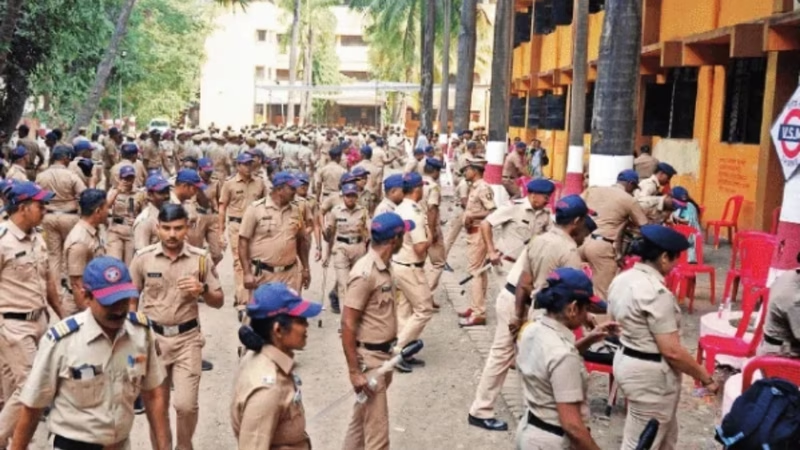
Mumbai is no stranger to election drama—but this time, the tension isn’t coming from tight races or last-minute alliances. It’s coming from the counting booth itself. For the 2026 Brihanmumbai Municipal Corporation (BMC) elections, the Election Commission has introduced a radical new approach: a phased vote count that limits result declarations to just 46 wards per day out of the city’s total 227.
The move, intended to “ensure accuracy and prevent technical glitches,” has instead ignited frustration among candidates, political parties, and citizens alike. With polling concluded on January 13, many expected a full tally by January 14—just like in 2017. Instead, they’re now staring at a multi-day wait, with some wards not seeing results until January 18 or later.
“Why change the system now?” asked a frustrated independent candidate from Andheri West. “In 2017, we had all results in one day. What’s broken that needed fixing?”
This shift isn’t just logistical—it’s political. In a high-stakes election where control of India’s richest civic body hangs in the balance, every hour of delay fuels speculation, rumors, and strategic maneuvering. So what’s really behind this slow-lane counting—and who stands to gain?
Table of Contents
- What Is the New BMC Vote Count Process?
- Why the Change From 2017?
- Candidate and Party Reactions
- Technical vs. Political Motives
- Impact on Voters and Transparency
- How Other Cities Handle Large Election Counts
- What to Expect in the Coming Days
- Conclusion: A Test of Electoral Trust
- Sources
What Is the New BMC Vote Count Process?
Unlike the 2017 BMC elections—where all 227 wards were counted simultaneously on a single day—the 2026 process is being rolled out in five phases:
- Day 1 (Jan 14): Results for up to 46 wards
- Day 2 (Jan 15): Next 46 wards
- Day 3 (Jan 16): Another 46 wards
- Day 4 (Jan 17): 46 more wards
- Day 5 (Jan 18): Final 43 wards
According to the Mumbai District Election Officer, this staggered approach allows officials to “dedicate full attention to each batch,” reducing errors and ensuring EVM-VVPAT verification is thorough. Counting centers will operate in shifts, with enhanced cybersecurity protocols.
Why the Change From 2017?
Election authorities cite three main reasons:
- Increased Ward Count: The number of wards rose from 227 to 234 in 2022 (though still contested as 227 in 2026 due to delimitation disputes).
- AI and Deepfake Threats: Fears of real-time misinformation prompted a “controlled information release” strategy.
- Staff Shortages: Limited trained personnel necessitate a phased deployment.
However, critics argue these justifications don’t hold water. “We managed 227 wards in one day before,” said a senior BJP leader. “This feels like artificial delay.”
Candidate and Party Reactions
Reactions have been swift and sharp across the spectrum:
- Shiv Sena (UBT): Accused the state government of “buying time” to influence close contests.
- BJP: Demanded live streaming of all counting halls to ensure transparency.
- INC: Called the move “undemocratic” and filed a formal complaint with the State Election Commission.
- Independent Candidates: Many report financial strain, as campaign teams must stay on standby for days longer than budgeted.
[INTERNAL_LINK:mumbai-bmc-election-2026-key-wards-to-watch] highlights constituencies where delays could sway outcomes.
Technical vs. Political Motives
While officials insist the decision is purely administrative, political analysts see subtext. A prolonged count gives ruling parties more time to negotiate with independents or swing-vote corporators—a tactic historically used in BMC floor tests.
“In a hung house scenario, every extra hour is leverage,” explains Dr. Meera Desai, a political sociologist at TISS. “This isn’t about efficiency—it’s about control.”
Impact on Voters and Transparency
For ordinary Mumbaikars, the delay breeds confusion and distrust. Social media is already flooded with unverified claims of “rigging” and “missing votes.” Without a clear, centralized dashboard showing real-time progress, misinformation spreads faster than official updates.
Moreover, media outlets struggle to provide coherent coverage when results trickle in piecemeal—diluting public engagement and accountability.
How Other Cities Handle Large Election Counts
Mumbai isn’t alone in managing large civic polls—but its approach is unusual:
- Delhi (2023): All 70 wards counted in one day with live webcast.
- Kolkata (2021): Simultaneous count across 144 wards; results within 12 hours.
- Chennai (2022): Used AI-assisted EVM verification but still declared all results in 24 hours.
These examples suggest Mumbai’s phased model is an outlier—not a best practice.
For authoritative guidelines on election integrity, the Election Commission of India’s official portal outlines standard operating procedures for urban local body polls.
What to Expect in the Coming Days
As counting begins on January 14, watch for:
- Protests outside counting centers if discrepancies arise.
- Court petitions challenging the phased process.
- Last-minute party-hopping if early results signal a hung corporation.
The final composition of the BMC—and who becomes Mayor—may not be clear until late Friday or even Saturday.
Conclusion: A Test of Electoral Trust
The BMC vote count controversy is more than a procedural hiccup—it’s a stress test for Mumbai’s democratic fabric. In a city where civic governance affects everything from water supply to waste management, timely and transparent elections aren’t a luxury; they’re a necessity. If the Election Commission wants public trust, it must prove this phased approach serves voters—not just bureaucrats or backroom negotiators.
Sources
- Times of India: “Polling tomorrow, counting to be phase-wise…” (January 13, 2026)
- Mumbai District Election Office – Press Briefing (Jan 12, 2026)
- Election Commission of India – Guidelines for ULB Elections 2025
- Interview with Dr. Meera Desai, Tata Institute of Social Sciences (TISS)
- Election Commission of India (ECI): https://eci.gov.in/