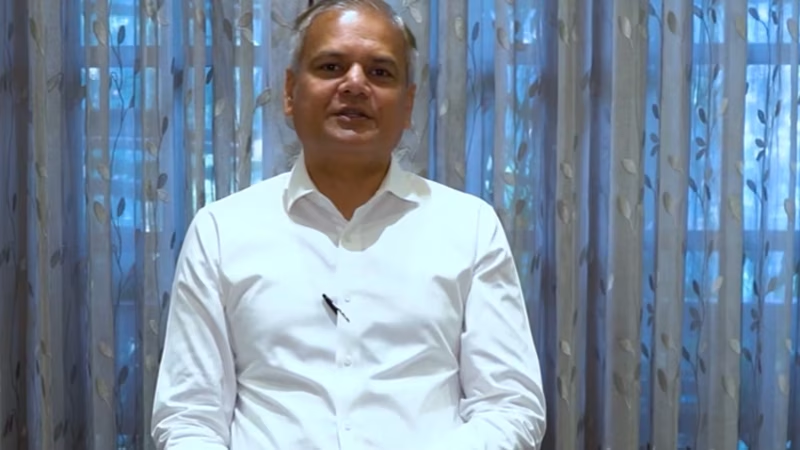
The stage is set for Mumbai’s most crucial civic election, but the spotlight isn’t just on manifestos and promises—it’s on bank balances. The latest affidavits filed for the BMC polls have revealed a jaw-dropping financial landscape, where the richest candidate boasts assets worth a staggering ₹124 crore, while others are fighting an uphill battle with little more than their commitment to public service. This isn’t just an election; it’s a masterclass in India’s deepening political wealth divide.
Table of Contents
- The Richest of the Rich: Makrand Narwekar’s Staggering Wealth
- Beyond the Top: A Closer Look at BMC Polls Crorepati Candidates
- The Other Side of the Coin: The Commoners Running for Office
- Why the Wealth Gap in BMC Elections Matters
- Conclusion: A Tale of Two Mumbais
- Sources
The Richest of the Rich: Makrand Narwekar’s Staggering Wealth
At the very top of the wealth pyramid stands BJP candidate Makrand Narwekar, the younger brother of Maharashtra Assembly Speaker Rahul Narwekar. His affidavit for the BMC elections has declared assets worth a colossal ₹124.4 crore . This figure isn’t just a number; it’s a statement. It represents a significant jump from previous election cycles and instantly makes him one of the wealthiest contenders in the entire civic body race .
Running from Ward 226, Makrand Narwekar’s entry into the political arena, backed by such immense personal wealth, raises critical questions about the nature of representation in India’s financial capital. His candidacy is a powerful symbol of the entrenched nexus between political power and personal fortune that often dominates Indian electoral politics .
Beyond the Top: A Closer Look at BMC Polls Crorepati Candidates
Makrand Narwekar may be the current frontrunner, but he is far from alone in the crorepati club. The affidavits paint a picture of a civic election dominated by the wealthy. In fact, a significant portion of the total candidates are self-declared crorepatis .
This trend is not isolated to Mumbai. A recent analysis of the 2024 Lok Sabha elections found that a staggering 93% of the winning candidates were crorepatis . This national pattern seems to be firmly replicated at the local level in the BMC polls, suggesting that substantial personal wealth has become a near-prerequisite for a serious run at public office. While other names like BJP’s Parag Shah (with declared assets of ₹690 crore) have also been reported in past elections, the current cycle’s affidavits confirm that the bar for financial entry is set extremely high .
The Other Side of the Coin: The Commoners Running for Office
In a striking and almost poetic contrast to the world of multi-crore assets, the BMC elections also feature candidates whose lives are a world away from such opulence. The affidavits include individuals like a humble pan vendor and a rickshaw driver, who have declared modest assets that reflect their everyday struggles .
These candidates represent the true spirit of grassroots democracy. They are not running on the back of vast financial resources or dynastic connections. Instead, they are banking on their deep connection to their communities and a genuine desire to serve. Their presence on the ballot is a powerful reminder that the fight for a better Mumbai isn’t just for the elite; it belongs to every citizen who dares to dream of a seat at the table. Their candidacies are a direct challenge to the notion that only the wealthy can effectively represent the people.
Why the Wealth Gap in BMC Elections Matters
The extreme disparity in candidate wealth is more than just a statistic; it has profound implications for governance and representation. A council dominated by the super-rich may find it difficult to truly empathize with or prioritize the needs of the city’s vast working-class and lower-income populations. Issues like affordable housing, accessible public transport, and basic sanitation—critical for millions of Mumbaikars—can easily be overshadowed by agendas that cater to a more affluent constituency.
Furthermore, the high cost of running a credible campaign in a city as vast and competitive as Mumbai creates a systemic barrier for qualified individuals without deep pockets. This effectively narrows the pool of potential leaders, potentially excluding brilliant minds and passionate community advocates simply because they lack the financial muscle. The result is a civic body that may not be a true mirror of the diverse and complex city it is meant to serve.
Conclusion: A Tale of Two Mumbais
The 2026 BMC polls richest candidate narrative, centered on Makrand Narwekar’s ₹124 crore fortune, is just one half of the story. The other half is written by the pan vendor and the rickshaw driver, whose candidacies are acts of quiet defiance against a system that increasingly favors the wealthy. This election is a microcosm of Mumbai itself—a city of impossible contrasts, where unimaginable wealth exists side-by-side with grinding poverty. The ultimate question for voters is not just who will win, but which version of Mumbai they want their representatives to fight for. Will it be the city of skyscrapers and stock portfolios, or the city of chawls and street-side livelihoods? The answer will shape Mumbai’s future for years to come.
Sources
- Times of India: BMC polls: Assembly speaker’s brother richest candidate; 35% of candidates crorepatis
- Press Trust of India (PTI): Maharashtra Assembly Speaker’s brother shows Rs 124 cr assets in BMC poll affidavit
- Association for Democratic Reforms (ADR): [INTERNAL_LINK:BMC_candidate_affidavits_analysis]