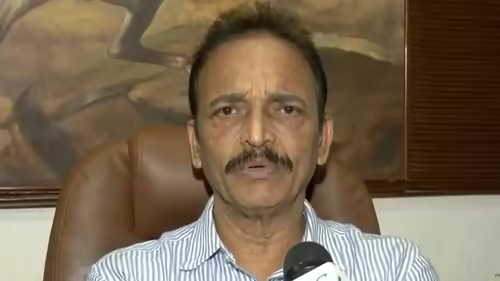
The dust has barely settled on Mumbai’s civic elections, but the aftershocks are already tearing through the Congress party. After suffering its worst-ever defeat in the Brihanmumbai Municipal Corporation (BMC) polls—a historic low that saw the party win fewer than 30 seats out of 236—the Mumbai unit is now engulfed in open rebellion.
In a dramatic escalation, former Mumbai Congress president Janak Desai has publicly called for the resignation of current city chief Varsha Gaikwad, citing “moral responsibility” for the electoral catastrophe. The backlash has forced the state leadership to issue a show-cause notice to Desai, accusing him of violating party discipline. But the damage is done: the BMC polls fiasco has exposed deep fractures in a party struggling to stay relevant in Maharashtra’s political chessboard.
Table of Contents
- The BMC Polls Disaster in Numbers
- Why Varsha Gaikwad Is Under Fire
- Internal Revolt and the Show-Cause Notice
- Congress Defense: Allegations of Misuse and Mismanagement
- Shifting Alliances and the Rising Shiv Sena Threat
- What Next for Mumbai Congress?
- Conclusion: A Party at a Crossroads
- Sources
The BMC Polls Disaster in Numbers
The scale of the Congress collapse in the BMC polls is staggering. Once the dominant force in Mumbai’s civic body, the party now holds just 27–29 seats—down from 84 in 2012 and even 31 in the last contested election . For context:
- Shiv Sena (Shinde faction): ~105 seats
- Shiv Sena (Thackeray faction): ~60 seats
- Bharatiya Janata Party (BJP): ~45 seats
- Congress: ~28 seats
This isn’t just a loss—it’s near-irrelevance in India’s financial capital. The party failed to win even in traditional strongholds like Dharavi, Bandra, and Dadar, where it once enjoyed unchallenged sway.
Why Varsha Gaikwad Is Under Fire
As Mumbai Congress president since 2022, Varsha Gaikwad—also a sitting MLA and former state minister—has borne the brunt of the blame. Critics within the party argue that her leadership was marked by:
- Poor candidate selection: Fielding weak or unpopular candidates in key wards.
- Lack of grassroots connect: Over-reliance on top-down campaigning while neglecting booth-level workers.
- Failure to counter BJP-Shiv Sena narrative: No coherent response to Hindutva or Marathi pride messaging.
- Internal factionalism: Inability to unify rival groups within the Mumbai unit.
“When you lose this badly, someone must take moral responsibility,” said Janak Desai in a press statement that triggered the current crisis .
Internal Revolt and the Show-Cause Notice
Desai’s public demand for Gaikwad’s resignation didn’t go unnoticed. Within 24 hours, the Maharashtra Pradesh Congress Committee (MPCC) issued him a show-cause notice, warning of disciplinary action for “indiscipline and damaging party unity.”
But many see this as a band-aid solution. “Slapping notices won’t win back voters,” said a senior Mumbai leader who spoke on condition of anonymity. “The anger is real, and it’s coming from the ground up.”
The episode highlights a recurring problem: the Congress’s tendency to suppress dissent rather than address systemic failures.
Congress Defense: Allegations of Misuse and Mismanagement
Not everyone agrees that Gaikwad alone is to blame. Party spokespersons have pushed back, arguing that the BMC polls were marred by “unfair advantages” enjoyed by rivals:
- Misuse of state machinery: Allegations that the ruling Mahayuti alliance (BJP-Shiv Sena-Shinde) used civic resources for campaigning.
- Voter suppression: Reports of voter ID mismatches and polling booth irregularities in Congress-leaning areas.
- Anti-incumbency against Maha Vikas Aghadi (MVA): Lingering resentment over the 2022 government collapse hurt Congress credibility.
“We fought under extraordinary constraints,” said a Congress communication team member. “This wasn’t just a loss—it was a targeted dismantling.”
Shifting Alliances and the Rising Shiv Sena Threat
The real story of the BMC polls isn’t just Congress’s decline—it’s the fragmentation and reconsolidation of Marathi identity politics. Both Shiv Sena factions together now control nearly 165 seats, proving that even a split can’t kill the party’s Mumbai dominance.
Meanwhile, the BJP has solidified its position as the second pole of power. For Congress, stuck in third place with no clear ideological differentiator, the path back looks increasingly narrow.
For deeper insights into Maharashtra’s evolving political map, see our [INTERNAL_LINK:maharashtra-politics-2026].
What Next for Mumbai Congress?
The party has announced plans for “organizational strengthening”—a euphemism for leadership reshuffles and worker re-engagement drives. But insiders say three outcomes are possible:
- Gaikwad survives: Backed by state leadership, she stays on but with reduced authority.
- Quiet exit: She’s moved to a central role, and a new face takes over Mumbai.
- Open split: Dissident leaders form a parallel group or defect, further weakening the unit.
Whichever path is chosen, rebuilding trust with Mumbai’s diverse electorate—from Dalits to Muslims to middle-class professionals—will require more than slogans.
Conclusion: A Party at a Crossroads
The BMC polls debacle is more than an electoral setback—it’s a symptom of the Congress’s identity crisis in urban India. With Varsha Gaikwad’s leadership under siege and internal unity fraying, the party must decide whether to cling to old hierarchies or embrace bold, grassroots renewal. In a city that never sleeps, Mumbai’s voters have sent a clear message: nostalgia won’t win seats. Only relevance will.
Sources
- Times of India: BMC polls setback: Ex-Mum Congress prez seeks Varsha Gaikwad’s resignation; party issues show-cause notice
- Election Commission of India: BMC Election 2026 Results Dashboard
- Association for Democratic Reforms (ADR): Analysis of Mumbai Civic Election Trends