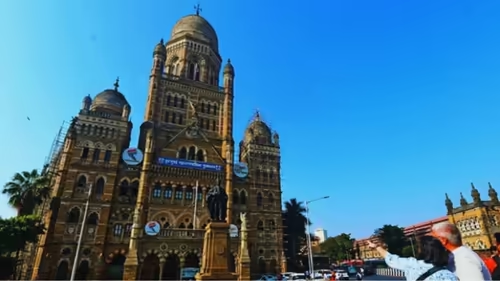
Mumbai’s political landscape just got a major shake-up. In a move that redefines representation in India’s richest civic body, the BMC mayoral race is now officially reserved for a woman from the general (unreserved) category. This decision, determined by a public lottery conducted by Maharashtra’s Urban Development Department, has ignited both hope and controversy across party lines .
The draw, held on January 22, 2026, wasn’t just about Mumbai—it set reservation categories for mayoral posts across all 29 municipal corporations in Maharashtra, balancing gender and caste-based representation as mandated by state law. But it’s the outcome for the Brihanmumbai Municipal Corporation (BMC)—which controls a budget larger than several Indian states—that has drawn national attention .
Table of Contents
- How the BMC Mayoral Race Reservation Works
- Why a General Category Woman Mayor Is Historic
- UBT Sena Condemns the Move: Political Fallout
- What This Means for Mumbai’s Civic Governance
- Broader Implications for Maharashtra’s Urban Politics
- Conclusion: A New Chapter for BMC Leadership
- Sources
How the BMC Mayoral Race Reservation Works
Maharashtra follows a rotational reservation system for mayoral posts in its municipal corporations. Every two-and-a-half years (the term of a BMC mayor), the state government conducts a public lottery to determine which category—based on gender and social classification—the next mayor must belong to.
The categories include:
- Women from Scheduled Castes (SC)
- Women from Scheduled Tribes (ST)
- Women from Other Backward Classes (OBC)
- Women from the General (Open) Category
This system ensures equitable representation over time. The January 22, 2026 draw—attended by leaders from Shiv Sena (Shinde faction), NCP, BJP, and others—officially assigned the BMC mayoral race to a woman from the general category for the upcoming term .
Why a General Category Woman Mayor Is Historic
While women have held the BMC mayor’s post before, a mayor from the general category hasn’t been elected since 2017. More significantly, this marks a rare instance where the top civic seat isn’t reserved for SC, ST, or OBC candidates—a fact that carries deep symbolic weight in a city grappling with questions of merit, equity, and inclusion.
Political analysts note that this opens the door for prominent female corporators from parties like the BJP or Congress, who often hail from the general category, to vie for the prestigious position. The role, though largely ceremonial, commands significant influence over civic agendas, disaster response coordination, and public health initiatives in a metropolis of over 20 million people .
UBT Sena Condemns the Move: Political Fallout
Not everyone is celebrating. The Uddhav Thackeray-led Shiv Sena (UBT) has strongly condemned the lottery outcome, calling it “politically motivated” and accusing the ruling Mahayuti alliance (BJP-Shiv Sena-Shinde-NCP-Ajit Pawar) of manipulating the process to favor their own candidates .
“This is not about fairness—it’s about consolidating power,” alleged a senior UBT leader, arguing that the timing and outcome conveniently benefit parties with strong general-category female leadership. The criticism underscores the deepening rift between the two Shiv Sena factions and highlights how even procedural decisions are now viewed through a partisan lens .
What This Means for Mumbai’s Civic Governance
Practically, the new reservation paves the way for a fresh leadership style at the BMC. A general-category woman mayor could prioritize issues like infrastructure modernization, coastal road projects, or digital governance—areas often championed by urban, middle-class constituencies.
However, critics warn against overlooking the needs of marginalized communities. “Representation isn’t just about who sits in the chair—it’s about whose voices are amplified,” said an urban policy expert from the Tata Institute of Social Sciences (TISS), a leading authority on urban development in India .
The real test will be whether the next mayor can bridge these divides and govern for all Mumbaikars—not just her base.
Broader Implications for Maharashtra’s Urban Politics
The BMC isn’t alone. The same lottery allocated mayoral reservations for cities like Pune, Nagpur, and Nashik. For instance, Pune’s mayor post went to an OBC woman, while Nagpur’s was reserved for an SC woman .
This synchronized approach reflects Maharashtra’s attempt to institutionalize inclusive urban leadership. Yet, as the UBT Sena’s reaction shows, such mechanisms remain vulnerable to political weaponization. The challenge for the state is to depoliticize these processes and focus on empowering local governance—regardless of category.
Conclusion: A New Chapter for BMC Leadership
The reservation of the BMC mayoral race for a woman from the general category is more than a bureaucratic update—it’s a pivotal moment in Mumbai’s civic evolution. While it offers a chance for dynamic, reform-oriented leadership, it also risks deepening political fault lines if not handled with transparency and inclusivity. As parties gear up for nominations, all eyes will be on who steps forward to lead India’s financial capital into its next chapter. For more on urban governance in India, see our analysis on [INTERNAL_LINK:mumbai-civic-infrastructure-challenges].
Sources
- Times of India: BMC mayoral race: Woman from general category to head richest civic body
- Hindustan Times: Maharashtra conducts lottery for mayoral posts in 29 cities
- Indian Express: BMC mayor post reserved for general category woman
- Tata Institute of Social Sciences (TISS): Official Website