For decades, the script was clear: go to college, get a white-collar job, climb the corporate ladder. Blue-collar work? That was seen as a fallback—a path for those who couldn’t “make it” academically. But what if that entire narrative is about to be flipped on its head?
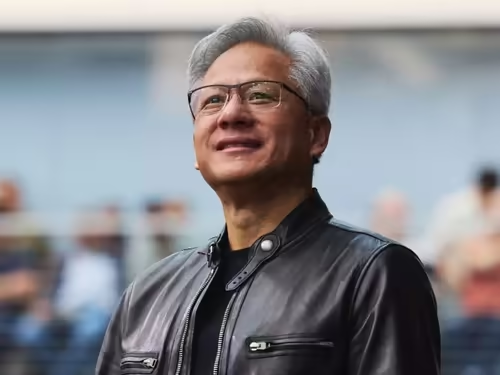
Enter Jensen Huang, the visionary CEO of Nvidia, who recently dropped a truth bomb that’s rattling the foundations of modern career planning. In a striking statement, Huang declared, “The value of blue-collar work will increase” in the age of artificial intelligence [[1]]. Not decrease. Not disappear. Increase.
This isn’t just optimistic speculation—it’s a fundamental rethinking of what makes someone valuable in tomorrow’s economy. As AI automates routine cognitive tasks, the irreplaceable human element is shifting toward practical, embodied knowledge: the ability to fix, build, operate, and understand real-world systems. And that, Huang argues, is the domain of the new blue collar.
Table of Contents
- What Jensen Huang Really Meant About Blue-Collar Work
- The Rise of the ‘New Blue Collar’ Worker
- Why Hands-On Skills Are Becoming Irreplaceable in the AI Era
- Is the College Degree Still Worth It?
- How to Prepare for the Future of Work
- Summary
- Sources
What Jensen Huang Really Meant About Blue-Collar Work
Huang’s comments weren’t about nostalgia for manual labor. He was pointing to a profound economic shift. Historically, career advancement meant moving away from physical work—into management, analysis, or strategy. But in an AI-saturated world, those very cognitive roles are increasingly automated or augmented by machines.
Meanwhile, jobs that require tactile intelligence, spatial reasoning, and real-time problem-solving in unpredictable environments—like electricians, plumbers, HVAC technicians, robotics maintenance specialists, and advanced manufacturing operators—are becoming more critical, not less. These roles can’t be outsourced to an algorithm. They demand a deep, intuitive understanding of how things work in the physical world—a skill set AI currently lacks.
“Leadership,” Huang noted, “will require understanding the reality of how things are built and operated” [[1]]. In other words, the future elite won’t just be coders—they’ll be hybrid professionals who can bridge the digital and physical realms.
The Rise of the ‘New Blue Collar’ Worker
Forget the stereotype of the grease-stained mechanic. The new blue collar is tech-savvy, data-literate, and AI-fluent. Imagine a wind turbine technician using AR glasses to overlay diagnostic data while repairing a blade 300 feet in the air. Or a construction foreman using AI-powered drones to survey a site and adjust plans in real time.
These aren’t science fiction scenarios—they’re already happening. According to the U.S. Bureau of Labor Statistics, many skilled trade occupations are projected to grow faster than average through 2032, with median wages often exceeding $50,000—and without the burden of student debt [[2]].
This evolution is creating a powerful counter-narrative to the “college-for-all” mantra that has dominated education policy for a generation.
Why Hands-On Skills Are Becoming Irreplaceable in the AI Era
AI excels at pattern recognition and data processing—but it stumbles in the messy, unpredictable real world. Consider these irreplaceable human advantages:
- Adaptive Problem-Solving: A plumber doesn’t follow a script; they diagnose based on sound, smell, and years of experience.
- Physical Dexterity: No robot can yet match the fine motor control of a skilled welder or surgeon (yes, surgery is a blue-collar skill in this context).
- Contextual Judgment: Knowing when to override a machine’s recommendation based on environmental factors is a uniquely human trait.
As AI handles more of the theoretical work, the premium on practical wisdom rises. This is the core of Huang’s insight: blue-collar work value isn’t just holding steady—it’s becoming the foundation of innovation itself.
Is the College Degree Still Worth It?
This doesn’t mean college is obsolete. For fields like medicine, law, or advanced research, it remains essential. But for millions of students, the ROI on a four-year degree is increasingly questionable—especially when alternatives like apprenticeships, trade schools, and AI-augmented certification programs offer faster, debt-free paths to high-demand careers [INTERNAL_LINK:alternatives-to-traditional-college].
High-authority sources like the U.S. Bureau of Labor Statistics show that many of the fastest-growing, highest-paying jobs don’t require a bachelor’s degree. The question isn’t “college vs. no college”—it’s “what specific skills does the future economy actually reward?”
How to Prepare for the Future of Work
Whether you’re a student, parent, or career-changer, here’s how to position yourself for this new landscape:
- Embrace Hybrid Skills: Learn a trade and basic data literacy. Can you operate a CNC machine? Great—now learn to interpret its performance analytics.
- Seek AI-Augmented Training: Look for programs that integrate AI tools into hands-on curricula (e.g., smart diagnostics in auto repair).
- Value Experience Over Credentials: Build a portfolio of real projects, not just certificates.
The goal isn’t to reject technology—it’s to master the intersection of human skill and machine intelligence.
Summary
Jensen Huang’s assertion that blue-collar work value will increase isn’t just a prediction—it’s a call to rethink our entire approach to education and career success. In the AI era, practical, hands-on expertise is transitioning from undervalued labor to a strategic asset. The future belongs not to those who avoid physical work, but to those who can intelligently combine it with digital tools. As we stand on the brink of this transformation, one thing is clear: the old ladder of success is being replaced by a new, more inclusive, and more resilient path forward.
Sources
- [[1]] Times of India: Nvidia CEO Jensen Huang says the value of blue-collar work will increase
- [[2]] U.S. Bureau of Labor Statistics: Occupational Outlook Handbook, 2024-2034