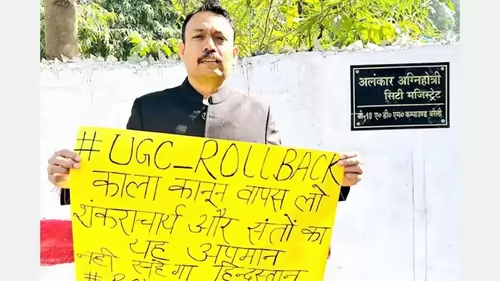
A government officer’s dramatic resignation has thrown a national spotlight on a set of new education rules, sparking a fierce debate about equity, fairness, and administrative overreach. Alankar Agnihotri, the City Magistrate of Bareilly, has stepped down from his post in a powerful protest against the University Grants Commission’s (UGC) newly notified UGC Equity Regulations 2026. His resignation wasn’t just a quiet exit; it came with a startling accusation that he was held “hostage” at the District Magistrate’s residence and a scathing label for the policy: a “black law” [[10]].
Table of Contents
- Who is Alankar Agnihotri and What Happened?
- Decoding the UGC Equity Regulations 2026
- Why the UGC Equity Regulations 2026 Are So Controversial
- The Hostage Claim and Official Response
- Broader Impact on Indian Higher Education
- Conclusion: A Nation at a Crossroads Over Equity
- Sources
Who is Alankar Agnihotri and What Happened?
Alankar Agnihotri is a 2019-batch Provincial Civil Service (PCS) officer serving in Uttar Pradesh. On January 27, 2026, he sent his resignation via email to both the state’s Governor, Anandiben Patel, and the Bareilly District Magistrate, Avinash Singh [[11]]. In his communication, Agnihotri cited his deep disagreement with the government’s policies, particularly the newly introduced UGC Equity Regulations 2026, which he believes are vitiating the academic environment [[10]]. His resignation has become a flashpoint in the growing national controversy surrounding these regulations.
Decoding the UGC Equity Regulations 2026
Notified by the UGC on January 13, 2026, the official title of the framework is the “Promotion of Equity in Higher Education Institutions Regulations, 2026” [[4]]. On the surface, its objective is noble and necessary: to eradicate discrimination in higher education on the basis of caste, religion, race, gender, and other identities [[3]]. The regulations aim to create a more inclusive and safe campus environment for historically marginalized communities, particularly Scheduled Castes (SCs), Scheduled Tribes (STs), and Other Backward Classes (OBCs) [[1]].
Why the UGC Equity Regulations 2026 Are So Controversial
Despite their stated goal of promoting equity, the regulations have faced intense backlash, primarily from students belonging to the general or unreserved category. Their core argument is that the framework is structurally biased and could lead to reverse discrimination. Critics contend that the rules implicitly assume that only students from SC, ST, and OBC backgrounds can be victims of discrimination, while those from the general category are automatically positioned as potential perpetrators [[18]].
This perceived imbalance has led to widespread protests on university campuses across the country. Students fear that the regulations could be misused to file false complaints, leading to severe penalties without adequate safeguards for the accused [[25]]. Many feel that the rules undermine the principle of equality before the law by creating a two-tiered system of justice on campus [[19]].
The Hostage Claim and Official Response
The controversy took a dramatic turn with Agnihotri’s specific allegation. He claimed that after submitting his resignation, he was held at the District Magistrate’s home for 45 minutes and subjected to ridicule [[13]]. This explosive “hostage” charge has added a layer of personal and political drama to the already heated policy debate.
However, the District Magistrate, Avinash Singh, has flatly denied these allegations. He dismissed Agnihotri’s claims as “completely baseless,” stating that there was no mistreatment or any such incident at his residence [[11]]. This stark contradiction between the two officials has left the public questioning the exact circumstances surrounding the resignation.
Broader Impact on Indian Higher Education
The fallout from the UGC Equity Regulations 2026 extends far beyond one officer’s resignation. It has ignited a crucial national conversation about how to balance the urgent need to protect vulnerable student groups with the fundamental rights of all students to a fair and unbiased process. The regulations represent a significant shift in the governance of India’s higher education institutions, mandating the creation of new committees and grievance redressal mechanisms with substantial powers [[7]].
While the intent to curb caste-based atrocities on campuses is widely supported, the method and structure of these new rules have created deep anxiety. The challenge for policymakers now is to address these legitimate concerns without diluting the core mission of creating truly equitable educational spaces. For more on the evolving landscape of Indian education policy, see [INTERNAL_LINK:indian-education-reforms].
Conclusion: A Nation at a Crossroads Over Equity
The resignation of Alankar Agnihotri is a symptom of a much larger, complex issue facing India. The UGC Equity Regulations 2026 were born from a place of necessity, aiming to heal deep social wounds. Yet, their implementation has inadvertently created a new set of anxieties and divisions. As the nation grapples with this “black law” controversy, the path forward must involve inclusive dialogue, careful calibration of the rules, and a commitment to justice that is blind to all categories, ensuring that the pursuit of equity does not itself become a source of injustice.
Sources
- [[3]] Mathrubhumi: “UGC promotion of equity regulations 2026, what they are”
- [[4]] LinkedIn: “UGC Notifies Equity Regulations, 2026”
- [[7]] Insights on India: “UGC’s new rules against caste discrimination”
- [[10]] NDTV Video: “Bareilly City Magistrate Resigns, Cites Disagreement With New UGC Policies”
- [[11]] NDTV: “Bareilly City Magistrate Alankar Agnihotri resigns…”
- [[13]] Times of India: “‘Atrocities against Brahmins’: What led to Bareilly city magistrate…”
- [[18]] Mathrubhumi: “Critics claim the regulations implicitly assume that students from the general category cannot be victims…”
- [[19]] India Today NE: “General Category Students Are the New Marginalized Group…”
- [[25]] India Today: “UGC equity rules ignite student fury over reverse bias”