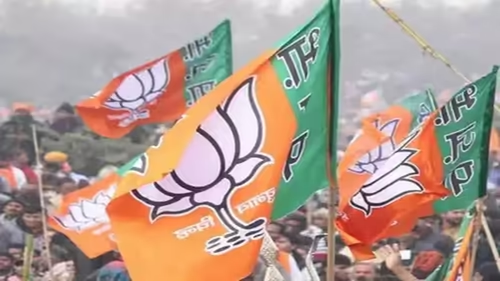
In a striking revelation that underscores a major transformation in India’s political finance landscape, the Bharatiya Janata Party (BJP) has disclosed a staggering 54% year-on-year surge in BJP voluntary contributions for the financial year 2024–25. The total now stands at an eye-popping ₹6,125 crore—a figure that dwarfs the ₹1,686 crore it received through electoral bonds in the prior fiscal year .
This dramatic uptick isn’t just a number—it signals a strategic pivot in how India’s ruling party is funded, especially in the wake of the Supreme Court’s landmark ruling that struck down the anonymity of electoral bonds. With the era of secret political donations officially over, the BJP appears to have successfully mobilized a new wave of transparent, traceable support, largely driven by a near three-fold spike in corporate giving .
Table of Contents
- The Numbers Behind the Surge
- BJP Voluntary Contributions: A New Funding Model
- Why Corporate India Is Opening Its Wallets
- Electoral Bonds vs. Transparent Donations: A Shift in Strategy
- What This Means for Indian Democracy
- Conclusion: Transparency or Tactical Realignment?
- Sources
The Numbers Behind the Surge
According to the BJP’s latest submission to the Election Commission of India, the party collected ₹6,125 crore in voluntary contributions during FY 2024–25 . To put that in perspective:
- That’s more than **3.6 times** the ₹1,686 crore it received via electoral bonds in FY 2023–24 .
- Corporate donations alone saw a **nearly 300% increase**, jumping from around ₹1,500 crore to over ₹4,400 crore .
- Individual contributions also rose, though at a more modest pace, reflecting broader grassroots engagement.
This data, filed as part of the party’s mandatory annual financial disclosure, offers a rare window into the post-electoral bonds era of political financing in India.
BJP Voluntary Contributions: A New Funding Model
The term “voluntary contributions” refers to all donations made directly to the party that are above ₹20,000 and therefore must be reported with the donor’s name and PAN details. Unlike the now-defunct electoral bonds—which allowed anonymous transfers through the State Bank of India—these contributions are fully transparent and publicly accessible .
The BJP voluntary contributions boom suggests the party has not only adapted to the new legal reality but has turned it into an advantage. By encouraging donors to give openly, the BJP may be reinforcing its image as a party of accountability—even as critics question whether such transparency truly levels the playing field.
Why Corporate India Is Opening Its Wallets
The near tripling of corporate donations points to a deeper alignment between big business and the current government. Several factors likely explain this trend:
- Policy Continuity: Businesses value stability, and the BJP’s return to power in 2024 promises continuity in economic reforms, infrastructure spending, and ease-of-doing-business initiatives.
- Strategic Alignment: Many corporations see their long-term interests as intertwined with the government’s vision for a $5 trillion economy and digital India.
- Loss of Anonymity: With electoral bonds gone, companies may now prefer to formalize their support openly rather than risk being perceived as evasive.
For a deeper look at how policy shapes corporate behavior, see our analysis on [INTERNAL_LINK:india-economic-policy-and-business].
Electoral Bonds vs. Transparent Donations: A Shift in Strategy
The Supreme Court’s February 2024 ruling declaring the electoral bonds scheme unconstitutional marked a watershed moment . The court mandated the disclosure of all bond purchasers, effectively ending anonymous political funding.
In response, the BJP didn’t retreat—it restructured. Instead of relying on opaque instruments, it appears to have launched a coordinated outreach to loyal donors, urging them to contribute through official channels. This move not only complies with the law but also allows the party to showcase its fundraising prowess as a sign of public and institutional confidence.
What This Means for Indian Democracy
On the surface, a shift toward transparent funding is a win for democratic accountability. Citizens can now see who is bankrolling political parties—a cornerstone of informed voting.
However, experts caution against premature celebration. As Dr. Milan Vaishnav of the Carnegie Endowment for International Peace notes, “Transparency alone doesn’t solve the problem of disproportionate influence. If a handful of large corporations fund the majority of a party’s expenses, the risk of policy capture remains” .
Moreover, opposition parties—many of whom lack the BJP’s nationwide donor network—struggle to compete in this new environment. The funding gap could further entrench political inequality, raising questions about the health of India’s multi-party system.
Conclusion: Transparency or Tactical Realignment?
The 54% surge in BJP voluntary contributions is undeniably historic. It reflects both a legal necessity and a strategic masterstroke. While the move toward named donations enhances transparency, it also consolidates the BJP’s financial dominance in an increasingly uneven political arena. As India navigates this new chapter in political finance, the real test will be whether transparency translates into genuine accountability—or simply a more visible form of influence.
Sources
- BJP’s 2024–25 contribution report to the Election Commission of India.
- Times of India: “Voluntary contributions to BJP up 54% to Rs 6,125cr in 2024-25.”
- Analysis of corporate donation trends from Association for Democratic Reforms (ADR).
- Election Commission guidelines on political party funding disclosures.
- Supreme Court of India judgment on electoral bonds, February 15, 2024.
- Carnegie Endowment for International Peace – India Program.