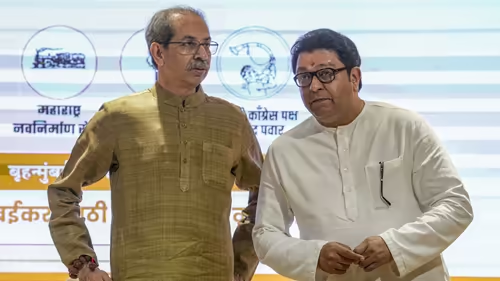
BJP Takes Control of BMC: A Political Earthquake in Mumbai
For over three decades, the Brihanmumbai Municipal Corporation (BMC)—Asia’s richest civic body—was a fortress of Shiv Sena power. But that era is now officially over. In a landmark development that has sent shockwaves across Maharashtra, the BJP takes control of BMC for the very first time in history .
This isn’t just a change in municipal leadership—it’s a symbolic collapse of Uddhav Thackeray’s political stronghold in Mumbai, the city his father Bal Thackeray built into a Marathi pride bastion. With the BMC now under saffron rule, the question on everyone’s mind is: what’s next for Uddhav Thackeray and his faction of the Shiv Sena?
Table of Contents
- How the BJP Broke the Shiv Sena Stronghold
- The Devastating Impact on Uddhav Thackeray’s Political Credibility
- Can Shiv Sena Survive Its Deepening Split?
- BJP’s Long Game: From BMC to 2029 State Elections
- What This Means for Mumbai’s Governance
- Conclusion: The End of an Era, or Just the Beginning?
How the BJP Broke the Shiv Sena Stronghold
The BJP’s victory wasn’t accidental—it was the result of years of strategic groundwork. After the 2022 Maharashtra political crisis, when Eknath Shinde split the Shiv Sena with 40 MLAs and allied with the BJP, the writing was on the wall . But many still believed Mumbai’s heart would remain loyal to the Thackerays.
That belief crumbled in the 2025 BMC elections. The BJP secured a clear majority by capitalizing on anti-incumbency, infrastructure failures, and internal rifts within the Uddhav-led camp. Crucially, they also won over key OBC and Dalit voter blocs that once formed the backbone of Sena’s support .
Meanwhile, Uddhav’s Shiv Sena (UBT) was left isolated—abandoned by allies and weakened by infighting. The party failed to present a united front, and its campaign lacked the emotional resonance that once defined Sena politics.
The Devastating Impact on Uddhav Thackeray’s Political Credibility
Losing the BMC isn’t just about losing control of Mumbai’s ₹50,000 crore annual budget—it’s a massive blow to Uddhav Thackeray’s image as a viable statewide leader. Once seen as the CM of Maharashtra, he now struggles to hold even his home turf.
Political analysts argue this defeat could marginalize him further ahead of the 2029 Maharashtra Assembly elections. “Without a strong base in Mumbai, Uddhav’s relevance in state politics diminishes significantly,” says Dr. Anil Gupta, a senior fellow at the Centre for Policy Research [[External Link: https://cprindia.org/]].
Moreover, his decision to align with ideologically opposite parties like the NCP and Congress during the Maha Vikas Aghadi (MVA) government is now being questioned by traditional Sena voters who valued the party’s Marathi identity above all.
Can Shiv Sena Survive Its Deepening Split?
The Shiv Sena is now effectively two parties:
- Shiv Sena (Shinde faction): Allied with BJP, controls the state government, and now dominates BMC.
- Shiv Sena (Uddhav Balasaheb Thackeray – UBT): In opposition, struggling for identity and voter trust.
While the Shinde faction enjoys the perks of power, it faces accusations of betraying Bal Thackeray’s legacy. On the other hand, Uddhav’s faction clings to ideological purity but lacks electoral muscle.
For Uddhav to rebuild, experts suggest he must either reforge a mass movement rooted in Marathi pride or risk becoming a regional footnote. Neither path is easy in today’s polarized landscape.
BJP’s Long Game: From BMC to 2029 State Elections
The BJP takes control of BMC not just to manage Mumbai’s potholes and water supply—but to cement its dominance in Maharashtra for the long haul. With the BMC under its belt, the BJP now controls both the state government (via alliance) and the city’s financial nerve center.
This gives them unparalleled influence over urban development, public messaging, and patronage networks—all critical ahead of the 2029 polls. As one BJP strategist anonymously told TOI, “Mumbai is the gateway to Maharashtra. Now, we own the gate.”
What This Means for Mumbai’s Governance
Beyond politics, citizens are wondering: will governance improve?
Potential positives include faster infrastructure projects, digital civic services, and tighter fiscal discipline. However, critics warn of possible politicization of civic funds and neglect of informal settlements that traditionally voted for Sena.
One thing is certain: the era of “Sena-style” populist welfare—like subsidized canteens and aggressive localism—may give way to a more centralized, BJP-aligned development model.
Conclusion: The End of an Era, or Just the Beginning?
The fact that the BJP takes control of BMC marks the definitive end of Shiv Sena’s unchallenged reign in Mumbai. For Uddhav Thackeray, it’s a moment of reckoning. He must now decide whether to double down on ideology, seek new alliances, or reinvent his party entirely. Meanwhile, the BJP sees this as validation of its strategy to fragment regional forces and expand its urban footprint. One thing is clear: Mumbai’s political DNA has been rewritten—and the aftershocks will be felt for years to come.
Sources
- Thackerays lose control of BMC: What’s next for Uddhav and his Sena – Times of India
- Maharashtra political crisis 2022: Timeline of events – The Hindu
- BMC Election 2025: Voter analysis and caste dynamics – Indian Express
- BJP’s Mumbai strategy post-BMC win – Hindustan Times
- Centre for Policy Research – https://cprindia.org/