Introduction: A Political Earthquake in Pimpri-Chinchwad
The Pimpri-Chinchwad Municipal Corporation (PCMC) was supposed to be a stronghold for the newly reunited Nationalist Congress Party (NCP). Instead, the PCMC election results have delivered a political earthquake, with the Bharatiya Janata Party (BJP) securing a commanding majority and leaving both Pawar factions reeling. This isn’t just a loss; it’s a fundamental rejection of their joint strategy and a powerful signal about the shifting sands of Maharashtra’s political landscape.
Table of Contents
- The Final Tally: BJP Sweeps the Board
- The Pawar Alliance: A Strategy Built on Sand?
- Why Did the NCP Factions Fail in PCMC?
- What This Means for Maharashtra’s Political Future
- Conclusion: The End of an Era or a New Beginning?
- Sources
The Final Tally: BJP Sweeps the Board
The numbers don’t lie. In the 128-member Pimpri-Chinchwad Municipal Corporation, the BJP has emerged as the undisputed victor, winning a clear and decisive majority. Early reports confirm the party has secured a staggering 81 to 84 seats [[7], [8]]. This is a resounding mandate that gives the saffron party full control over one of Maharashtra’s most crucial urban local bodies.
In stark contrast, the combined might of the Ajit Pawar-led NCP (Democratic) and the Sharad Pawar-led NCP (SP) could not mount a serious challenge. Their alliance, which was meant to consolidate anti-BJP votes, has instead been left fragmented and defeated. The voter turnout for the PCMC polls was recorded at a healthy 57.71%, with nearly a million voters casting their ballots, indicating a highly engaged electorate that ultimately chose a different path .
The Pawar Alliance: A Strategy Built on Sand?
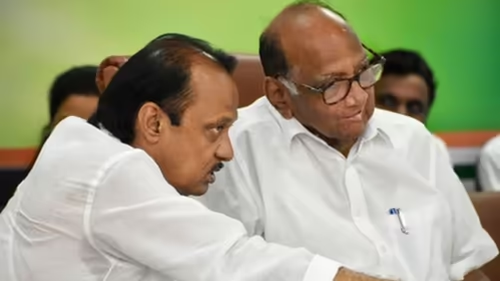
Just weeks before the polls, the sight of uncle and nephew—Sharad and Ajit Pawar—campaigning together was seen as a masterstroke. The idea was simple: reunite the NCP’s core base and present a united front against the BJP. However, the PCMC election results have exposed the fragility of this arrangement. The alliance appeared more like a marriage of convenience than a genuine reunion, lacking a coherent, on-the-ground strategy to counter the BJP’s well-oiled machinery.
The failure raises immediate questions about the future of this alliance. While there have been calls from other parties, like the Shiv Sena (UBT), for a formal merger of the two NCP factions after the elections , the electoral setback may have the opposite effect. Ajit Pawar himself has been non-committal, recently dismissing merger talks while acknowledging that the “bitterness” between the factions has eased [[16], [17]]. A poor showing in their home turf could harden positions rather than soften them.
Why Did the NCP Factions Fail in PCMC?
Several factors contributed to the NCP’s dramatic collapse in Pimpri-Chinchwad:
- Lack of a Unified Ground Game: Despite a joint campaign, the two NCP factions likely struggled to integrate their separate organizational structures and loyalists at the booth level, leading to inefficiencies and confused messaging.
- Strong Anti-Incumbency Against Alliances: Voters in urban Maharashtra are increasingly skeptical of large, opportunistic coalitions. The BJP successfully painted the NCP alliance as a desperate, last-minute ploy lacking a clear vision for the city’s development.
- BJP’s Localized Campaign: The BJP ran a hyper-local campaign, focusing on specific ward-level issues and leveraging its strong network of local leaders and workers, a strategy that resonated deeply with the electorate.
- Identity Crisis: For many voters, the split NCP had already lost its distinct identity. The sudden alliance failed to reignite the old NCP’s emotional connect, leaving a vacuum that the BJP was quick to fill.
What This Means for Maharashtra’s Political Future
The implications of these PCMC election results extend far beyond Pimpri-Chinchwad. They serve as a critical bellwether for the entire state.
For the BJP, this is a massive confidence booster. It demonstrates their ability to dominate even in traditional NCP strongholds and solidifies their position as the single largest party in Maharashtra’s urban politics. This victory will undoubtedly fuel their ambitions for the next state assembly elections.
For the Maha Vikas Aghadi (MVA) alliance—comprising the Shiv Sena (UBT), NCP (SP), and Congress—the result is a major red flag. It highlights the difficulty of stitching together a viable alternative to the BJP without a clear, unified leadership and a compelling narrative. The dream of a grand anti-BJP front appears more distant than ever.
As for the Pawars, the road ahead is fraught with uncertainty. This defeat forces a moment of deep introspection. Will they double down on their alliance to salvage their legacy, or will the electoral blow lead to a further drift? The answer to this question will shape the opposition’s fate in Maharashtra for years to come. You can read more about the broader context of Maharashtra’s political dynamics on the official website of the Election Commission of India.
Conclusion: The End of an Era or a New Beginning?
The 2026 PCMC election results mark a definitive turning point. The BJP’s landslide victory is not just a win; it’s a statement of dominance. Conversely, the failure of the Pawar alliance is a stark reminder that past glories offer no guarantee of future success. For the residents of Pimpri-Chinchwad, the hope is that this clear mandate will translate into effective governance and tangible development. For the rest of Maharashtra, all eyes are now on how the opposition picks up the pieces from this significant setback. One thing is certain: the old political order in the state has been irrevocably shaken.
Sources
- Times of India: PCMC election results: Pawars fail to deliver in Pimpri-Chinchwad, Pune; BJP takes major lead
- [INTERNAL_LINK: maharashtra-politics-analysis]
- [INTERNAL_LINK: bjp-maharashtra-strategy]