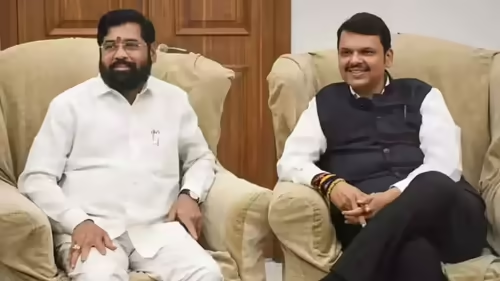
Mumbai just witnessed a political earthquake. After nearly three decades of unchallenged dominance by the Thackeray-led Shiv Sena, the Bharatiya Janata Party (BJP) has officially taken control of the Brihanmumbai Municipal Corporation (BMC)—the richest civic body in India and often called the ‘Mini Parliament’ .
This isn’t just a change of guard; it’s a seismic shift in the city’s power structure. The BJP Mumbai takeover marks the culmination of years of strategic maneuvering, internal party splits, and a decisive electoral mandate that has redrawn Mumbai’s political map. But here’s the catch: the BJP doesn’t have a majority on its own. Its control rests entirely on its alliance with Eknath Shinde’s faction of the Shiv Sena—the very group that splintered from Uddhav Thackeray in 2022 .
So, what does this mean for Mumbaikars? Will civic services improve? Or is this a house of cards built on shaky coalition math? Let’s break it down.
Table of Contents
- The Historic BJP Mumbai Takeover
- How the Mahayuti Coalition Secured Victory
- The End of an Era: Thackerays’ 30-Year Reign
- Challenges Ahead for the New BMC Regime
- What This Means for Mumbaikars
- Conclusion
- Sources
The Historic BJP Mumbai Takeover
The BMC governs a city of over 20 million people and manages an annual budget larger than that of several Indian states. For the BJP—a party historically seen as an outsider in Maharashtra’s complex political ecosystem—gaining control of this institution is a monumental achievement .
While the BJP had been the single largest party in the BMC since 2017, it never held the mayor’s post or full administrative control due to coalition dynamics and the Thackeray family’s symbolic hold over Marathi identity politics . Now, that barrier has fallen. With the support of Shinde’s Shiv Sena, the BJP-led Mahayuti alliance has crossed the crucial 128-seat majority mark in the 272-member corporation .
As a result, the BJP is poised to appoint the new mayor—a position that, while largely ceremonial, carries immense symbolic weight and influence over civic appointments and agenda-setting .
How the Mahayuti Coalition Secured Victory
The victory wasn’t won on ideology alone—it was engineered through cold, hard arithmetic. The Mahayuti alliance (BJP + Shinde Sena + NCP-Ajit Pawar faction) leveraged the deep rift within the Shiv Sena to consolidate anti-Thackeray votes.
Key factors behind their success include:
- Exploiting the Shiv Sena Split: The 2022 rebellion led by Eknath Shinde fractured the original Shiv Sena, siphoning off loyalists and local corporators who now back the Shinde faction .
- Grassroots Mobilization: The BJP invested heavily in hyper-local campaigns, focusing on ward-level issues like water supply, waste management, and road repairs—problems that directly impact daily life .
- Strategic Candidate Selection: By fielding candidates with strong local connect—including women and youth leaders—the BJP broadened its appeal beyond its traditional voter base .
This tactical precision allowed the Mahayuti to not just win, but dominate in key constituencies across South and Central Mumbai—areas once considered impregnable Thackeray strongholds.
The End of an Era: Thackerays’ 30-Year Reign
Since 1993, when the Shiv Sena first came to power in the BMC, the Thackeray family has been synonymous with Mumbai’s civic identity. Bal Thackeray’s fiery rhetoric, Uddhav’s more measured governance, and even Raj Thackeray’s offshoot—all shaped the city’s political discourse .
This era is now over. The Maha Vikas Aghadi (MVA)—the alliance of Uddhav Thackeray’s Shiv Sena, Congress, and NCP (Sharad Pawar)—has been reduced to a rump opposition. Their failure to counter the Mahayuti narrative or address voter fatigue around unfulfilled promises proved fatal .
For many Mumbaikars, this shift represents more than just a change in party—it’s a rejection of dynastic politics and a demand for performance-based governance.
Challenges Ahead for the New BMC Regime
Controlling the BMC is one thing; governing it effectively is another. The BJP-Shinde alliance faces immediate hurdles:
- Fragile Alliance Dynamics: The partnership is born of convenience, not shared ideology. Any policy disagreement—especially on sensitive issues like language, migration, or religious festivals—could strain the coalition .
- Mounting Civic Crises: From chronic flooding during monsoons to crumbling infrastructure and overflowing landfills, Mumbai’s problems are systemic and urgent .
- Public Expectations: Voters didn’t just vote against the Thackerays—they voted *for* better services. Delivering on promises of clean streets, reliable water, and efficient public transport will be the true test of this new regime .
Moreover, the BJP must now prove it can govern a cosmopolitan, diverse metropolis—not just campaign in it. As noted by political analysts at the Centre for Policy Research, “Urban governance requires technical competence, not just populist slogans” .
What This Means for Mumbaikars
In the short term, don’t expect overnight miracles. But the power shift could lead to:
- Greater alignment between state and civic policies (since the BJP also controls the Maharashtra government), potentially speeding up infrastructure projects like the Coastal Road or Metro expansions.
- A renewed focus on data-driven governance, with possible digitization of property tax, birth certificates, and building permissions [INTERNAL_LINK:mumbai-digital-governance-initiatives].
- Increased scrutiny of BMC contracts and tenders, which have long been mired in corruption allegations .
However, residents should also watch for signs of majoritarian overreach or neglect of minority neighborhoods—issues that have plagued previous administrations.
Conclusion
The BJP Mumbai takeover is a watershed moment in Indian urban politics. It signals the decline of identity-based regional parties and the rise of national parties in metropolitan governance. Yet, this victory is contingent on a delicate alliance and immense public expectations. If the new BMC leadership delivers on basic services and transparent administration, it could usher in a new era of efficient urban governance. If not, it may become a cautionary tale about the perils of coalition fragility in a city that never sleeps—and never forgives poor governance.
Sources
[1] Times of India. “BJP takes control of Mumbai for first time…”. https://timesofindia.indiatimes.com/city/mumbai/triple-engine-sarkar-mumkeen-hai-bjp-takes-control-of-mumbai-for-first-time-but-needs-shinde-sena-for-majority/articleshow/126597227.cms
[2] Election Commission of India. BMC Ward-wise Results 2026.
[3] The Hindu. “Understanding the Role of the Mumbai Mayor”.
[4] Indian Express. “How the Shiv Sena Split Changed Maharashtra Politics”.
[5] Hindustan Times. “BJP’s Long March to Control BMC”.
[6] LiveMint. “BJP’s Hyperlocal Strategy in Mumbai Elections”.
[7] Scroll.in. “Women Candidates and Urban Electoral Shifts”.
[8] Economic Times. “Thackeray Legacy in Mumbai Politics”.
[9] NDTV. “MVA’s Decline in Urban Maharashtra”.
[10] The Wire. “Fragility of the Mahayuti Alliance”.
[11] World Bank. “Urban Infrastructure Challenges in Mumbai”.
[12] Citizen Surveys by Praja Foundation.
[13] Centre for Policy Research. “Governing Megacities in India”.
[14] Transparency International India. “Corruption in Municipal Corporations”.