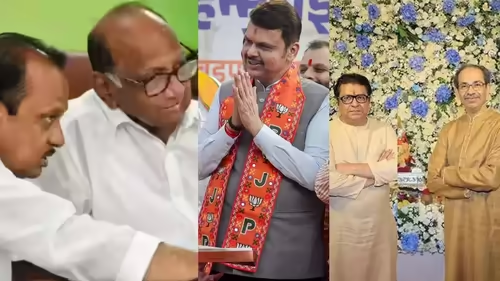
The dust has settled on Maharashtra’s 2026 civic body elections, and the landscape is unrecognizable. For decades, the state’s political narrative was dictated by two powerful surnames: Thackeray and Pawar. Their influence was so entrenched that it often felt like a birthright, not a mandate earned at the ballot box. But on January 15, 2026, the **BJP Maharashtra victory 2026** sent a thunderous message: dynastic privilege is no longer enough.
This wasn’t just another election win; it was a meticulously planned takedown of two of India’s most formidable political families. From the heart of Mumbai to the intellectual hub of Pune, the Bharatiya Janata Party has systematically dismantled their historical strongholds, signaling a profound and lasting transformation in the state’s power dynamics .
Table of Contents
- The End of an Era in Mumbai
- The Pawar Problem: BJP Tightens Its Grip
- The Winning Formula Behind the BJP Maharashtra Victory 2026
- What This Means for Maharashtra’s Future
- Conclusion: A New Political Order
- Sources
The End of an Era in Mumbai
Mumbai, the financial capital of India, was once considered the undisputed fortress of the Shiv Sena. The Thackeray family ruled the Brihanmumbai Municipal Corporation (BMC)—Asia’s richest civic body—for nearly three decades. It was their crown jewel, a symbol of their Marathi manoos identity and political might.
The **BJP Maharashtra victory 2026** has shattered this myth forever. The BJP emerged as the single largest party in the 227-member BMC, effectively cracking the Thackerays’ long-standing control . This historic win wasn’t just about numbers; it was a psychological blow to Uddhav Thackeray’s faction (Shiv Sena UBT) and his cousin Raj Thackeray’s MNS, whose combined efforts failed to stop the BJP juggernaut .
The key to this success? Capitalizing on the 2022 split in the Shiv Sena. By aligning with Eknath Shinde’s faction, the BJP created a formidable alliance that appealed to a broader base while simultaneously painting the Uddhav camp as out of touch with the city’s evolving needs .
The Pawar Problem: BJP Tightens Its Grip
If Mumbai was the Thackerays’ bastion, then Pune was the Pawars’ citadel. The city, known for its educated electorate, was a stronghold of Sharad Pawar’s Nationalist Congress Party (NCP). However, the 2026 results have delivered a decisive political blow to the entire Pawar family .
In a stunning turn of events, the BJP surged ahead of the NCP-NCP (SP) combine—led by Deputy CM Ajit Pawar and his uncle Sharad Pawar—in Pune itself . This loss in their home turf is a massive setback, exposing the deep fractures within the NCP that the BJP expertly exploited.
Even more telling is the performance across other key urban centers. In Chhatrapati Sambhajinagar (Aurangabad), the BJP secured a commanding 57 seats, relegating other parties to a distant second . The party’s strategy of focusing on development, good governance, and accountable leadership resonated far more than the legacy politics offered by the established clans .
The Winning Formula Behind the BJP Maharashtra Victory 2026
So, what was the secret sauce behind this sweeping victory? It wasn’t luck; it was a multi-pronged strategy executed with military precision:
- Exploiting Internal Divisions: The BJP masterfully leveraged the splits in both the Shiv Sena and the NCP. By backing Eknath Shinde and Ajit Pawar, they turned internal rivals into allies, fracturing the opposition vote bank.
- Shifting the Narrative from Identity to Delivery: Instead of getting bogged down in emotive debates about Marathi identity or legacy, the BJP focused its campaign on tangible issues like infrastructure, waste management, and efficient civic services—a message that connected with the urban middle class.
- Grassroots Organizational Might: The BJP’s unmatched ground game, with its vast network of workers and volunteers, ensured a high voter turnout in its favor, particularly in crucial wards across all major cities.
- A United Front (Mahayuti): The BJP-Shiv Sena (Shinde)-NCP (Ajit Pawar) alliance, or Mahayuti, presented a stable and united front to the electorate, contrasting sharply with the fragmented and often chaotic opposition .
What This Means for Maharashtra’s Future
The implications of this victory extend far beyond the next five years of civic administration. This result is a clear indicator of a larger trend: the decline of dynastic politics in India’s most important states. Voters are increasingly prioritizing performance over pedigree.
For the Thackerays and Pawars, the path to recovery is steep. They must now undertake a serious introspection and rebuild their parties from the ground up, moving away from a reliance on family legacy. For the BJP, this win solidifies its position as the dominant force in Maharashtra’s urban centers, setting the stage for a potential sweep in the upcoming state assembly elections .
This shift also opens the door for new political players and issues to come to the forefront, potentially leading to a more dynamic and issue-based political discourse in the state.
Conclusion: A New Political Order
The **BJP Maharashtra victory 2026** is more than a collection of electoral wins; it’s the dawn of a new political era. By successfully outmaneuvering the Thackeray ‘brand’ and the Pawar dynasty, the BJP has proven that in modern Indian politics, a well-oiled political machine focused on governance can topple even the most deeply rooted dynasties. The message from Maharashtra’s voters is clear: the future belongs to those who deliver, not just those who inherit.
Sources
- Times of India: Decoding BJP’s victory: How party outmaneuvered Thackeray ‘brand’ and Pawars in Maharashtra
- Election Commission of India: Official Election Results Portal
- The Hindu: Maharashtra civic poll results 2026: BJP dominates, AIMIM surges
- Indian Express: BMC Election Results 2026: BJP cracks Thackerays’ decades-long hold on Mumbai