Table of Contents
- Shocking Remarks at Bengal Rally
- TMC Fires Back, Accuses BJP of Inciting Violence
- The Politics of Misogyny and Symbolism
- National Reaction and Legal Implications
- Conclusion: A Dangerous New Low?
- Sources
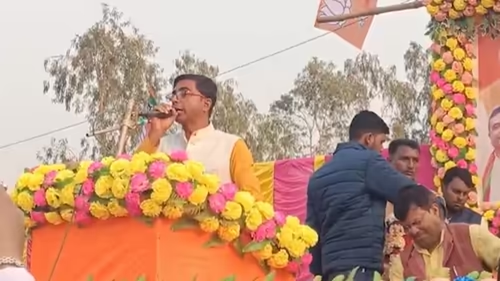
In a disturbing escalation of political rhetoric in West Bengal, a senior BJP leader has been caught on video calling for the Mamata Banerjee beheading, using vile and misogynistic language that has sent shockwaves across the nation. The incident, which occurred at a recent party rally, has not only drawn fierce condemnation from the Trinamool Congress (TMC) but has also reignited a critical debate about the state of political discourse in India.
Shocking Remarks at Bengal Rally
The controversy centers around Sanjay Das, identified as a Vice President of the Mathurapur Organisational unit of the BJP. In a widely circulated video from a party event, Das is heard making deeply offensive remarks against the democratically elected Chief Minister of West Bengal. He referred to her as an “old witch” and then made the chilling statement: “She must be beheaded with a kharga (scimitar)” .
These are not just words of political dissent; they are a direct and public call for violence against a sitting head of government. The use of such explicit and violent imagery in a public forum, especially by a figure representing a major national party, marks a dangerous precedent. It moves the conversation far beyond the realm of healthy political opposition and into the territory of what the TMC has aptly described as “outright criminality” .
TMC Fires Back, Accuses BJP of Inciting Violence
The Trinamool Congress wasted no time in responding with fury. The party’s official stance is that Das’s comments were not an isolated incident but a reflection of the BJP’s broader culture of intolerance and aggression. The TMC has framed this as a “public call for murder against a democratically elected representative,” highlighting the gravity of the threat .
Furthermore, the TMC has attempted to connect this incident to a larger pattern within the BJP. They pointed to Prime Minister Narendra Modi’s past actions, such as his participation in events where swords are used as ceremonial props, to argue that the party is normalizing a culture of symbolic and actual violence [[19], [22]]. While the PM’s actions are often steeped in cultural or historical context, the TMC’s argument is that in the current charged atmosphere, such symbolism can be easily weaponized by party workers on the ground, as seen in Das’s remarks.
The Politics of Misogyny and Symbolism
Beyond the explicit call for violence, the language used by Sanjay Das is deeply rooted in misogyny. Labeling a powerful female leader a “witch” is a classic patriarchal trope used to delegitimize and demonize women who defy traditional roles. This tactic is not new in global politics, but its open use by a mainstream political figure in India is a stark reminder of the challenges women in power continue to face.
The choice of the word “kharga” (scimitar) is also significant. It evokes a sense of medieval, brutal justice, completely at odds with the principles of a modern democracy governed by the rule of law. This kind of rhetoric doesn’t just attack an individual; it attacks the very institutions that protect all citizens, regardless of their political affiliation. It’s a strategy designed to dehumanize the opponent and make extreme actions seem like a justified form of retribution.
Why This Rhetoric is So Dangerous
Such inflammatory speech can have real-world consequences:
- Incites Violence: It can embolden fringe elements to take matters into their own hands.
- Erodes Democratic Norms: It replaces debate and policy discussion with threats and intimidation.
- Polarizes Society: It deepens existing social and political fissures, making reconciliation harder.
National Reaction and Legal Implications
The incident has sparked a national debate. Opposition parties across the spectrum have condemned the remarks, demanding a formal apology from the BJP and legal action against Sanjay Das. The central question now is how the BJP’s national leadership will respond. Will they distance themselves from these comments and take disciplinary action, or will they remain silent, allowing the remarks to stand as an unofficial party sentiment?
From a legal standpoint, Das’s statements could potentially fall under various sections of the Indian Penal Code (IPC), including those related to promoting enmity between groups, criminal intimidation, and even sedition, given that the target is a constitutional authority. The TMC is likely to press for a formal police investigation, turning this from a political scandal into a potential legal one.
This event also casts a long shadow over the already tense political climate in West Bengal, a state with a history of political violence. For more on the complex dynamics of West Bengal’s political history, our in-depth analysis provides crucial context.
Conclusion: A Dangerous New Low?
The call for the Mamata Banerjee beheading is more than just a crude outburst; it’s a symptom of a deeper malaise in the country’s political culture. It represents a shift from competing on ideas to attempting to eliminate the opponent through fear and hatred. The BJP’s response in the coming days will be a critical test of its commitment to democratic values and the rule of law. For the sake of India’s vibrant democracy, it is imperative that such overt calls for violence are met with swift and unambiguous condemnation from all quarters of the political establishment. The alternative is a future where the ballot is replaced by the bullet, and political discourse is silenced by the sword.
Sources
- Times of India: ‘Outright criminality’: BJP leader calls for Mamata’s beheading at Bengal rally; TMC hits back
- NDTV: BJP Leader’s Mamata Banerjee Remark Sparks Row
- The Hindu: BJP leader’s remarks on Mamata draws TMC’s ire
- Press Trust of India (PTI) reports on TMC’s official statement.