In a dramatic convergence of cricket, commerce, and communal politics, the Bharatiya Janata Party (BJP) has declared the BCCI’s order for Kolkata Knight Riders (KKR) to release Bangladeshi fast bowler Mustafizur Rahman as nothing short of a “victory of Hindus.” This inflammatory yet politically potent statement has thrown the Indian Premier League into the heart of a fierce national debate, where the boundary between sport and state has all but vanished [[1], [2]].
The controversy erupted after KKR, co-owned by Bollywood superstar Shah Rukh Khan, acquired Mustafizur Rahman for ₹9.20 crore in the IPL 2026 auction. The signing, seen as a strategic masterstroke on the field, quickly became a lightning rod for political criticism off it. Facing mounting pressure from BJP leaders and affiliated groups, the BCCI intervened and instructed KKR to terminate the player’s contract—a decision the BJP is now celebrating as a win for its ideological stance on India’s foreign and domestic policy .
Table of Contents
- BJP Declares ‘Victory of Hindus’ in Mustafizur Rahman Case
- The Mustafizur Rahman-KKR Deal That Sparked the Fire
- The Political Backlash Against Shah Rukh Khan and KKR
- Why the BJP Took a Hardline Stance on a Cricket Signing
- BCCI in a Tight Spot: Balancing Sport and Sovereignty
- The Broader Implications for IPL and India-Bangladesh Diplomacy
- Conclusion: Cricket as a Political Pawn
- Sources
BJP Declares ‘Victory of Hindus’ in Mustafizur Rahman Case
Senior BJP leaders have been unequivocal in their response to the BCCI’s decision. The phrase “victory of Hindus” has been widely circulated in party circles and on social media, framing the removal of Mustafizur Rahman not as a sporting adjustment, but as a moral and political triumph .
Party spokespersons argued that in the wake of reported violence against Hindu minorities in Bangladesh, allowing a Bangladeshi national to play in India’s premier sporting league was “insensitive” and “tone-deaf” to the sentiments of the Indian public . They contended that the BCCI’s action reflects a growing national consciousness that prioritizes the safety and dignity of Indian citizens over commercial or entertainment interests .
The Mustafizur Rahman-KKR Deal That Sparked the Fire
Mustafizur Rahman’s IPL journey has been one of high highs and sudden lows. A veteran of the league since 2016, the 29-year-old left-arm pacer has played for franchises including Sunrisers Hyderabad, Mumbai Indians, and RCB. His 65 wickets in 60 matches have made him a T20 specialist, known for his lethal cutters and pinpoint yorkers .
When KKR shelled out ₹9.20 crore to secure him for IPL 2026, it was seen as one of the most astute buys of the auction. However, the celebratory mood was short-lived. Within days, social media campaigns and political rallies began demanding his removal, citing deteriorating India-Bangladesh relations and alleged incidents of religious persecution in Bangladesh since August 2025 .
The Political Backlash Against Shah Rukh Khan and KKR
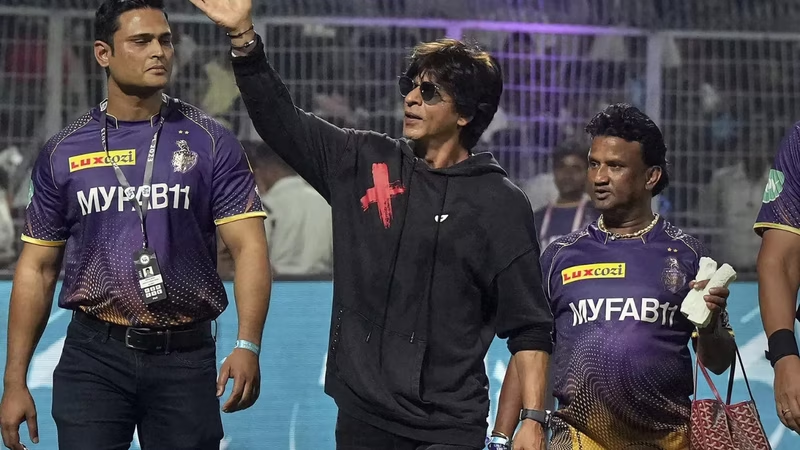
Shah Rukh Khan, one of India’s most beloved but also most scrutinized celebrities, found himself at the center of the storm once again. As the face of KKR, he was directly targeted by BJP supporters and right-wing groups who questioned his “nationalist credentials” for signing a player from a country perceived as hostile to Indian interests .
Hashtags like #BoycottKKR and #SRKNotPatriotic trended on social media, putting immense public pressure on the franchise. The narrative quickly shifted from cricketing strategy to a test of political loyalty, forcing KKR into a defensive position and ultimately leading them to comply with the BCCI’s directive without public protest .
Why the BJP Took a Hardline Stance on a Cricket Signing
This move is not an isolated incident but part of a broader political strategy. The BJP has increasingly used cultural and sporting symbols to reinforce its nationalist narrative. By framing Mustafizur Rahman’s presence as a threat to “Hindu sentiments,” the party taps into deep-seated anxieties about minority security in South Asia .
Key factors driving the BJP’s stance include:
- Electoral Messaging: With several state elections on the horizon, the party is keen to project itself as the sole protector of Hindu interests.
- Foreign Policy Signaling: The decision sends a strong message to Bangladesh’s new government that India’s goodwill is conditional on its treatment of minority communities.
- Controlling Cultural Narratives: Sports, especially the IPL, are powerful tools of soft power. The BJP’s intervention asserts its authority over these national platforms.
BCCI in a Tight Spot: Balancing Sport and Sovereignty
The Board of Control for Cricket in India (BCCI), while officially an autonomous body, operates in a complex ecosystem where political goodwill is crucial. Faced with direct pressure from the ruling party and widespread public controversy, the BCCI chose the path of least resistance .
However, this sets a dangerous precedent. If player signings can be reversed based on political whims, the IPL’s credibility as a professional, global sporting league is at serious risk. This move could deter future international stars from participating, fearing their careers might become collateral damage in diplomatic disputes. For context on sports diplomacy, the U.S. Department of State’s Sports Diplomacy program outlines how sport can bridge divides—but also how it can be weaponized .
The Broader Implications for IPL and India-Bangladesh Diplomacy
The fallout from this episode extends beyond one player or one team. It signals a new phase in India’s cultural foreign policy, where sports are no longer a neutral ground but an extension of geopolitical strategy .
For the IPL, this incident raises urgent questions about its future as a global league. Can it maintain its international appeal if its roster is subject to political vetting? For KKR, the damage is both strategic and reputational. And for Mustafizur Rahman, a professional athlete caught in a political crossfire, the personal cost is immeasurable .
This situation underscores the fragility of [INTERNAL_LINK:ipl-international-player-policy] frameworks in the face of rising nationalism.
Conclusion: Cricket as a Political Pawn
The BJP’s celebration of the BCCI’s order to remove Mustafizur Rahman from KKR as a “victory of Hindus” marks a turning point in Indian public life. It demonstrates how deeply politics has permeated every facet of national culture—even a game as beloved as cricket is no longer safe from ideological battles.
While the party sees this as a win for its base, the long-term consequences for India’s sporting ecosystem, its international image, and its diplomatic relationships could be far more complex and damaging. In the end, the real casualty may not be a single player, but the very idea that sport can be a unifying force above politics.