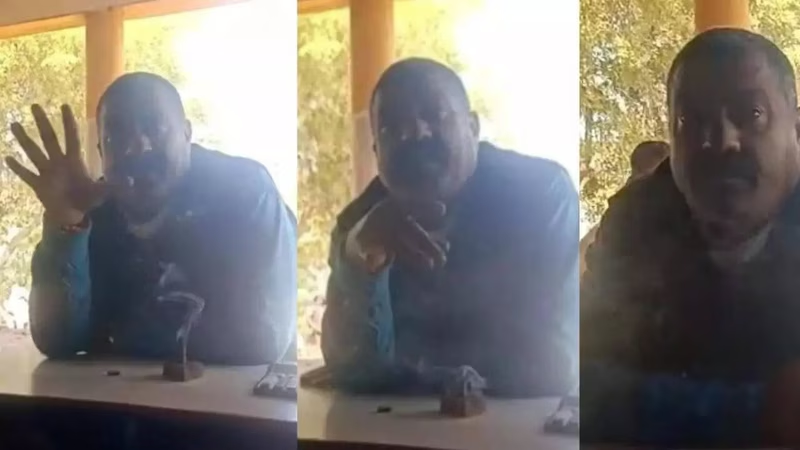
“Nothing will happen to me.”
Those six words, spoken with brazen confidence in a now-viral video, have come back to haunt a man whose only claim to public attention was being married to a BJP corporator in Madhya Pradesh’s Satna district. What followed wasn’t impunity—but police action, public fury, and a stark reminder that in the age of smartphones, power and connections may no longer shield the guilty.
The incident, captured on video and widely shared across social media, shows the man allegedly threatening a woman while making what she describes as “objectionable demands.” Within hours of the footage going viral, local authorities sprang into action, registering a case and detaining the accused. The case has ignited a fierce debate about accountability, gender safety, and the conduct of those linked to political power.
Table of Contents
- BJP Corporator Husband Arrested: The Viral Incident Explained
- The Video That Sparked Nationwide Outrage
- Police Action and Legal Charges
- Political Fallout and Public Reaction
- Broader Implications for Women’s Safety in Madhya Pradesh
- Conclusion: When Viral Justice Meets Real-World Accountability
- Sources
BJP Corporator Husband Arrested: The Viral Incident Explained
The controversy centers on a man identified as the husband of a female BJP corporator in Satna—a position that, while local, carries significant influence in municipal affairs. According to the woman in the video, the accused approached her with inappropriate demands and, when she resisted, began issuing threats.
In the footage, he is heard saying, “Nothing will happen to me,” implying a sense of untouchability derived from his political connections. The woman, visibly distressed, later filed a formal complaint, alleging both verbal harassment and coercive behavior.
This case of alleged misconduct quickly escalated from a private grievance to a public scandal, thanks to the viral nature of the video—a phenomenon that has increasingly become a catalyst for justice in India .
The Video That Sparked Nationwide Outrage
The video, recorded in what appears to be a public or semi-public space, shows the accused speaking aggressively, with hand gestures and a tone that many viewers interpreted as intimidating and predatory. While the exact wording is partially muffled, the woman’s testimony and contextual cues have led authorities to treat the matter as a serious case of intimidation and attempted coercion.
Social media users were quick to condemn the incident, with hashtags like #JusticeForSatnaWoman trending on X (formerly Twitter). Many pointed to a troubling pattern: individuals leveraging political affiliations to act with impunity, especially against women who may fear retaliation or disbelief.
Police Action and Legal Charges
Responding to mounting public pressure, the Satna police acted swiftly. A First Information Report (FIR) was registered under relevant sections of the Indian Penal Code, likely including:
- Section 506: Punishment for criminal intimidation,
- Section 509: Word, gesture, or act intended to insult the modesty of a woman,
- Potentially Section 354 if physical contact or assault is confirmed.
The accused has been apprehended and is in police custody as of the latest reports. Authorities have also stated they are verifying the full context of the video and gathering additional witness statements to build a robust case .
For a deeper understanding of how such cases are legally processed in India, refer to the Ministry of Home Affairs’ guidelines on [INTERNAL_LINK:handling-gender-based-violence-cases].
Political Fallout and Public Reaction
Although the BJP corporator herself has not been accused of any wrongdoing, the incident has cast a shadow over her public role. Opposition parties have demanded her resignation, arguing that family conduct reflects on the moral authority of elected representatives.
The BJP district leadership has so far maintained a cautious stance, stating they “respect the due process of law” and will take “appropriate action” based on the investigation’s outcome. However, civil society groups argue that swift disciplinary measures are needed to uphold public trust.
As noted by the National Commission for Women (NCW), cases involving politically connected individuals require extra transparency to ensure equal justice—a principle central to democratic accountability .
Broader Implications for Women’s Safety in Madhya Pradesh
Madhya Pradesh has long grappled with challenges related to women’s safety. While the state government has launched initiatives like the “Mukhyamantri Mahila Kosh” and helplines for women in distress, cases like this highlight the gap between policy and on-ground reality—especially when perpetrators believe they are above the law.
This incident underscores a critical truth: legal frameworks alone are insufficient. Cultural attitudes, enforcement rigor, and the willingness of institutions to act against the powerful are equally vital. The fact that police acted within 24 hours of the video going viral is encouraging—but it also raises the question: would action have been taken without public pressure?
Conclusion: When Viral Justice Meets Real-World Accountability
The arrest of the BJP corporator husband in Satna is more than just a crime story—it’s a litmus test for India’s evolving relationship with power, gender, and digital accountability. His arrogant claim that “nothing will happen to me” now stands in stark contrast to his detention and pending trial.
While the judicial process must run its course, this case serves as a powerful reminder: in today’s hyper-connected world, no one is truly invisible—and no threat goes unheard. For real change, however, we must move beyond viral outrage to systemic reform that protects every woman, with or without a camera rolling.
Sources
- Times of India: ‘Nothing will happen to me’: BJP corporator’s husband accused of assault
- National Commission for Women (NCW): https://ncw.nic.in/
- Indian Penal Code (IPC) Sections: India Code