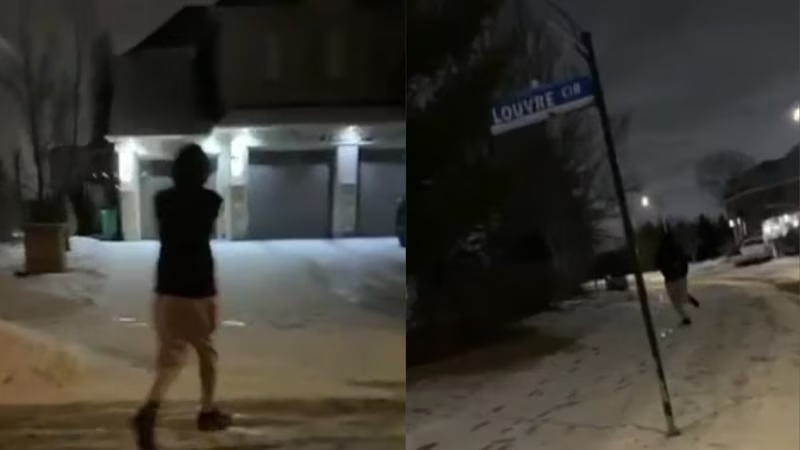
A quiet suburban street in Brampton, Ontario, was transformed into a war zone this week—not by local criminals, but by an Indian gang operating with chilling impunity on foreign soil. The target: businessman Jasvir Desi’s home. The perpetrators: alleged members of the **Bishnoi gang Canada** network, led by fugitive Goldy Dhillon. And the message? Clear, violent, and meant for global consumption.
According to police reports and verified social media footage, multiple assailants opened fire on Desi’s residence in broad daylight, emptying rounds into walls and windows before fleeing. Within hours, Goldy Dhillon—a key lieutenant of jailed gangster Lawrence Bishnoi—claimed responsibility online, accusing Desi of supporting rival factions and vowing similar fates for “enemies of the group” . This isn’t an isolated incident. It’s part of a disturbing pattern of Punjabi-origin gangs using Canada as a base to wage proxy wars that began thousands of miles away in Punjab and Delhi.
Table of Contents
- The Brampton Attack: What Happened?
- Who Is Goldy Dhillon? The Bishnoi Gang’s Canada Chief
- How the Bishnoi Gang Operates in Canada
- A Pattern of Violence: From Kapil Sharma to Jasvir Desi
- Why Canada Has Become a Hub for Indian Gangs
- International Response and Law Enforcement Challenges
- What This Means for the Indian Diaspora
- Conclusion: A Transnational Threat Demanding Global Action
- Sources
The Brampton Attack: What Happened?
On the morning of January 10, 2026, residents in Brampton’s Sandalwood Parkway neighborhood heard rapid gunfire. Surveillance footage later showed two masked men on a motorcycle pull up to Jasvir Desi’s home and unleash a barrage of bullets. No one was injured, but the psychological impact was immediate—and intentional.
The attackers recorded the assault and shared it across encrypted platforms with a caption: “This is what happens when you side with our enemies.” Goldy Dhillon soon posted a follow-up video confirming the hit, alleging Desi had financially backed rival gangs linked to the now-deceased Sidhu Moose Wala murder case . Canadian police have launched a manhunt, but Dhillon is believed to be hiding in British Columbia or possibly the U.S.
Who Is Goldy Dhillon? The Bishnoi Gang’s Canada Chief
Once a low-level associate, Goldy Dhillon has risen to become the de facto operational head of the **Bishnoi gang Canada** wing. Wanted in India for conspiracy, extortion, and murder, he fled to Canada years ago and allegedly built a sophisticated network involving money laundering, drug trafficking, and arms smuggling.
Using social media as a weapon, Dhillon issues threats, claims credit for attacks, and recruits disillusioned youth from the Punjabi diaspora. Indian intelligence agencies believe he coordinates directly with Lawrence Bishnoi—who, despite being incarcerated in Delhi’s Tihar Jail, continues to run his empire via smuggled phones and coded messages .
How the Bishnoi Gang Operates in Canada
The gang’s Canadian operations rely on three pillars:
- Diaspora Networks: Leveraging cultural ties and community events to recruit foot soldiers and launder money through small businesses.
- Drug Trade Profits: Earnings from fentanyl and methamphetamine distribution fund weapons purchases and hit contracts.
- Digital Propaganda: Viral videos and social media posts amplify fear and project power back to India, boosting the gang’s reputation among rivals and followers.
This model mirrors tactics used by other transnational syndicates—but with a uniquely Punjabi flavor rooted in honor codes and vendettas.
A Pattern of Violence: From Kapil Sharma to Jasvir Desi
This Brampton shooting is not the first time the Bishnoi network has struck in Canada. In late 2025, comedian Kapil Sharma’s Toronto café was vandalized and shot at after he made jokes referencing gang culture—a move widely seen as intimidation . Other incidents include arson attacks on rival-owned gas stations and threats against community leaders who speak out.
Each act serves dual purposes: settling scores in India while asserting dominance within the diaspora. As one RCMP analyst noted, “These aren’t random crimes—they’re strategic communications wrapped in violence” .
Why Canada Has Become a Hub for Indian Gangs
Several factors make Canada attractive to Indian organized crime:
- Lenient Immigration Policies (Historically): Past loopholes allowed individuals with criminal records to enter under false pretenses.
- Thriving Punjabi Communities: Large populations in Surrey, Brampton, and Calgary provide cover and recruitment pools.
- Weak Extradition Framework: India and Canada lack a robust extradition treaty, making it hard to repatriate fugitives like Dhillon.
- Profitable Drug Markets: Canada’s opioid crisis creates high demand for illicit substances controlled by these gangs.
The Royal Canadian Mounted Police (RCMP) has acknowledged the growing threat but faces resource constraints in tackling deeply embedded networks .
International Response and Law Enforcement Challenges
India’s National Investigation Agency (NIA) has repeatedly requested Canada extradite key figures, including Dhillon. Meanwhile, joint task forces between Interpol, the FBI, and Canadian authorities are tracking financial flows and communication trails.
However, jurisdictional hurdles remain. Evidence gathered in India is often inadmissible in Canadian courts, and witness intimidation within diaspora communities stifles cooperation. [INTERNAL_LINK:india-canada-crime-cooperation] efforts are intensifying, but progress is slow.
What This Means for the Indian Diaspora
For law-abiding Punjabi-Canadians, these incidents fuel stigma and fear. Community leaders report increased anxiety among families, especially those with ties to Punjab. Many worry their neighborhoods will be labeled “gang territories,” affecting property values and social cohesion.
Grassroots groups are now organizing awareness campaigns to counter gang recruitment, emphasizing education and legal pathways over criminal glamour.
Conclusion: A Transnational Threat Demanding Global Action
The **Bishnoi gang Canada** phenomenon is no longer just India’s problem—it’s a global security challenge. The Brampton shooting proves that geographic distance offers no protection from vendettas rooted in South Asia. Only through coordinated intelligence sharing, stronger extradition agreements, and community-based prevention can nations dismantle this dangerous nexus. Until then, the bullets may keep flying—even in the quietest suburbs.
Sources
- Times of India: Bishnoi gang strikes in Canada: Jasvir Desi’s Brampton home sprayed with bullets
- National Investigation Agency (NIA) – Wanted Notices & Case Files (2025–2026)
- RCMP Public Safety Reports – Organized Crime in British Columbia & Ontario
- Interpol Red Notices Database – Goldy Dhillon Profile
- Royal Canadian Mounted Police (RCMP): Official Statements on Transnational Gang Activity