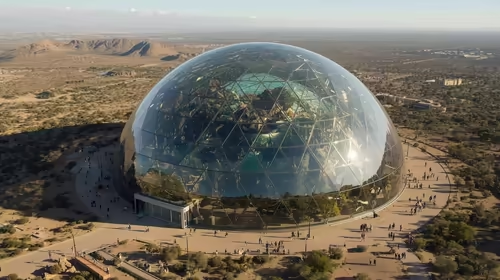
In the heart of the Arizona desert, a $150 million glass-and-steel monument to human ambition stands as a testament to one of the most audacious—and controversial—scientific experiments of the 20th century. In 1991, eight individuals, known as “biospherians,” stepped inside this massive structure, called Biosphere 2, and were sealed off from the rest of the world for two full years . Their mission? To prove that humans could create and live in a completely self-sustaining, artificial world—a miniature version of our own planet, Earth, which they called Biosphere 1.
But what was meant to be a triumphant demonstration of human ingenuity quickly descended into a saga of food shortages, plummeting oxygen levels, and internal conflict. So, what really happened during the Biosphere 2 experiment, and what can we learn from it today?
Table of Contents
- The Grand Vision Behind Biosphere 2
- Life Inside the Bubble: The Two-Year Mission
- The Shocking Problems of the Biosphere 2 Experiment
- Legacy and Lessons from a Failed Utopia
- Conclusion
- Sources
The Grand Vision Behind Biosphere 2
Conceived in the late 1980s, Biosphere 2 was a project of staggering scale and ambition. Spanning over three acres under a sealed glass canopy, it contained a variety of biomes, including a miniature ocean with a coral reef, a rainforest, a savanna, a desert, and even a mangrove wetland. The idea was to create a materially closed ecological system where nothing—not even air or water—could enter or leave without being accounted for .
The ultimate goal was twofold: first, to study how complex ecosystems interact and whether they could be engineered to support human life indefinitely; and second, to serve as a prototype for future space colonies on Mars or the Moon. It was a bold statement about humanity’s potential to master its environment and become a multi-planetary species.
Life Inside the Bubble: The Two-Year Mission
On September 26, 1991, the eight biospherians—four men and four women—entered their new world, waving goodbye to the outside as the massive airlock doors were sealed shut . For the next two years, they were entirely dependent on the systems they had built. They grew all their own food in an intensive agricultural area, recycled their water, and managed the delicate balance of the various biomes.
Life was not easy. The crew worked long hours tending to crops and maintaining the facility’s complex machinery. Their diet was strictly controlled and often meager, leading to significant weight loss for all members. Social dynamics were strained by the intense pressure and isolation, creating factions within the group that would have lasting consequences .
The Shocking Problems of the Biosphere 2 Experiment
Despite the meticulous planning, the Biosphere 2 experiment was plagued by a series of critical and unexpected failures that threatened the entire mission.
Oxygen Crisis
The most alarming issue was a steady and unexplained drop in oxygen levels. Over the course of the first year, the oxygen concentration in the atmosphere fell from a normal 21% to a dangerous 14%, equivalent to the air at an altitude of over 17,000 feet . The crew began to suffer from chronic fatigue, sleep apnea, and other health issues. Scientists later discovered that the culprit was an excess of carbon dioxide, which was being absorbed by the concrete used in the structure’s construction, triggering a chemical reaction that consumed vast amounts of oxygen .
Food Shortages and Ecological Collapse
The agricultural system failed to produce enough calories to sustain the crew. A combination of cloudy weather, pest infestations (notably ants and cockroaches), and crop failures led to severe food shortages [[11], [14]]. The crew was perpetually hungry, a state that fueled tension and conflict. Meanwhile, many of the carefully introduced plant and animal species went extinct. The pollinators died, and the once-vibrant coral reef in the ocean biome began to bleach and die due to an unexpected algal bloom [[10], [12]].
Management Controversy
The scientific integrity of the mission was further compromised when, in January 1993, the management team secretly injected pure oxygen into the atmosphere to save the crew’s health. Later, in the second mission, they also had to add food from the outside. These actions were seen by critics as a fundamental betrayal of the project’s core principle of being a closed system, leading to accusations of fraud and mismanagement .
Legacy and Lessons from a Failed Utopia
While the original vision of Biosphere 2 as a self-sustaining ark for humanity was a dramatic failure, its legacy is far more nuanced and valuable. The experiment provided a wealth of data on the incredible complexity of Earth’s natural systems and the hubris of trying to replicate them artificially. It taught us that our planet, Biosphere 1, is far more intricate and resilient than we ever imagined.
Today, Biosphere 2 is owned and operated by the University of Arizona as a world-class research facility focused on pressing environmental challenges like climate change, water scarcity, and sustainable agriculture [[18], [20]]. Its unique, controlled environment allows scientists to run large-scale experiments that would be impossible in the open world. For example, its “Landscape Evolution Observatory” is a massive artificial hillside used to study how water, soil, and vegetation interact under different climate scenarios .
So, while the dream of a sealed, artificial world may have been shattered, Biosphere 2 has found a new and vital purpose: not in trying to replace Earth, but in helping us understand and protect it. You can learn more about current sustainability research in our article on [INTERNAL_LINK:sustainable-living-practices].
Conclusion
The Biosphere 2 experiment was a grand, flawed, and ultimately human story. It was a cautionary tale about the limits of our control over nature, but also a powerful source of scientific insight. The struggles of those eight people sealed in a fake Earth for two years remind us of the precious, fragile, and irreplaceable balance of our own planet. Their failure, in many ways, became a profound success for environmental science.
Sources
- Times of India: They built a fake Earth and sealed people inside it for 2 years for an experiment
- University of Arizona Biosphere 2: https://biosphere2.org/
- Smithsonian Magazine: How the Biosphere 2 experiment changed our understanding of planet Earth
- History.com: When Biosphere 2 Became a Grand Experiment in Self-Sufficiency