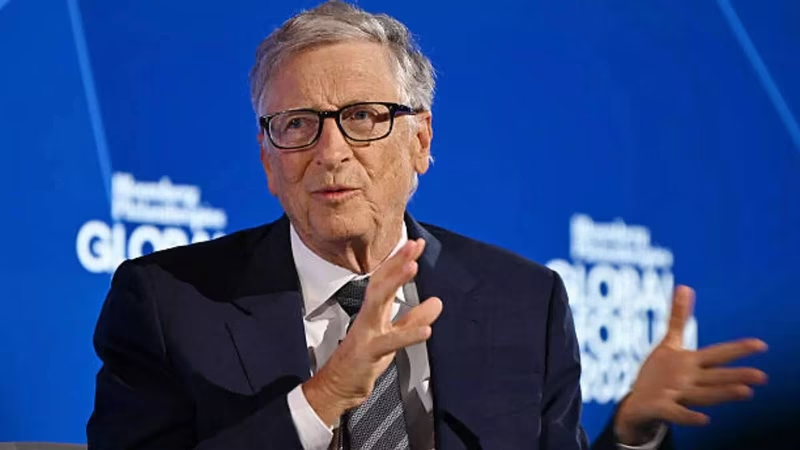
Imagine an invention so powerful it could cure diseases, personalize your child’s education, and yet, in the wrong hands, unleash a pandemic worse than COVID-19. This isn’t science fiction; it’s the stark reality painted by Microsoft co-founder Bill Gates AI vision for our immediate future.
In a series of recent interviews and his 2026 annual letter, Gates has doubled down on his belief that artificial intelligence is the single most impactful creation in human history—surpassing even the printing press or the internet. But his optimism comes with urgent, sobering footnotes about the existential risks we must confront head-on .
Table of Contents
- The Most Transformative Invention Ever?
- Bill Gates’ AI Utopia in Healthcare and Education
- The Dark Side of the Coin: Bioterrorism and Job Losses
- Preparing for an AI-Driven Future
- Conclusion: A Dual-Edged Sword
- Sources
The Most Transformative Invention Ever?
Gates’ central thesis is clear and compelling: of all the tools humans have ever built, artificial intelligence will be the one that reshapes society at its core. He argues that AI’s ability to reason, learn, and act autonomously gives it a unique power to amplify human capability on a global scale .
This isn’t just about smarter phones or chatbots. We’re talking about a fundamental shift in how we solve problems, create knowledge, and interact with the world. The pace of this change, according to Gates, will be unlike anything we’ve experienced before, demanding that we use the year 2026 to prepare strategically .
Bill Gates’ AI Utopia in Healthcare and Education
Gates is particularly bullish on AI’s potential to democratize two critical pillars of a thriving society: health and learning.
Revolutionizing Healthcare
He envisions a world where expert medical advice is no longer a luxury but a free, universally accessible resource. An AI-powered personal health advisor could analyze your symptoms, medical history, and even genetic data to provide guidance that rivals a top specialist . This could be a game-changer for remote or underserved communities.
Furthermore, AI could accelerate drug discovery and help identify rare diseases with astonishing speed, moving us towards truly personalized medicine . Gates has even suggested that within a decade, the role of a doctor might be fundamentally altered, with AI handling “most things” .
Personalizing Education
In education, Gates sees AI as the ultimate tutor. Imagine a patient, tireless AI that adapts its teaching style to a student’s unique learning pace and challenges, providing instant feedback and support . This could finally close the gap for students who fall behind in traditional classroom settings, offering a bespoke learning experience that was previously impossible to scale.
His prediction here is equally bold: AI could replace many teachers for core instructional tasks within the next ten years, freeing human educators to focus on mentorship, social development, and complex problem-solving .
The Dark Side of the Coin: Bioterrorism and Job Losses
However, Gates is far from naive. His enthusiasm is matched by a profound sense of caution. He has repeatedly identified two primary threats that keep him awake at night.
Bioterrorism: An Existential Threat
Gates’ top concern is chilling: the potential for AI to be weaponized for bioterrorism. He warns that open-source AI tools could soon empower non-state actors or extremist groups to design dangerous biological agents with a potency and ease that was previously the domain of nation-states .
“Today, an even greater risk than a naturally caused pandemic is that a non-government group will use open source AI tools to design a bioterrorism weapon,” he stated plainly . This scenario, he believes, could be more devastating than the COVID-19 pandemic .
Massive Job Market Disruption
The second major threat is economic and social: widespread job displacement. As AI systems become capable of performing complex cognitive and physical tasks—from coding to construction—the job market will be turned upside down .
While Gates believes roles for coders, energy experts, and biologists will remain essential for the foreseeable future , vast swathes of the workforce face an uncertain future. This disruption won’t just be about losing a job; it will force a complete redefinition of work, purpose, and how we structure our societies .
Preparing for an AI-Driven Future
So, what’s the plan? Gates isn’t just sounding the alarm; he’s calling for action. His advice is to use this critical window—the year 2026 and beyond—to build the guardrails and social safety nets we’ll need .
This includes:
- Robust International AI Governance: Establishing global norms and regulations to prevent the malicious use of AI, especially in areas like biosecurity.
- Investing in Reskilling: Creating massive public and private initiatives to help workers transition into new roles that leverage uniquely human skills.
- Rethinking Social Structures: Exploring ideas like a shorter work week or new economic models to adapt to a world where human labor is less central to production .
For a deeper dive into the ethical frameworks needed, see our analysis on [INTERNAL_LINK:ai-ethics-and-governance].
Conclusion: A Dual-Edged Sword
Bill Gates’ message on AI is a powerful paradox. It is our greatest hope for solving humanity’s most intractable problems in health and education, and simultaneously our most potent new threat in the form of bioterrorism and social upheaval. The outcome isn’t predetermined. It hinges entirely on the choices we make today. As Gates urges, we must move forward with both eyes open—embracing the immense promise while diligently building defenses against the peril. The future shaped by Bill Gates AI predictions is not a distant dream; it’s being written right now.
Sources
- Original Article: Times of India
- Gates, Bill. “The Year Ahead 2026: Optimism with Footnotes.” Gates Notes.
- “Bill Gates says AI could be used as a bioterrorism weapon.” CNBC.
- “Bill Gates Predicts AI Will Replace Many Doctors, Teachers Within 10 Years.” Forbes.
- Stanford University Human-Centered AI Institute. https://hai.stanford.edu/