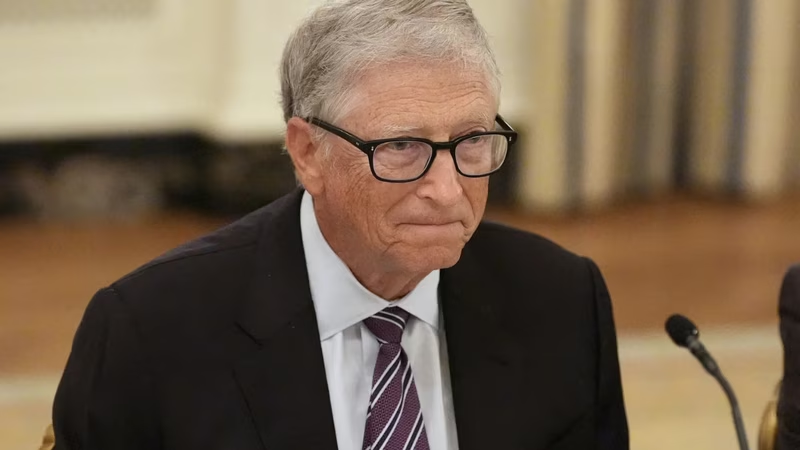
It’s not every day that one of the world’s most influential technologists and philanthropists sounds an alarm this grave—yet hopeful. In his Bill Gates 2026 letter, released this week, the Microsoft co-founder and longtime global health advocate drops a bombshell: for the first time since 2000, the number of children dying before their fifth birthday is on the rise .
This reversal of two decades of hard-won progress isn’t just a statistic—it’s a moral emergency. And while the news is deeply troubling, Gates doesn’t wallow in despair. Instead, he pairs this warning with a powerful message of cautious optimism, centered squarely on the transformative potential of artificial intelligence (AI). The result? A compelling paradox: a world backsliding on child survival, yet standing on the brink of unprecedented innovation.
Table of Contents
- The Alarming Reversal in Child Survival
- Bill Gates 2026 Letter: A Dual Narrative of Crisis and Hope
- Why Is Child Mortality Rising? The Funding Gap Explained
- Gates’ AI Optimism: Not a Tech Fix, But a Tool for Equity
- Three Key Actions Gates Urges World Leaders to Take
- Conclusion: Can We Turn the Tide Before It’s Too Late?
- Sources
The Alarming Reversal in Child Survival
For more than 20 years, the global health community celebrated a steady decline in under-five mortality. From 9.2 million deaths in 2000 to just 4.9 million in 2022, vaccines, better nutrition, and access to basic healthcare saved millions of lives . But now, that trend has reversed. According to data cited by Gates, disruptions from recent global crises—coupled with a sharp drop in development aid—have pushed child deaths upward again.
Gates calls this “the thing I’m most upset about” in his entire letter—a rare emotional admission from a figure known for his data-driven calm. This isn’t just a setback; it’s a betrayal of the promise made to the world’s most vulnerable.
Bill Gates 2026 Letter: A Dual Narrative of Crisis and Hope
The brilliance of the Bill Gates 2026 letter lies in its balance. While sounding the alarm on child mortality, Gates refuses to surrender to pessimism. He argues that long-term progress is still possible—but only if we recommit to generosity, equity, and smart innovation.
“Progress isn’t inevitable,” he writes. “It’s the result of choices we make.” And among the most powerful tools at our disposal today, he insists, is artificial intelligence. But—and this is critical—he doesn’t see AI as a magic wand. Instead, he frames it as a force multiplier for human ingenuity, capable of accelerating solutions in health, agriculture, and education—if deployed responsibly.
Why Is Child Mortality Rising? The Funding Gap Explained
So what’s behind this tragic reversal? Gates points to a confluence of factors:
- Declining foreign aid: Many high-income countries have reduced their overseas development assistance, citing domestic economic pressures.
- Supply chain breakdowns: Conflicts and climate disasters have disrupted the delivery of vaccines and essential medicines to remote regions.
- Health system fragility: Pandemic fatigue and underinvestment have left primary care networks in low-income countries dangerously weak.
The result? Preventable diseases like pneumonia, diarrhea, and malaria are once again claiming young lives at an alarming rate—deaths that cost-effective interventions could easily stop .
Gates’ AI Optimism: Not a Tech Fix, But a Tool for Equity
Here’s where Gates’ vision gets exciting. He believes AI can help close these gaps faster than ever before. Imagine AI-powered diagnostic tools that community health workers can use on a smartphone to detect malnutrition or respiratory infections. Or AI models that predict disease outbreaks weeks in advance, allowing governments to pre-position supplies.
At the Gates Foundation, early pilots are already showing promise. One project uses machine learning to optimize vaccine delivery routes in rural Nigeria, cutting waste and increasing coverage. Another leverages natural language processing to translate medical guidelines into dozens of local languages instantly .
But Gates is adamant: “AI won’t fix broken systems on its own. It must be paired with political will, funding, and a commitment to reach the last mile.” This nuanced take separates his optimism from Silicon Valley hype.
Three Key Actions Gates Urges World Leaders to Take
In closing his letter, Gates issues a clear call to action—not just for governments, but for citizens, businesses, and innovators:
- Restore and increase global health funding: Donor nations must honor their commitments and protect aid budgets from austerity cuts.
- Scale proven solutions equitably: Innovations like new vaccines or maternal health programs must reach the poorest communities, not just urban centers.
- Guide AI development with ethics and inclusion: Ensure AI tools are built with input from the Global South and designed to reduce, not widen, inequality.
These aren’t abstract ideals—they’re practical steps that could reverse the current trend within a few years.
Conclusion: Can We Turn the Tide Before It’s Too Late?
Bill Gates’ 2026 letter is more than an annual update—it’s a moral compass for our times. It forces us to confront an uncomfortable truth: progress can be undone. But it also offers a roadmap forward, powered by both compassion and cutting-edge technology. The rise in child mortality is a wake-up call. And Gates’ message is clear: we have the tools to respond. What we need now is the collective will to act. For readers following [INTERNAL_LINK:global-health-initiatives], this moment demands attention, advocacy, and action.
Sources
- Times of India: Bill Gates pens the year 2026 note: Says ‘thing I am most upset about is…’
- World Health Organization (WHO): Trends in under-five mortality
- UNICEF: Levels & Trends in Child Mortality
- Gates Foundation: How AI Can Accelerate Progress for the World’s Poorest
- Our World in Data: Child Mortality: Global Historical Trends