Table of Contents
- The Verdict That Changed the Game
- What Does “Bike Taxi Ban Revoked” Actually Mean?
- Background: The Original Ban and Why It Happened
- Key Directions from the High Court
- Impact on Commuters and Aggregators
- What Comes Next? The Regulatory Roadmap
- Conclusion: A Balanced Approach to Urban Mobility
- Sources
The Verdict That Changed the Game
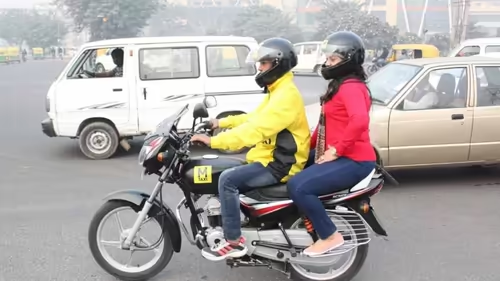
After months of uncertainty and stalled operations, relief has finally arrived for millions of urban commuters and gig economy workers in Karnataka. In a landmark ruling, the Karnataka High Court’s division bench has officially revoked the bike taxi ban, overturning a previous single-judge order that had effectively grounded two-wheeler ride-hailing services across the state .
This decision isn’t just a legal correction—it’s a recognition of the real-world transportation needs of a rapidly growing metro like Bengaluru, where traffic congestion and last-mile connectivity remain persistent challenges.
What Does “Bike Taxi Ban Revoked” Actually Mean?
At its core, the court’s ruling doesn’t give bike taxis a free pass. Instead, it mandates that the state government shift from prohibition to regulation. The division bench emphasized that two-wheelers used for commercial passenger transport must be treated as legitimate transport vehicles—provided they meet safety, insurance, and licensing standards.
Crucially, the court directed the state to:
- Consider applications for registering bikes as transport vehicles.
- Grant permits under the Motor Vehicles Act where applicable.
- Establish clear operational guidelines for aggregators and drivers.
This paves the way for platforms like Rapido, Ola, and others to legally operate their bike taxi services once again—this time under a structured regulatory framework.
Background: The Original Ban and Why It Happened
The controversy began in early 2025 when a single-judge bench of the Karnataka High Court upheld a state transport department directive that classified bike taxis as illegal. The reasoning? Two-wheelers were not listed as approved vehicle types for public transport under existing state rules .
Aggregators argued that this interpretation was outdated and failed to account for evolving urban mobility patterns. They pointed out that cities like Delhi, Hyderabad, and Pune already have regulated bike taxi ecosystems that improve accessibility while reducing carbon emissions and road congestion.
The ban left thousands of driver-partners without income and frustrated commuters who relied on affordable, agile two-wheeler rides to navigate Bengaluru’s notorious traffic jams—especially during peak hours or in narrow lanes inaccessible to cars.
Key Directions from the High Court
The division bench’s judgment is notable for its pragmatic approach. Rather than getting stuck in technicalities, the judges focused on functionality and public interest. Key takeaways include:
- No blanket ban: The court ruled that the state cannot impose a total prohibition on a service that addresses genuine public need.
- Regulation over restriction: Authorities must create a licensing system similar to auto-rickshaws or cabs, ensuring accountability without stifling innovation.
- Vehicle classification: Bikes used for commercial rides must be registered as transport vehicles, requiring valid permits, commercial insurance, and driver training.
This aligns with the spirit of the Central Motor Vehicles Rules, which allow states to notify additional vehicle categories for public transport based on local requirements [INTERNAL_LINK:india-urban-mobility-policy].
Impact on Commuters and Aggregators
For daily commuters, the revival of bike taxis means faster, cheaper, and more flexible travel options—especially for short distances (2–8 km), where autos are often unwilling or overpriced. Students, office-goers, and elderly residents stand to benefit the most.
For aggregators, the verdict unlocks a massive market opportunity. Bengaluru alone has over 12 million residents and some of the worst traffic in Asia. With proper regulation, bike taxis could capture a significant share of the last-mile segment, estimated to be worth over ₹3,000 crore annually in Karnataka .
Moreover, the decision validates the gig economy model, offering livelihood security to tens of thousands of driver-partners who depend on these platforms for their primary income.
What Comes Next? The Regulatory Roadmap
Now, the ball is in the state government’s court. Within weeks, the transport department is expected to draft a comprehensive policy that includes:
- Mandatory helmet use for both driver and passenger.
- GPS-enabled tracking and SOS features in apps.
- Background verification of drivers.
- Standardized fare structures to prevent surge pricing abuse.
- Clear demarcation of operational zones (e.g., no airport pickups without special permits).
Industry experts suggest that Karnataka could look to Goa’s model, where bike taxis operate under a well-defined permit system with strict safety protocols—a system praised by both riders and regulators [EXTERNAL_LINK:https://www.morth.nic.in/].
Conclusion: A Balanced Approach to Urban Mobility
The Karnataka High Court’s decision to revoke the bike taxi ban marks a turning point in India’s urban transportation policy. It acknowledges that innovation shouldn’t be punished simply because it doesn’t fit into legacy frameworks. By mandating smart regulation instead of outright bans, the court has set a precedent that other states would do well to follow.
For Bengaluru—a city constantly battling gridlock—this ruling offers a practical, eco-friendly, and inclusive solution. As long as safety and fairness remain at the heart of the new rules, bike taxis could become a cornerstone of the city’s sustainable mobility future.
Sources
- Times of India: Karnataka HC clears way for bike taxis, sets aside last year’s ban
- Ministry of Road Transport and Highways (MoRTH): Official Guidelines on Transport Vehicle Classification
- Economic Times: Bike taxis could be game-changer for Indian cities, experts say