Introduction
In a move that’s being hailed as a game-changer for grassroots entrepreneurship, Bihar Chief Minister Nitish Kumar has dramatically expanded financial support under the state’s flagship Bihar women employment scheme. What was once a modest ₹10,000 grant is now set to soar to a staggering ₹2 lakh for eligible women beneficiaries. Announced on January 29, 2026, this policy shift isn’t just about numbers—it’s a strategic push to transform women from passive recipients of welfare into active drivers of Bihar’s economy. But who qualifies? How will it be implemented? And what does this mean for gender equity in one of India’s most economically challenged states? Let’s break it all down.
Table of Contents
- What Is the Bihar Women Employment Scheme?
- The Big Announcement: From ₹10,000 to ₹2 Lakh
- Who Qualifies for the Top-Up?
- Why This Matters: Economic Impact and Women’s Empowerment
- Implementation: Challenges and Opportunities
- How It Compares to Other State Schemes
- Conclusion: A Bold Step Toward Gender-Inclusive Growth
- Sources
What Is the Bihar Women Employment Scheme?
The Bihar women employment scheme, officially known as the Mukhyamantri Mahila Udyami Yojana (MMUY), was launched to promote self-employment among women through interest-free loans and startup grants. Initially, the scheme provided up to ₹10,000 to women enrolled in self-help groups (SHGs) to kickstart micro-enterprises—be it tailoring, food processing, handicrafts, or small retail.
Backed by the state’s Department of Social Welfare and implemented through the Bihar Rural Livelihoods Promotion Society (JEEViKA), the program has already reached over 8 million women across 38 districts. It’s part of Bihar’s broader strategy to leverage SHGs as engines of financial inclusion and social transformation [INTERNAL_LINK:jeevika-bihar-success-stories].
The Big Announcement: From ₹10,000 to ₹2 Lakh
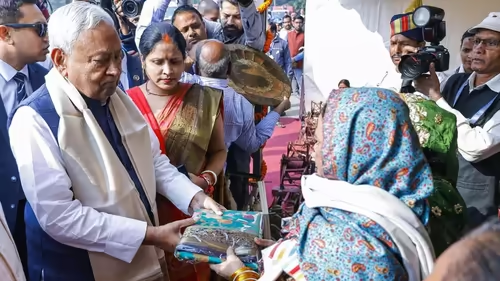
During a public address in Patna, CM Nitish Kumar revealed a major upgrade to the Bihar women employment scheme. “We are not just giving money—we are investing in dignity, independence, and leadership,” he declared. The new top-up will raise the maximum assistance to ₹2 lakh—but with a crucial condition: it will be extended only to high-performing SHG members who have successfully repaid initial loans and demonstrated business acumen.
This isn’t a blanket increase. Instead, it’s a performance-based incentive designed to reward sustainability and scale. Beneficiaries can use the funds for equipment upgrades, inventory expansion, digital marketing, or even formal business registration—steps that move them from subsistence to scalable enterprise.
Who Qualifies for the Top-Up?
Not every woman in an SHG will automatically receive ₹2 lakh. The state has outlined clear eligibility criteria to ensure accountability and impact:
- Must be an active member of a JEEViKA-affiliated self-help group for at least 2 years.
- Must have fully repaid any previous loan or grant received under MMUY.
- Must present a viable business plan endorsed by block-level officials.
- Prioritization will be given to women from SC/ST/OBC communities and those in aspirational districts.
The application process will be digitized via the state’s e-Sahayata portal, reducing bureaucratic delays and minimizing leakages—a common criticism of past welfare schemes.
Why This Matters: Economic Impact and Women’s Empowerment
This policy shift could be transformative. Studies by the World Bank show that when women control income, they reinvest up to 90% back into their families—on nutrition, education, and healthcare [[1]]. By scaling financial access, Bihar isn’t just creating jobs; it’s catalyzing intergenerational upliftment.
Moreover, empowering women entrepreneurs strengthens local economies. A single successful agri-processing unit, for example, can create ripple effects—boosting demand for farm produce, packaging, logistics, and retail. In a state where female labor force participation hovers below 15%, this scheme offers a lifeline to economic agency.
Implementation: Challenges and Opportunities
While the vision is powerful, execution is everything. Key challenges include:
- Capacity Building: Many rural women lack formal business training. The state must pair funding with mentorship in accounting, digital literacy, and market linkages.
- Last-Mile Delivery: Ensuring timely disbursement in remote blocks remains a logistical hurdle.
- Social Barriers: Patriarchal norms may restrict women’s mobility or decision-making power, even with financial resources.
To counter this, Bihar plans to deploy ‘Udyami Sakhis’—trained female field agents—who will provide hand-holding support. Partnerships with platforms like ONDC (Open Network for Digital Commerce) could also help beneficiaries reach national markets [INTERNAL_LINK:digital-india-for-women-entrepreneurs].
How It Compares to Other State Schemes
Bihar’s enhanced grant puts it ahead of many peers:
| State | Scheme Name | Max Support |
|---|---|---|
| Telangana | Stree Nidhi | ₹1.5 lakh (loan) |
| Odisha | Mission Shakti | ₹50,000 (grant + loan) |
| Madhya Pradesh | Ladli Behna Yojana | ₹1,000/month (cash transfer) |
| Bihar | Mukhyamantri Mahila Udyami Yojana | ₹2 lakh (performance-based grant) |
Unlike monthly cash transfers, Bihar’s model focuses on asset creation—aligning with the Centre’s emphasis on ‘wealth over welfare.’ It also mirrors the success of Kerala’s Kudumbashree model, which turned SHGs into formidable economic collectives.
Conclusion: A Bold Step Toward Gender-Inclusive Growth
The revamp of the Bihar women employment scheme signals a maturing approach to women’s development—one that sees them not as dependents but as entrepreneurs, leaders, and nation-builders. If implemented with transparency and support, this ₹2 lakh top-up could ignite a quiet revolution in Bihar’s villages and towns. As Nitish Kumar rightly noted, “When a woman earns, an entire family rises.” Now, the real test begins: turning promise into prosperity, one empowered woman at a time.
Sources
- Times of India. “From Rs 10k to Rs 2 lakh: Bihar CM announces top-up for beneficiaries under women employment scheme.” https://timesofindia.indiatimes.com/…
- World Bank. “Women’s Economic Empowerment in India: Status Report 2024.” https://www.worldbank.org/…
- Bihar Rural Livelihoods Promotion Society (JEEViKA). “Mukhyamantri Mahila Udyami Yojana Guidelines.” https://jeevika.bihar.gov.in
- Ministry of Rural Development, Government of India. “National Rural Livelihoods Mission (NRLM).” https://nrlm.gov.in