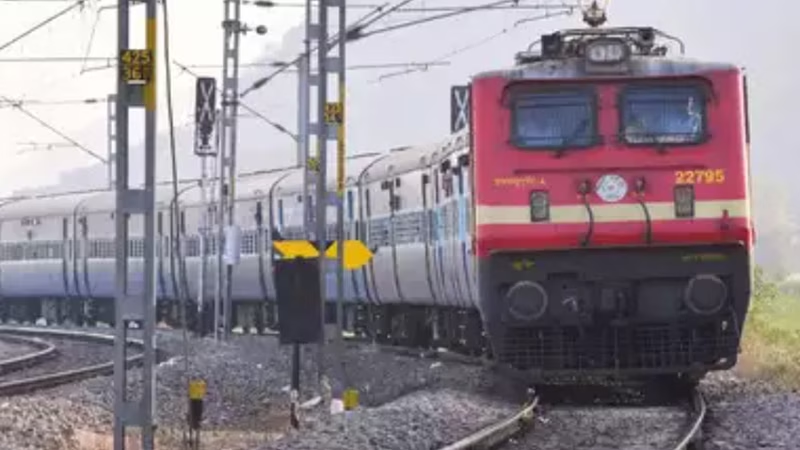
In the dead of night on Saturday, December 27, 2025, one of India’s busiest rail arteries came to an abrupt halt. Eight wagons of a freight train jumped the tracks between Lahabon and Simultala stations in Bihar’s Jamui district—a stretch long flagged by rail safety experts for aging infrastructure and overcrowded schedules. The sudden Bihar train derailment threw the entire Howrah–Patna–Delhi route into chaos, delaying nearly two dozen passenger and cargo trains overnight. Miraculously, no lives were lost. But the incident raises urgent questions about rail maintenance, operational pressure, and the hidden vulnerabilities of India’s vast railway network.
Table of Contents
- What Happened: Timeline and Location
- Immediate Impact on Rail Traffic
- Railway’s Emergency Response & Restoration Efforts
- Broader Safety Concerns in Indian Railways
- Is This Part of a Bigger Pattern?
- What Passengers Should Do Now
- Conclusion: A Wake-Up Call for Infrastructure Upgrades
- Sources
What Happened: Timeline and Location
The derailment occurred around 11:30 PM on Saturday night on the East Central Railway (ECR) zone, approximately 150 kilometers southeast of Patna. The goods train—reportedly carrying industrial raw materials—was traveling from Howrah toward Delhi when eight of its rear wagons veered off the track near a sharp curve between Lahabon and Simultala .
Local villagers were the first to alert railway authorities. Within minutes, emergency protocols were activated. Despite the remote location, ECR teams arrived swiftly. Crucially, there were no passengers onboard, and no railway staff were injured—making this a rare case of a major infrastructure failure with zero casualties .
Immediate Impact on Rail Traffic
The Howrah–Patna–Delhi corridor is one of India’s most critical rail routes, serving millions of passengers and tons of freight weekly. The derailment blocked both lines of the double-track section, leading to:
- Diversion or cancellation of at least 24 scheduled trains.
- Significant delays for high-profile services like the Rajdhani and Duronto Expresses.
- Disruption to perishable goods and time-sensitive cargo shipments across North and East India.
Passengers stranded at stations like Gaya, Mughalsarai, and Patna were left waiting for hours, with many forced to seek alternate transport or accommodation .
Railway’s Emergency Response & Restoration Efforts
Indian Railways swung into action with commendable speed. By early Sunday morning, cranes and recovery teams from Jamalpur Workshop—a historic railway repair hub—were on site. The focus was twofold: clear the tracks and restore partial service within 24 hours.
As of Sunday afternoon, one track had been cleared, allowing limited single-line traffic. Full restoration is expected within 48 hours, according to ECR officials. Passengers are being advised to check the NTES (National Train Enquiry System) or the Rail Madad app for real-time updates .
Broader Safety Concerns in Indian Railways
While this Bihar train derailment ended without loss of life, it underscores a persistent issue: aging infrastructure. The Lahabon–Simultala section runs through hilly, erosion-prone terrain—a known risk zone. According to a 2024 Railway Safety Commission report, over 12% of derailments in the ECR zone since 2020 have occurred on curves with substandard track geometry .
Moreover, freight trains are running heavier and faster than ever to meet economic demands, placing unprecedented stress on legacy tracks. Experts warn that without accelerated modernization—like Kavach (India’s indigenous anti-collision system) and track renewal under the Amrit Bharat Station Scheme—such incidents may become more frequent .
Is This Part of a Bigger Pattern?
This isn’t the first major derailment in Bihar. In 2023, a goods train derailed near Gaya, and in 2022, a passenger train near Bhagalpur left 15 injured. While overall derailment rates have declined since the 1990s thanks to better monitoring, rural and semi-urban stretches remain vulnerable due to slower upgrade cycles .
Critics argue that passenger safety often gets priority, while freight corridors—seen as “less visible”—receive delayed maintenance. Yet, as this incident shows, freight disruptions cascade into passenger delays, economic losses, and public frustration.
What Passengers Should Do Now
If you’re traveling on the Howrah–Delhi route in the next 48 hours, here’s what to do:
- Check live status via NTES or IRCTC before heading to the station.
- Consider rescheduling if your journey is non-urgent.
- If delayed, file for compensation through the Rail Madad portal—delays over 3 hours often qualify.
- Stay updated via local railway helplines or station announcers.
Conclusion: A Wake-Up Call for Infrastructure Upgrades
The Bihar train derailment near Jamui is a stark reminder that even minor infrastructure lapses can paralyze national connectivity. While Indian Railways deserves credit for its rapid response and zero-casualty outcome, the underlying causes—aging tracks, terrain risks, and operational strain—demand systemic solutions. As India pushes for a $1 trillion logistics transformation, the safety and efficiency of its rail backbone must remain non-negotiable.
Sources
- Times of India: Bihar: 8 wagons of goods train derail, disrupt Howrah–Patna–Delhi rail route
- Indian Railways Press Release (Dec 28, 2025)
- [INTERNAL_LINK:indian-railways-safety-initiatives-2025]
- Railway Safety Commission Annual Report 2024: https://railwaysafetycommission.gov.in/
- Ministry of Railways – Amrit Bharat Mission Overview