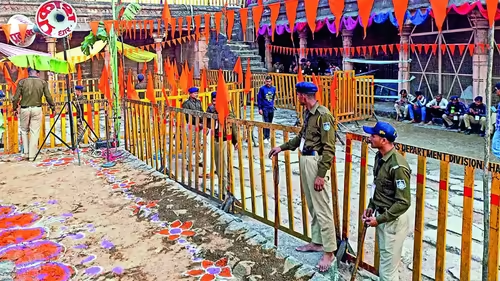
Introduction: A New Chapter in the Bhojshala Saga
The ancient walls of the Bhojshala in Dhar, Madhya Pradesh, have witnessed centuries of history, but January 23, 2026, marks a pivotal new chapter. On this day, coinciding with the vibrant festival of Basant Panchami, the site became a focal point of a carefully orchestrated, court-mandated arrangement for dual religious observance. This follows a landmark intervention by the Supreme Court of India, which has not only provided immediate, practical directions for the day but has also decisively revived the long-pending legal battle over the site’s identity.
Table of Contents
- The Supreme Court’s Historic Order
- What is the Bhojshala and Why is it Disputed?
- Decoupling from the Places of Worship Act
- The Practical Arrangements for Basant Panchami
- What Happens Next: The Road Ahead
- Conclusion: A Balancing Act of Faith and Law
- Sources
The Supreme Court’s Historic Order
In a significant development on January 22, 2026, the Supreme Court issued a comprehensive order that directly impacts the Bhojshala complex. The apex court lifted its previous stay on the case, effectively reviving the proceedings before the Madhya Pradesh High Court . This move is crucial as it allows the lower court to continue its examination of the site’s historical and religious character, a process that had been stalled for years.
Furthermore, the Court provided specific, time-bound instructions for the conduct of prayers on Basant Panchami (January 23, 2026). Hindus were granted permission to perform their Saraswati Puja rituals from sunrise to sunset, while Muslims were allotted a dedicated window for their Friday prayers (Jumu’ah) between 1 PM and 3 PM [[15], [16]]. This structured approach aims to ensure mutual respect and prevent any potential conflict on the ground.
What is the Bhojshala and Why is it Disputed?
The Bhojshala is an 11th-century monument complex in Dhar, originally constructed by the legendary Hindu King Raja Bhoj as a center of learning and a temple dedicated to Goddess Saraswati, the deity of knowledge and wisdom [[6], [9]]. Over the centuries, its history became intertwined with various rulers, leading to its current contested status.
In the modern era, the dispute crystallized in the 20th century. In 1936, the Muslim community sought permission to offer prayers at the site, which they refer to as the Kamal Maula Mosque, leading to resistance from the Hindu community . The Archaeological Survey of India (ASI) declared it a protected monument in 1951, but the underlying religious claims remained unresolved . Today, the site stands as a powerful symbol of India’s complex historical and religious tapestry, claimed by both communities as a sacred space .
Decoupling from the Places of Worship Act
A critical aspect of the Supreme Court’s recent decision is its directive to decouple the Bhojshala case from the broader constitutional challenges to the Places of Worship (Special Provisions) Act, 1991 . This is a strategic legal move that isolates the Bhojshala dispute, allowing it to be adjudicated on its own unique historical and factual merits.
It’s important to note that the Bhojshala, being a protected ancient monument under the ASI, already falls under an exception to the 1991 Act. Section 5 of the Act explicitly exempts “any place of worship which is an ancient and historical monument or an archaeological site” [[21], [25]]. Therefore, the legal framework governing the Bhojshala is distinct from that of other places of worship, making a focused, independent hearing essential for a just resolution.
The Practical Arrangements for Basant Panchami
The Supreme Court’s order for January 23, 2026, is a masterclass in practical conflict management. To ensure a peaceful and orderly day, the Court mandated the following:
- For Hindus: Full access to the complex for Basant Panchami celebrations and Saraswati Puja from sunrise to sunset.
- For Muslims: A dedicated, secure, and dignified space for Friday prayers from 1:00 PM to 3:00 PM.
- Security and Management: The state administration of Madhya Pradesh was tasked with ensuring robust security, crowd control, and the smooth implementation of these directives to maintain communal harmony .
This arrangement respects the sanctity of both religious observances while preventing any overlap that could lead to tension.
What Happens Next: The Road Ahead
With the Supreme Court’s stay lifted, the baton has now passed back to the Madhya Pradesh High Court. The High Court is expected to resume its proceedings, which include a directive for a “complete scientific investigation, survey and excavation of the Bhojshala complex” to determine its true nature and character .
This scientific inquiry, combined with historical evidence and legal arguments, will form the bedrock of the final judgment. The outcome of this case will have far-reaching implications, not just for the local communities in Dhar, but for how India navigates its complex historical legacies and manages inter-faith sensitivities at shared heritage sites. For more on India’s legal landscape, see our analysis on [INTERNAL_LINK:indian-constitutional-law].
Conclusion: A Balancing Act of Faith and Law
The Supreme Court’s intervention in the Bhojshala matter is a delicate balancing act. It provides an immediate, workable solution for a sensitive day like Basant Panchami while simultaneously clearing the path for a definitive, evidence-based legal resolution of the core dispute. By decoupling it from larger political debates and focusing on its unique historical context, the Court has given the judicial system its best chance to deliver a verdict that is both legally sound and respectful of the deep faith held by both communities. The eyes of the nation are now on the Madhya Pradesh High Court as it takes up this historic responsibility.
Sources
- Times of India: Basant Panchami, Friday prayers in separate areas of MP’s Bhojshala today
- LiveLaw: Supreme Court issues directions for conduct of Friday prayers at Bhojshala on January 23, 2026
- The Hindu: SC allows Hindus, Muslims to offer prayers at Bhojshala on Basant Panchami
- Indian Kanoon: The Places of Worship (Special Provisions) Act, 1991
- Archaeological Survey of India: Official Website