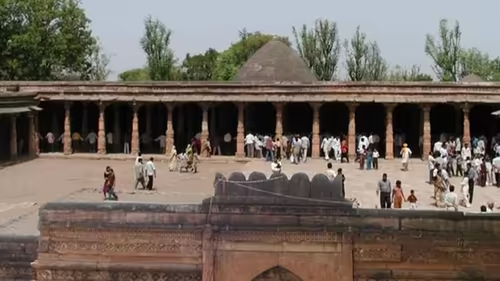
In a move that seeks to navigate the delicate balance between faith and law, the Supreme Court of India has delivered a significant verdict on the long-standing Bhojshala dispute. Just one day before the vibrant festival of Basant Panchami, the apex court has laid down a clear, time-bound framework for worship at the 11th-century monument in Dhar, Madhya Pradesh—a site revered by Hindus as the temple of Goddess Saraswati (Vagdevi) and by Muslims as the Kamal Maula Mosque .
Table of Contents
- The Supreme Court’s Bhojshala Order Explained
- Unraveling the History of the Bhojshala Dispute
- The ASI Report: A Scientific Perspective on a Sacred Site
- What This Verdict Means for Communal Harmony
- Conclusion: A Path Forward for Bhojshala
- Sources
The Supreme Court’s Bhojshala Order Explained
The Supreme Court’s order, announced on January 22, 2026, is a direct response to the immediate need for a peaceful resolution ahead of the Basant Panchami celebrations on January 23 . The court has meticulously carved out specific time slots for each community:
- For Hindus: Full access to offer prayers from sunrise to sunset on Basant Panchami.
- For Muslims: A dedicated window to perform their Friday Juma namaz between 1 PM and 3 PM on the same day .
This arrangement is not just about scheduling; it’s a judicial attempt to acknowledge the deep-seated religious sentiments of both groups while ensuring public order. The court has also mandated that the Archaeological Survey of India (ASI) share its expert scientific report on the site’s religious character with representatives from both communities, promoting transparency in a historically opaque conflict .
Unraveling the History of the Bhojshala Dispute
The roots of the Bhojshala dispute run deep into India’s medieval past. The structure in question is an ASI-protected monument dating back to the 11th century, originally believed to be a center of learning and a temple dedicated to Goddess Saraswati, the deity of knowledge and wisdom . Historical accounts suggest that in the 14th or 15th century, parts of this pre-existing temple complex were repurposed to build what is now known as the Kamal Maula Mosque .
This layered history has created a complex web of ownership and reverence. For centuries, the site has been a flashpoint, with both communities laying claim to its spiritual legacy. The dispute isn’t merely about bricks and mortar; it’s about identity, heritage, and the right to practice faith at a place they consider sacred .
The ASI Report: A Scientific Perspective on a Sacred Site
A critical element of the current legal proceedings is the long-awaited report from the Archaeological Survey of India. This scientific survey was commissioned to provide an objective, evidence-based account of the monument’s origins and evolution .
Preliminary findings from the ASI, as reported in the media, indicate that the current mosque structure was indeed built using materials and architectural elements from a pre-existing Hindu temple . The Hindu petitioners have pointed to the discovery of idols and other religious symbols during the survey as validation of their claim .
The Supreme Court’s directive to share this report with both parties is a crucial step. It moves the conversation from pure faith-based assertion towards a dialogue informed by historical and archaeological evidence. This transparency is essential for any lasting resolution.
What This Verdict Means for Communal Harmony
The timing of this verdict is particularly noteworthy. By issuing a clear, unambiguous order just before a major religious festival, the Supreme Court has effectively pre-empted potential clashes and provided local authorities with a definitive protocol to enforce .
This decision reflects a pragmatic approach to a deeply emotional issue. Instead of making a final, sweeping judgment on the site’s ultimate ownership—which could have inflamed tensions—the court has opted for a practical, interim solution focused on the immediate future. It’s a classic example of the judiciary acting as a stabilizing force in a volatile situation.
For observers of India’s socio-political landscape, this case is a microcosm of the larger challenge of managing its rich, multi-layered religious history. The court’s emphasis on a shared, albeit time-bound, use of the space could serve as a potential model for handling other similar disputes across the country. You can read more about the legal principles involved in such cases on the official website of the Supreme Court of India.
Conclusion: A Path Forward for Bhojshala
The Supreme Court’s order on the Bhojshala site is a masterclass in judicial restraint and practical problem-solving. By allowing Hindus to celebrate Basant Panchami throughout the day while carving out a specific, respectful window for Muslim Friday prayers, the court has acknowledged the validity of both communities’ attachments to the site. The mandate to share the ASI report further underscores a commitment to resolving the core dispute through evidence and dialogue, rather than through prolonged legal battles or street protests. As security is tightened in Dhar for the festival , this verdict offers a beacon of hope for a peaceful and orderly observance, paving the way for a more permanent and mutually agreeable solution in the future. For more on India’s cultural heritage sites, see our coverage on [INTERNAL_LINK:india-archaeological-sites].
Sources
- Times of India: MP: SC allows Hindus, Muslims to offer prayers at Bhojshala on Basant Panchami
- India Legal: Bhoj Shala-Kamal Maula dispute: Supreme Court orders segregated spaces for Vasant Panchmi puja & Juma namaz
- Hindu Janajagruti Samiti: ASI says ‘parts of pre-existing temples converted into a mosque’ in scientific report on Bhojshala complex
- Supreme Court of India: Official Website