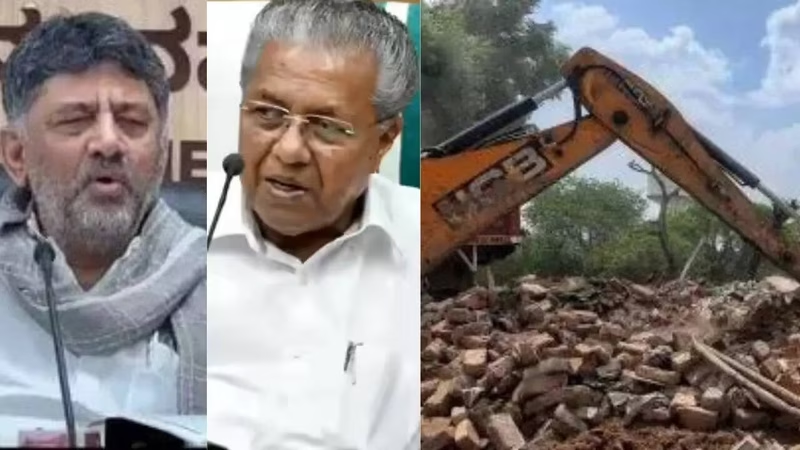
Political tensions flared this week as Karnataka’s Deputy Chief Minister DK Shivakumar issued a sharp rebuttal to Kerala Chief Minister Pinarayi Vijayan over controversial remarks about the Bengaluru demolition drive. The exchange has ignited a national debate about urban governance, land rights, and the role of senior politicians in commenting on inter-state administrative actions.
Table of Contents
- What Sparked the Row?
- DK Shivakumar’s Fiery Response
- Inside the Bengaluru Demolition Drive
- The Real Enemy: Land Mafia and Encroachment
- Political Ramifications and Public Reaction
- Conclusion: Governance vs Grandstanding
- Sources
What Sparked the Row?
The controversy began when Kerala CM Pinarayi Vijayan publicly criticized the recent demolition actions in Bengaluru, implying they were excessive or politically motivated. Without naming specific incidents, Vijayan used strong language—reportedly referencing ‘bulldozer justice’—a term that has gained notoriety in Indian political discourse for its association with heavy-handed state action.
His comments quickly drew ire from Karnataka officials, who viewed them as uninformed interference in a complex local issue. The state government has been battling rampant illegal construction and land grabbing for decades, particularly in fast-growing zones like Electronic City, Whitefield, and outer Bengaluru.
DK Shivakumar’s Fiery Response
Speaking to reporters in Bengaluru, Deputy CM DK Shivakumar didn’t mince words. “We are not into bulldozers,” he stated bluntly. “This is about the rule of law. Senior leaders should understand ground realities before making comments from afar.”
Shivakumar emphasized that the demolitions were not targeted at any religious or ethnic community—as some social media narratives have falsely suggested—but were strictly against illegal structures on government land. He urged Vijayan to “get the facts straight” before offering unsolicited critiques.
“If someone encroaches on public land meant for parks, roads, or schools, they must be removed—regardless of who they are,” Shivakumar added, framing the action as a civic duty rather than political vendetta.
Inside the Bengaluru Demolition Drive
The current Bengaluru demolition drive is part of a larger initiative by the Karnataka government to reclaim thousands of acres of public land allegedly seized by powerful real estate syndicates. According to the Revenue Department, over 12,000 illegal structures have been identified across the city, with hundreds already razed since late 2024 .
Key features of the drive include:
- Legal basis: Actions are taken under Section 144 of the Karnataka Land Revenue Act and relevant BBMP (Bruhat Bengaluru Mahanagara Palike) bylaws.
- Notice-based process: Encroachers are typically given 15–30 days to vacate before demolition.
- Transparency measures: Demolition lists and land ownership records are being published online via the Karnataka Land Records Portal, a move praised by urban policy experts .
This isn’t the first such drive—previous efforts under both Congress and BJP administrations have faced legal and political hurdles. But the current campaign appears more systemic and data-driven, leveraging GIS mapping and citizen complaints to identify violations.
The Real Enemy: Land Mafia and Encroachment
Shivakumar and other Karnataka officials consistently point to the land mafia as the true adversary. These organized groups allegedly collude with corrupt officials to grab public land, construct illegal buildings, and sell them at premium rates—often to unsuspecting buyers.
According to a 2023 report by the Comptroller and Auditor General (CAG), Karnataka lost an estimated ₹20,000 crore ($2.4 billion) in potential revenue due to unauthorised land use in urban areas over a five-year period . The Bengaluru demolition drive is seen as a corrective step to reclaim not just land, but public trust.
“This is not about religion or region,” explained an urban planning expert from the Indian Institute for Human Settlements (IIHS). “It’s about preserving civic infrastructure for future generations.”
Political Ramifications and Public Reaction
Vijayan’s comments are widely interpreted as part of a larger political narrative, especially ahead of upcoming state elections in southern India. Critics argue that invoking ‘bulldozer’ rhetoric—popularized in other contexts—risks misleading the public about what’s actually happening in Bengaluru.
Meanwhile, public opinion in Karnataka remains largely supportive of the demolitions, particularly among residents affected by haphazard construction, blocked stormwater drains, and vanishing green spaces. Social media campaigns like #SaveBengaluruLand have gained traction, calling for sustained action against encroachers.
For more on urban land governance in India, see our analysis on [INTERNAL_LINK:urban-land-reforms-india].
Conclusion: Governance vs Grandstanding
At its core, the clash between DK Shivakumar and Pinarayi Vijayan isn’t just a political spat—it’s a question of responsible governance. The Bengaluru demolition drive represents a difficult but necessary effort to uphold property laws and protect public assets in one of Asia’s fastest-growing cities. While political commentary is inevitable, Shivakumar’s message is clear: solutions must be rooted in local facts, not national soundbites. As Bengaluru struggles to balance growth with sustainability, the focus must remain on the rule of law—not rhetorical bulldozers.
Sources
- The Times of India. “‘We are not into bulldozers’: DK Shivakumar hits back at Kerala CM over Bengaluru demolition drive.” December 27, 2025.
- Karnataka Revenue Department. “Action Taken Against Illegal Encroachments in Bengaluru – Monthly Report.” November 2025.
- Karnataka Land Records Portal. https://landrecords.karnataka.gov.in
- Comptroller and Auditor General of India (CAG). “Report No. 3 of 2023: Urban Land Management in Karnataka.”
- [INTERNAL_LINK:urban-land-reforms-india]