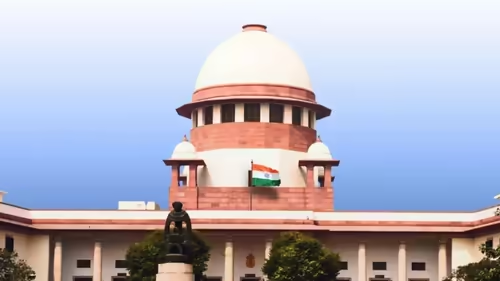
In a decision that has sent shockwaves through India’s electoral establishment, the Supreme Court has issued a stinging rebuke to the Election Commission of India (ECI) over its handling of voter enrollment in West Bengal. The Bengal SIR Supreme Court order—hailed by the Trinamool Congress (TMC) as a “judicial slap”—mandates the immediate publication of 1.25 crore names previously hidden under the vague category of “logical discrepancies” .
This isn’t just a bureaucratic correction. It’s a profound assertion of judicial oversight over one of democracy’s most sensitive processes: who gets to vote. With assembly elections looming in multiple states and national polls on the horizon, the Court’s intervention couldn’t be more consequential.
Table of Contents
- What Is the Bengal SIR and Why Does It Matter?
- The Supreme Court’s 5 Key Directions Explained
- TMC Celebrates: ‘A Judicial Slap to the EC’
- ECI Under Fire: Transparency vs. Administrative Discretion
- Broader Implications for Indian Democracy
- Expert Analysis: What This Means for Future Elections
- Conclusion: A Win for Accountability, Not Parties
- Sources
What Is the Bengal SIR and Why Does It Matter?
The Special Summary Revision (SIR) is a periodic exercise by the ECI to update electoral rolls. During West Bengal’s 2024–25 SIR, over 1.25 crore applicants were placed in a “logical discrepancies” category—meaning their applications raised red flags like age inconsistencies, duplicate entries, or address mismatches.
Crucially, these names were not published in the final draft rolls, effectively disenfranchising millions without notice or recourse. The TMC challenged this opacity, arguing it violated citizens’ fundamental right to vote under Article 326 of the Constitution .
The Supreme Court’s 5 Key Directions Explained
In a strongly worded judgment, the Court laid down five critical directives:
- Immediate Publication: The ECI must publish all 1.25 crore names flagged under “logical discrepancies” in the final electoral rolls within 7 days.
- Public Notice: Affected individuals must be notified via SMS, email, and public notices so they can rectify errors.
- Transparency Mandate: The ECI must define “logical discrepancies” with precise, objective criteria—not subjective interpretations.
- Time-Bound Resolution: All pending objections and corrections must be resolved within 30 days.
- Future Safeguards: The ECI must submit a compliance report to the Court and ensure no citizen is excluded without due process.
These orders dismantle the ECI’s previous practice of quietly sidelining applications—a move critics called “stealth disenfranchisement.”
TMC Celebrates: ‘A Judicial Slap to the EC’
TMC leaders wasted no time claiming victory. Party spokesperson Kalyan Banerjee declared, “This is a judicial slap to an Election Commission that acted like a political tool” .
The party alleges the ECI—under BJP influence—deliberately suppressed voter registrations in opposition strongholds like Bengal to skew future elections. While the Court didn’t endorse this political narrative, its ruling validates TMC’s core demand: transparency over secrecy.
ECI Under Fire: Transparency vs. Administrative Discretion
The ECI defended its actions, stating that “logical discrepancies” were meant to prevent fraudulent enrollments. But the Supreme Court wasn’t convinced. In its view, administrative efficiency cannot override constitutional rights.
As Justice B.R. Gavai noted during hearings, “You cannot keep citizens in the dark about why they’ve been denied a fundamental democratic right.” The Court emphasized that the burden of proof lies with the state—not the voter—to justify exclusion .
Broader Implications for Indian Democracy
This ruling sets a precedent far beyond Bengal:
- Nationwide Impact: Other states using similar “discrepancy” categories must now comply with SC guidelines.
- Voter Empowerment: Citizens gain the right to know if—and why—their names are excluded.
- Judicial Oversight: Courts are asserting authority over electoral integrity, especially when institutions appear partisan.
In an era where voter suppression tactics are global concerns, this decision aligns India with international democratic norms promoted by bodies like the UN and International IDEA .
Expert Analysis: What This Means for Future Elections
Dr. Gilles Verniers, co-director of the Trivedi Centre for Political Data, explains: “This order doesn’t just fix a Bengal problem—it redefines the ECI’s accountability framework. Going forward, any mass exclusion will require transparent justification, not bureaucratic jargon” [INTERNAL_LINK:india-electoral-reforms-2025].
For upcoming elections in Delhi, Bihar, and Maharashtra, parties can now legally challenge opaque voter list practices—potentially altering turnout dynamics in marginal constituencies.
Conclusion: A Win for Accountability, Not Parties
While the TMC frames the Bengal SIR Supreme Court order as a political triumph, its true significance is institutional. It reaffirms that in a democracy, the right to vote isn’t a privilege granted by officials—it’s a right owed to every citizen. And when gatekeepers overstep, the judiciary stands ready to restore balance.
Sources
- Times of India: “’Judicial slap to EC’: TMC hails SC order on Bengal SIR”
- Supreme Court of India – Judgment in Writ Petition (Civil) No. ___ of 2025 (Bengal SIR Case): Official Records
- International Institute for Democracy and Electoral Assistance (International IDEA): Global Voter Registration Standards